America’s Rembrandt
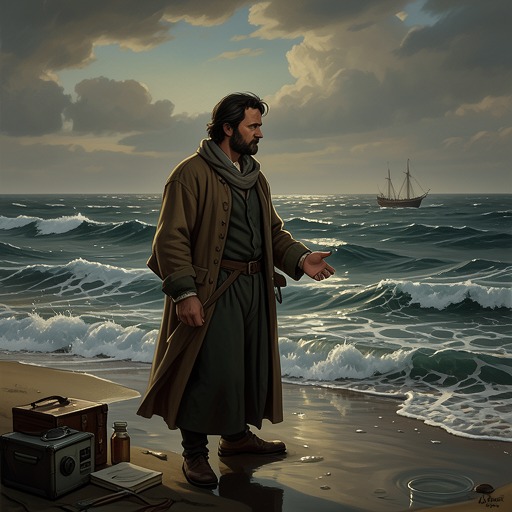
The light house: A love story“America’s Rembrandt” is the art-world epithet attached to Blake McGrath, presenting him as the pre-eminent American contemporary artist and, more specifically, as a painter whose reputation had reached the scale of a national cultural legend. The phrase is not merely praise: it establishes the commercial and institutional value of his work, shapes Connie Dixon’s understanding of the hidden artist she has encountered, and becomes the standard against which his disappearance, concealed paintings, and return to public life are measured.
Origin and Meaning
Duncan Cartwright explains that Blake McGrath was “America’s most famous contemporary artist,” admired by gallery curators throughout the world and honored with special exhibitions at the Louvre and the National Gallery in London. The comparison with Rembrandt therefore places Blake within a tradition of exceptional, internationally recognized artistic authority rather than treating him as a successful local painter. His fame had been built through critical acclaim, elite exhibitions, and the recognition of institutions capable of converting artistic achievement into cultural prestige.
The title also carries a national dimension. Calling Blake “America’s Rembrandt” turns an individual painter into a symbolic representative of American art, while the allusion to Rembrandt invokes mastery, historical endurance, and singular genius. Within the novel, however, the expression is never entirely separable from the mechanisms that produce fame. Blake’s standing depends on curators, galleries, collectors, journalists, and buyers, all of whom help determine what counts as a masterpiece and what price a work can command.
Reputation and Market Value
Blake’s reputation is matched by extraordinary prices. Duncan identifies him as the most renowned seascape artist in the world and recalls that his last exhibition contained twenty-four paintings. The largest sold for 1.6 million, while even a small study of shells and rocks fetched several hundred thousand. A later Blake McGrath seascape sold at Sotheby’s for almost half a million pounds, demonstrating that the artist’s market remained powerful even during his absence.
Duncan describes the discovery of unknown Blake paintings as comparable to finding missing songs by The Beatles or a new masterpiece by Picasso. The analogy translates rarity into immediate cultural and financial significance: a newly found work would not simply be another painting but an event capable of changing the market’s understanding of the artist’s surviving production. This logic explains why Connie’s photographs of a painting provoke Duncan’s intense interest and why he quickly recognizes that the work is genuine.
The Epithet in the Plot
The expression first reaches Connie through Duncan, who supplies the public history behind the isolated man living beside the sea. Blake’s last major exhibition had taken place in New York roughly six or seven years earlier; it had been announced that he was leaving to create new work, but he was never heard from again. The disappearance transforms “America’s Rembrandt” from a simple honorific into part of a mystery. The celebrated artist has vanished from the public world, while the name survives as an unresolved promise.
When Duncan confirms that Connie’s photographed painting is a genuine McGrath, the title becomes a weapon within the art market as well as a mark of artistic greatness. Connie already knows the painting’s importance, but Duncan’s admission gives institutional validation to what she has recognized. His response also reveals the power imbalance surrounding the name: possession of a genuine Blake McGrath can determine negotiations, prices, and control over the future of the work.
From Legend to Exhibition
Connie eventually proposes opening the Connie Dixon Gallery of Fine Art with Blake’s long-lost paintings. She imagines an opening night attended by the mayor, local dignitaries, and art media, believing that the exhibition could establish her profile and attract other major artists. The title “America’s Rembrandt” is central to that plan because the gallery’s launch depends on presenting Blake not as an obscure recluse but as a recovered master whose disappearance has made his work more consequential.
The exhibition fulfills that expectation on a global scale. At the opening, at least a hundred people who have flown in from around the world enter the gallery, followed by collectors and investors spilling onto the sidewalk. Many had invested in Blake’s paintings during his earlier career, and Blake recognizes familiar names from his past even as Connie explains which works are attracting attention and rejects numerous purchase offers. The scene restores the phrase’s public force: “America’s Rembrandt” is no longer only a remembered label attached to a vanished artist, but a living reputation capable of drawing international money, press, and devotion back into the room.
Irony and Significance
The grandeur of the title contrasts sharply with Blake’s private experience. Connie sees Hoyt Harbor as “a piece of paradise,” whereas Blake insists that he hates the place and that it feels like a prison. The world that once celebrated “America’s Rembrandt” has not freed him from grief. His retreat is connected to Chloe’s drowning, and the beach that might serve as a picturesque source of seascapes is instead the site of repeated mourning: Blake and Ned go there at sunset to send a rose into the sea, while Ned waits on the empty beach through the night for Chloe.
This contrast gives the epithet its central tension. Public acclaim names Blake as a master, but it cannot repair the private catastrophe that stopped his painting. The title promises artistic immortality while the man behind it remains trapped in loss. His later recovery does not erase that contradiction. After sharing the pain of Chloe’s death with Connie, Blake experiences a glimpse of his former self returning, and the opening of Connie’s gallery places his work before the world again; yet his renewed public identity is built alongside, not in place of, the continuing bond with Chloe. Even when he tells Connie that he must say goodbye to Chloe, the farewell is a movement through grief rather than a denial of it.
“America’s Rembrandt” thus functions simultaneously as accolade, market certificate, narrative clue, and ironic burden. It explains why Blake’s hidden paintings matter, why Connie can build a gallery around them, and why collectors respond with such intensity. At the same time, the phrase exposes the distance between the artist manufactured by public memory and the wounded man who has withdrawn from it. The novel ultimately reopens that distance rather than closing it: Blake returns to the art world, but the title acquires new meaning because the celebrated master now carries the history of disappearance, mourning, and renewed creation within the fame that once seemed to define him.