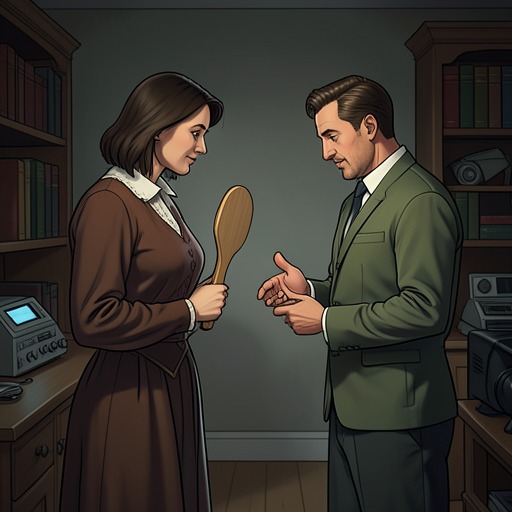
Blake shows Connie his concealed exhibition
The light house: A love storyBlake shows Connie his concealed exhibition in the room that has become both an archive of his former life and a physical monument to his withdrawal from painting. The discovery matters because the hidden canvases make his artistic hiatus tangible: these are not merely abandoned supplies or memories of past success, but a complete exhibition preserved in silence, waiting for someone capable of recognizing what has been concealed.
The Abandoned Studio
Blake leads Connie down the passage past the kitchen and into his studio, a large, cluttered room at the far end of the house. The space retains the exact conditions of a professional working environment, but everything has been overtaken by neglect. A six-foot triangular easel stands before a large window; a backless chair and a small wheeled bookcase sit beside it; tubes of paint, rags, a wooden palette, and brushes remain in place beneath a thick coat of gray dust. The room is equipped with an elaborate system of color-corrected lights, designed by consultants and electricians to produce natural, constant illumination without the yellow cast that could distort paint colors. Its precision makes the abandonment more striking: Blake once engineered the room to protect the truth of color, then stopped entering it.
Blake explains that he no longer comes into the studio, and Connie initially responds with silence rather than analysis. Her attention moves across the room until it reaches a timber rack of high vertical shelves. More than three dozen canvases stand upright there, each wrapped in cloth and varying in size and shape. Connie approaches in a reverent trance and touches the edges of the bundles, as though physical contact might convey the artistic force hidden beneath them. The paintings are presented not as ordinary possessions but as dormant works whose existence she can feel before seeing them.
Thirty-One Hidden Paintings
When Connie asks how many paintings are stored in the room, Blake gives the precise number: thirty-one. He identifies them as everything he created for an exhibition, and confirms that this was the exhibition he canceled. The number establishes the concealed collection as a coherent body of work rather than a handful of discarded experiments. It also gives material form to the gap between Blake’s public reputation and his private life: a complete show exists, yet the public has never seen it.
Blake makes clear that the canceled exhibition does not fully explain why he stopped exhibiting and painting. His refusal to reduce the matter to a canceled professional engagement hints at a deeper rupture, one that Connie has already sensed in the dust, the isolation, and the strange ritual of his nightly departures. The concealed exhibition therefore functions on two levels. It is a lost artistic career made visible, but it is also the threshold through which Connie begins to approach the wound that caused Blake to abandon that career.
To reveal the first canvas, Blake turns the easel toward the room and wipes dust from its frame with his palm. He removes a painting from the storage rack, places it on the easel, and tells Connie to stand back near the door. The staging is controlled and almost ceremonial. Blake warns that the works are more than five years old and may not meet her expectations, but Connie’s impatience shows that she is already convinced the hidden collection deserves to be seen. When he finally draws away the dust cover, the surrounding storm seems to recede from her awareness. The unveiling converts the studio from a neglected room into an exhibition space again.
The Seascapes and Daybreak
The first revealed canvas is a Blake McGrath seascape, a relatively small work whose effect exceeds its physical dimensions. Connie experiences it as an eruption of drama and pathos, recognizing the distinctive force associated with Blake’s work. Her reaction is not merely professional admiration. She becomes physically still and overwhelmed, as though the painting reaches her through sensation before she can formulate a critical judgment. The scene confirms that Blake’s artistic power has survived the years of silence, even if he himself no longer trusts the language once used to praise it.
Blake then presents a second painting called Daybreak. He identifies it as his favorite work and says that he intended it to be the exhibition’s feature painting, with its image used for the gallery catalogue and marketing launch. More unusually, he admits that it came closer than any other of his works to satisfying him. The statement reveals a rare moment of confidence in an artist otherwise defined by withdrawal and self-denial. Daybreak is not simply one canvas among thirty-one; it is the work around which Blake once imagined a public return.
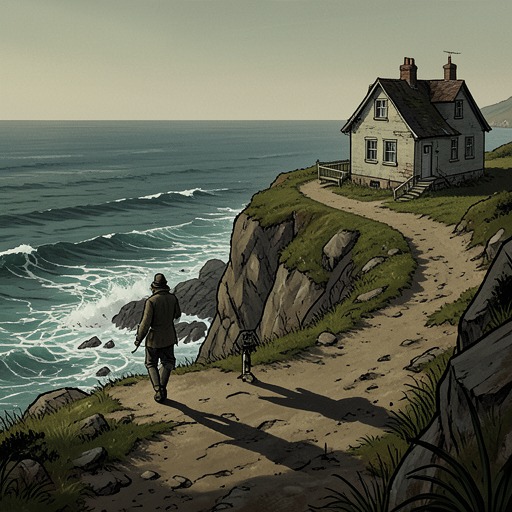
The painting is three feet wide and two feet high and depicts the ocean from a high cliff top. Beneath a pale dawn sky streaked with sunrise colors, a heaving swell breaks against jagged rock formations. The wave is caught in the instant before it reaches the shore: green surf boils and begins to curl, preserving both imminent violence and suspended beauty. Connie calls it a masterpiece and feels its vibrancy and hulking energy as an almost overwhelming presence. Her response supplies the affirmation Blake will not give himself.
Blake rejects the term masterpiece as a hackneyed expression without present relevance or significance. His objection is more than a disagreement over critical vocabulary. Connie sees an achievement that could restore the public meaning of his career; Blake sees a word emptied by repetition and refuses to let an external label settle the value of the work. The contrast places the painting between two forms of judgment: Connie’s immediate, embodied conviction that the work is extraordinary, and Blake’s defensive skepticism toward the institutions and formulas that once surrounded art.
Connie also identifies the peculiarity of Blake’s brushwork. Unlike oil painters who build texture and dimension through thick applications of paint, Blake seems to let the pigment melt into the canvas. He describes this as a distinctive way of working rather than a deliberate program, acknowledging influence from the old masters while insisting that the effect emerged from his own practice. The technique becomes part of the concealed exhibition’s revelation: the paintings are recognizable not only through subject and drama but through a method that Connie understands as uniquely his.
Art, Grief, and the Nightly Beach
The exhibition cannot be separated from the movements of Blake’s life outside the studio. During the unveiling, a clock sounds elsewhere in the house, and Ned raises his head as though answering a familiar summons. Blake nods, and the Great Dane leaves the room for the beach. The interruption links the hidden paintings to the nightly routine that governs the household. Even while Connie is being introduced to the work Blake made before his withdrawal, Ned is returning to the shore, where he waits through the night.
Blake later explains that he and Ned go to the beach at sunset to send a rose into the sea, while Ned remains there until sunrise waiting for Chloe. The concealed exhibition thus stands beside a ritual of continuing grief. Blake’s art was once organized around the sea as a source of vision and drama; after Chloe’s drowning, the same ocean became the site of loss, remembrance, and repeated vigil. The paintings preserved in the studio belong to the life before the catastrophe, but their seascapes also acquire a new meaning through the tragedy that followed.
Blake tells Connie that he was given two great loves: painting and his daughter, Chloe, who died at six years old. Chloe drowned on the beach five years earlier, the same period that separates the hidden exhibition from the present. He leaves lights burning so that she might find her way home. The studio’s artificial daylight and the house’s lights directed toward the shore form an unspoken contrast: one system once enabled Blake to paint accurately, while the other now expresses his hope of guiding the dead back to him. Both are attempts to control darkness through illumination, but only one has allowed him to return to creative work.
From Concealment to Renewal
The showing changes Connie’s relation to Blake’s past. She does not encounter a relic of finished greatness; she encounters thirty-one paintings that can still alter the future. Later, after she leaves to collect her clothes and personal belongings from the rental house in Hoyt Harbor, Blake dusts Chloe’s bedroom and changes the sheets. Sharing the pain of Chloe’s death has not removed his grief, but it gives him an unexpected lightness and allows a version of his former self to rise from despair. The movement from the studio’s dust to the cleaned bedroom marks a practical form of recovery: memory remains, but the house is no longer entirely governed by paralysis.
The exhibition’s significance expands after Blake becomes blind. At the opening of the Connie Dixon Gallery of Fine Art, he moves through the gallery with his cane, counting paces and memorizing distances while Connie handles the arrangements. He publicly credits Connie with lifting him from despair, then declares that blindness seemed to mark the end of his artistic career but that he painted Connie’s portrait in search of redemption. He announces that he will return to the easel, not to paint seascapes or portraits, but to paint emotion.
That declaration reinterprets the concealed exhibition. The thirty-one canvases are the lost works of the sighted Blake, preserved through years of isolation; the future work will emerge from a transformed artist who no longer defines painting by the visual subjects that once made his reputation. The hidden exhibition begins as a revelation of what Blake abandoned, but its deeper consequence is to make renewed creation imaginable. By allowing Connie to see the paintings, Blake opens the locked studio, exposes the continuity between artistic excellence and personal grief, and takes the first step toward bringing art back into a life that had been organized around loss.