Blake's near-drowning
The light house: A love storyBlake's near-drowning is the central ordeal through which Blake McGrath passes from grief-bound self-punishment toward a difficult willingness to live. The event begins as a violent confrontation with Connie on the beach and becomes, when the ocean carries him toward death, an involuntary test of whether he can abandon the past without abandoning Chloe. He survives by hearing Connie call him back, and the reunion that follows makes possible his farewell to Chloe, his renewed relationship with Connie, and his return to painting.
Causes and Background
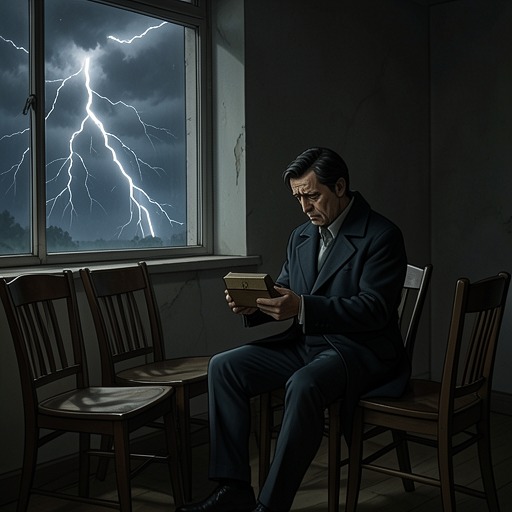
The crisis grows out of Blake's long refusal to make room for a future. After Chloe drowned at the age of six, Blake turned the beach into a place of ritualized mourning. Each sunset he and Ned went to the shore and sent a red rose into the sea; Ned then remained on the empty beach through the night, waiting for Chloe. Blake also kept every light in his house burning day and night because he wanted Chloe to find her way home. The house was known locally as the light house, not because it was an actual lighthouse, but because fishermen could see its constant illumination for miles offshore. His grief therefore occupied both his daily behavior and the physical landscape around him.
The ocean was also tied to Blake's artistic and emotional collapse. Chloe's drowning had ended his ability to paint the sea, and his isolation had made sorrow into an identity he defended against change. Connie recognizes that his blindness is not the deepest obstacle between them: the greater danger is the hollowed heart in which grief has left no room for her. Blake insists that he cannot simply release this misery, while Connie demands that he remember Chloe without allowing the tragedy to consume their entire relationship. Their argument turns on incompatible forms of love—Blake's loyalty to the dead and Connie's insistence that love must still make space for the living.
What Happens
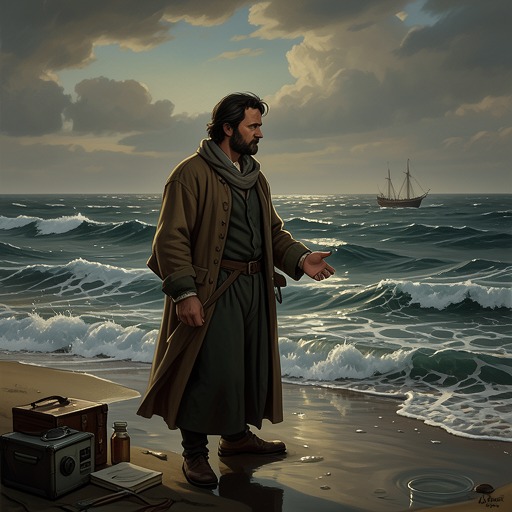
The immediate turning point comes when Connie, overwhelmed by frustration, plants both hands against Blake's chest and pushes him backward. The surf is already tugging at their feet, and the sand seems to dissolve beneath them. Blake loses his balance, falls into the water, and is carried into deeper surf. Blind and unable to locate a stable handhold, he is swept away by the current until he is fifty feet offshore and can no longer feel the bottom.
The physical experience is presented as a rapid collapse of control. Waves drive him under, salt water burns his throat, and the current carries him beyond the point where standing is possible. He cries out for help and calls Connie's name while Connie enters the surf only as far as her hips, unable to follow him safely into the stronger pull of the ocean. Her response is neither a simple rescue nor an abandonment. She refuses to let the sea take him, but she also refuses to remove the struggle from him; instead, she calls him toward her and orders him to come back.
For a moment Blake gives up. Beneath the dark water, his breathing fails and the desperation drains from his body. His blindness becomes an inward field of visions: he sees Chloe as the small child she was, running along the sand, laughing, trusting him, and being gathered into his arms. The vision connects the sea's present violence with the memory that has governed his life since her death. Yet the near-death vision does not end in reunion with the dead. He suddenly understands that he does not want to die and is not ready to surrender. The instincts for survival return, and he begins fighting upward.
Connie's voice becomes the thread that guides him. At first it reaches him faintly, then more clearly and urgently, until he can orient himself toward it. He swims against the weight of his soaked jeans and his exhaustion, catches the momentum of a wave, and eventually feels his foot scrape sand. Another wave tumbles him toward shore, but he manages to stand and take one step, then another. Connie holds out her hand and resists the impulse to lead him physically, asking him to come to her while leaving tragedy and the past behind. Blake reaches for the sound, touches her fingers, and is drawn into her arms.
Consequences and Aftermath
The rescue changes the meaning of Blake's relationship with Chloe. Blake does not decide that his daughter should be forgotten, and Connie does not ask him to surrender his memories. Instead, the ordeal makes it possible for him to want a beginning that includes remembrance without being governed by debilitating sadness. When Connie asks whether they will be all right, Blake answers that he must first say the one thing to Chloe that he has never been able to say: goodbye.
That farewell occurs at sunset, in the same ritual space where Blake and Ned have repeatedly sent roses into the sea. This time Blake carries the last red rose, kisses it, and throws it into the foaming waves. He tells Chloe that her father loves her, that she is beautiful, and that he has loved her with all his heart. He calls her a painting in his heart, a masterpiece made perfect by memory, transforming the continuing bond from an unanswered summons to a conscious act of remembrance. The ritual retains the beach, the rose, and the ocean, but its emotional direction changes: the rose is no longer only a signal asking the lost child to return; it becomes an acknowledgment that Blake must let her go.
The near-drowning also alters Blake's relation to Connie. Their reunion in the water is physical, desperate, and mutual: he must fight his way back, while she waits and calls him toward her. When their hands meet, he recognizes that her love is what he wants, even though he believes he deserves less. The scene therefore resolves the immediate conflict not through an abstract declaration but through a bodily passage from separation to contact, from the ocean's pull to Connie's grasp.
Artistic and Narrative Significance
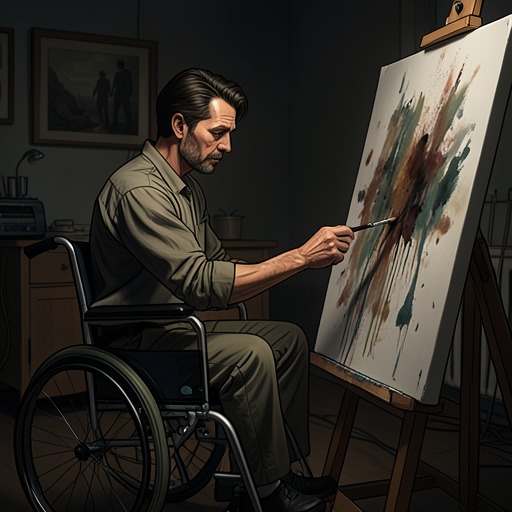
The event is a reversal in Blake's larger artistic arc. Before it, blindness and grief appear to him as punishment and as the end of his career. After the near-drowning and the farewell, his suffering can be placed within a life that still has a future. Connie's return to Hoyt Harbor the next morning, while Blake dusts Chloe's bedroom and changes its sheets, marks the quieter aftermath of this change: his grief has not vanished, but the burden begins to lift, and a glimpse of his former self rises from despair.
The later public consequence is Blake's decision to paint again. At the opening of the Connie Dixon Gallery of Fine Art, he explains that he believed going blind had ended his art career and that he painted Connie's portrait in search of redemption. He then announces that he will return to the easel, not to repeat his old seascapes or portraits, but to paint emotion. The near-drowning thus becomes the hidden hinge between physical survival and artistic transformation. The ocean nearly takes Blake's life, yet confronting it releases the will and emotional language needed for his next work.
Structurally, the event reverses Blake's established pattern of returning to the beach to wait for the dead. Earlier, Ned leaves the room at the chime of the clock to go to the beach, repeating the nightly vigil; later, Blake walks there with Ned to offer Chloe his final farewell. Between those repetitions, the near-drowning forces a decisive value shift from deathward surrender to chosen life. Blake's survival does not cancel the wound. It changes what he does with it, allowing memory, love, and art to coexist rather than leaving grief as the only form of fidelity.