Cartwright Gallery
The light house: A love storyCartwright Gallery is the inherited New York art business through which Duncan Cartwright concentrates money, reputation, artistic legitimacy, and personal power. To Connie Dixon, it is first a promised gateway to recognition, then the workplace that absorbs her labor and the setting of her subordination, and finally the institution she leaves behind when she reclaims control of her career and future.
Institution and Duncan Cartwright’s Power
Cartwright Gallery belongs to Duncan Cartwright through inheritance: he took over one of New York’s oldest and most venerable commercial art galleries from his aging father and enlarged the business through ruthless acquisitions of works by prominent artists. The gallery therefore represents more than a workplace or retail space. It is the material expression of Duncan’s authority in the art market, backed by inherited institutional standing and the ability to decide which artists and objects receive attention, validation, and high prices.
Duncan’s cultivated appearance conceals the predatory structure of that authority. He presents himself as charming, debonair, and elegantly dressed, with a disarming smile, but his eyes carry mockery and challenge. The narrative compares him to a pirate and to a lethal dagger, making the gallery’s polish inseparable from danger. Its culture is shown through Duncan’s private office, where he conducts a telephone conversation with Connie while sexually abusing a nineteen-year-old girl on an antique desk. The contrast between the gallery’s refined commercial identity and Duncan’s casual exploitation exposes the institution as a place where aesthetic sophistication does not prevent possession, humiliation, or abuse.
Connie Dixon’s Entry and Exploitation
Connie Dixon arrived in New York from the Midwest at thirty, leaving a futile life in Kansas with an arts degree, only a few months’ rent, and a desperate ambition to paint. Duncan discovered her at a downtown studio and approached her as if he were recognizing and cultivating an important talent. His promises of career support, exhibitions, fame, and artistic recognition drew her into an intense affair; he then used the relationship to bind her to him personally and financially.
The promised exhibitions never occurred. Over the following four years, Connie’s artistic dream died while Duncan continued to support her and accumulated leverage over her through debt. She eventually understood that he had not simply sponsored her: he had bought her, body and soul. She began working at Cartwright Gallery during the day, selling other artists’ work, while surrendering herself to Duncan whenever he demanded it. The gallery thus converts her cultural knowledge and emotional endurance into labor that sustains Duncan’s enterprise, even as her own artistic identity is suppressed.
Her attempts to leave demonstrate how the gallery operates within a larger system of coercive control. Connie left the gallery the previous year, but Duncan brought her back by threatening to ruin her and have her mother removed from the nursing home. His accusation, “You owe me,” turns financial assistance into a permanent claim over her body and choices. The gallery’s institutional power is consequently reinforced by private dependency: employment, debt, sexual access, professional reputation, and the care of Connie’s elderly mother become parts of one enclosing arrangement.
The McGrath Paintings and Market Authority
Cartwright Gallery also supplies the language and expertise through which the value of Blake McGrath’s work is established. When Connie asks Duncan about the vanished artist, he identifies Blake as America’s most famous contemporary artist, known as America’s Rembrandt, whose exhibitions at the Louvre and the National Gallery in London had won worldwide acclaim. Duncan recalls that Blake’s last major New York exhibition, six or seven years earlier, sold out, though Blake disappeared after announcing plans to create new work.
Duncan’s knowledge is especially precise when Connie asks about prices. Blake’s final exhibition contained twenty-four works; the largest sold for 1.6 million, while even a small study of shells and rocks fetched several hundred thousand dollars. These figures transform Connie’s discovery of paintings attributed to the reclusive Bill Mason into a potential escape from debt and dependence. The gallery’s authority lies not only in displaying art but in naming an artist, authenticating a work, and assigning it a monetary scale.
That authority is initially monopolized by Duncan. Connie tells the proprietor of a Hoyt Harbor shop that she represents Cartwright Gallery and falsely claims to be in Maine seeking artists to represent, using the institution’s name to gain access to information about Bill Mason. Later, when she sends Duncan photographs of the paintings, he recognizes them as genuine McGrath works. His acknowledgment confirms that the gallery possesses the expertise to authenticate them, but it also reveals that Connie’s independent discovery can threaten his control of their value.
The Boardroom Confrontation
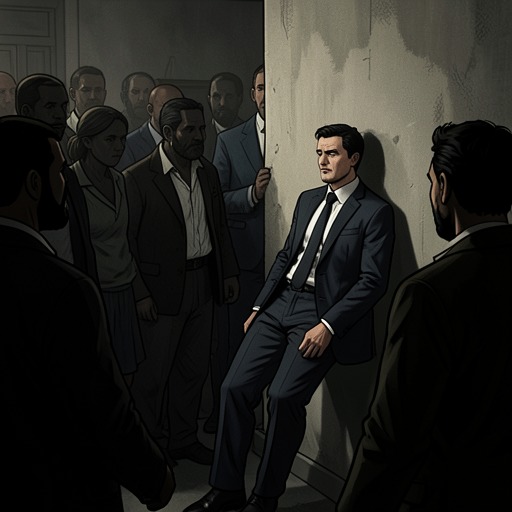
After returning to New York with a briefcase containing the paintings, Connie rides the elevator into the offices above the gallery, trembling from exhaustion and fear because she knows Duncan’s cunning and malice. She enters the boardroom while Duncan is meeting two elderly men. He dismisses them with a scowl and waits until the door closes, turning the institution’s formal business room into a private arena of intimidation.
Duncan confirms that the photographed painting is genuine and asks where it is, suspecting that it lies in Connie’s briefcase. Connie opens the case and slides the smallest painting across the table. Duncan freezes, then realizes that she has found other works. She tells him that she bought the last two available seascapes and offers him one in exchange for a complete waiver of their debts, responsibilities, and personal obligations. The painting becomes a counterweight to the years in which the gallery’s money and Duncan’s promises kept her trapped.
Duncan responds with sexual insults, assuming that Connie must have used her body to obtain the paintings and attempting to return her to the shame through which he controlled her. She rejects his gutter morality and leaves with the briefcase. His threat that she is finished in New York and will never work in the city again is the final institutional assertion of power. Connie answers that she does not intend to remain in New York for more than another day, then reaches the elevator and collapses in relief only after the doors close. The gallery has been the site of her exploitation, but its boardroom becomes the place where she names the terms of her departure.
From Commercial Prison to Abandoned Past
Cartwright Gallery remains important because Connie does not merely escape Duncan; she reimagines what an art institution might be. After returning to Maine, she plans a high-end gallery in Hoyt Harbor, distinct from the local gallery on the foreshore that exhibits art for tourists. She intends to open with Blake’s long-lost works, invite the mayor, local dignitaries, and art media, and use the exhibition to establish her profile and attract major artists. Her plan takes the cultural and commercial mechanisms once controlled by Duncan—exhibition, publicity, consignment, collectors, and pricing—and places them within a future she directs herself.
The contrast is completed when the Connie Dixon Gallery of Fine Art opens. At least a hundred people arrive from around the world, followed by collectors and investors who spill onto the sidewalk. Connie greets them, manages offers to purchase Blake’s work, and makes the opening speech, thanking everyone and presenting the gallery as the completion of a dream. Cartwright Gallery had promised Connie visibility while withholding it; her own gallery gives that promise institutional form.
In this transformation, Cartwright Gallery becomes a measure of the difference between art as domination and art as renewed agency. Duncan uses the gallery to acquire works, define value, and claim ownership over people as well as objects. Connie eventually uses the knowledge gained there to build an independent venue in Hoyt Harbor, where Blake’s lost works and new portrait can enter public life without Duncan’s personal ownership. The gallery is therefore both the origin of her entrapment and the institution against which her professional and moral independence is defined.