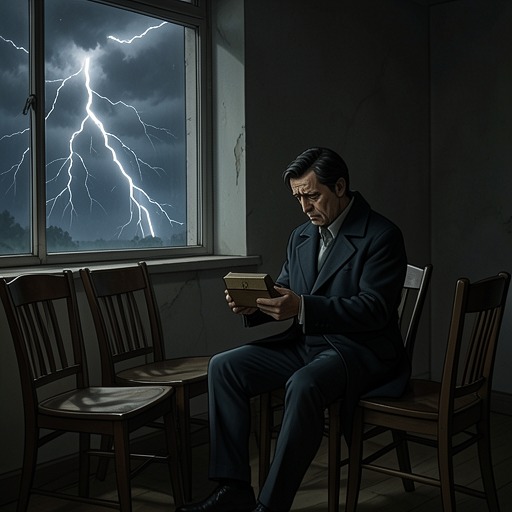
Chloe’s memorial ritual
The light house: A love storyChloe’s memorial ritual is the central ceremonial expression of Blake McGrath’s grief after Chloe’s drowning. At sunset, Blake and Ned go down to the beach, carry a single red rose to the water, and release it beyond the breaking wave. Above them, the house remains illuminated day and night: a local landmark called the light house because fishermen can see its lights for miles out to sea. Together, the rose, the shore, the dog, the repeated hour, and the unwavering beacon turn private sorrow into a practice of continued remembrance. The ritual first keeps Blake imprisoned in the past, but its final performance transforms remembrance into an act of release.
Form and Repetition
Blake performs the ceremony every day at sunset, a recurrence so dependable that it is built into the household’s rhythms. A clock chimes through the closed doors; Ned, whose arthritic legs make him rise slowly, recognizes the hour and leaves the room for the beach. Blake then retrieves the rose and invites Connie Dixon to witness the practice, explaining that it is a moment shared by him and the dog, but also something she must understand if she is to stay in the house. The regularity gives the ritual the force of an obligation rather than a spontaneous gesture. It is grief measured by the clock and repeated against the ocean’s indifference.
The ceremony is deliberately spare. Blake and Ned cross the sand in silence and stop at the water’s edge while Connie keeps her distance, sensing the intimate bond between the two mourners. Blake raises his face toward the last colored clouds, kisses the crimson petals, and wades into the surf until the water reaches his knees. He throws the rose beyond the first breaking wave, returns to the sand, and waits beside Ned until the tide draws the flower away. By the time they turn back, it is almost dark, and Connie notices that Blake’s eyes are red-rimmed and swollen. The physical simplicity of the act makes its emotional repetition unmistakable: each evening reenacts loss without resolving it.
Grief, Place, and the Beacon
The ritual is inseparable from the coast that Blake experiences in opposition to Connie. Connie sees the beach and Hoyt Harbor as a piece of paradise and has come to the town seeking answers and the possibility of a new life. Blake, by contrast, tells her that the same landscape feels like a prison. The beach is not merely scenic space for him; it is the place where Chloe disappeared, and every return brings the original catastrophe into the present. The ocean functions simultaneously as the source of his artistic identity, the setting of his daughter’s death, and the force that repeatedly carries the rose away.
The lights of the house extend the ritual beyond the beach. When Connie learns that the local name light house refers not to an official lighthouse but to the Mason house, where every light is always on, she asks why Blake maintains such a practice. No one in the community knows the answer. Blake later explains that he leaves the lights burning so Chloe can find her way home and return to him. The apparently eccentric household custom therefore becomes a message addressed to the dead. Its welcoming brightness conceals an unbearable expectation: the house is lit not because Blake has found peace, but because he still imagines that Chloe may come back.
The same meaning is visible after dark, when Connie looks from the beach toward the house and sees the lights blazing through the gloom. They appear as a warm beacon, yet also as a sorrowful reminder of a little girl lost. This contrast defines the ritual’s emotional structure. Its signs promise guidance and homecoming while acknowledging absence; they preserve Blake’s connection with Chloe while keeping him oriented toward an impossible return. The ceremony does not deny death, but neither does it permit death to become final within the emotional world of the house.
From Waiting to Witnessing
Blake eventually tells Connie why he and Ned send the rose into the sea and why Ned spends every night sitting on the empty beach until sunrise. The dog is waiting for Chloe, and Blake’s own ritual is a human counterpart to that vigil. His explanation reveals that the repeated action is not a decorative memorial but an extension of their shared refusal to abandon her. Blake has also created five paintings in which he added a beautiful raven-haired young woman, imagining how Chloe might have looked if she had grown up. He sent those paintings into the world so that she might someday recognize herself and know that she had been remembered and loved. The rose ritual and the paintings perform the same task in different media: they project Chloe’s continued presence into a world from which she is physically absent.
Connie’s response begins to alter the ceremony’s function. She follows Blake and Ned, then later finds Ned alone on the beach and sits beside him, placing an arm around his shoulder. Holding sand in her hand, she reflects on the limited time available for joy, disappointment, agony, and ecstasy, but also on what remains within one’s grasp. She tells Ned, “I’ll stay,” and walks back toward the house with sand still clinging between her fingers. Her decision does not replace Chloe or cancel Blake’s grief. It introduces a living relationship into the space governed by the dead, allowing the beach to become a place where companionship and hope can coexist with remembrance.
The following morning, Blake dusts Chloe’s bedroom and changes the sheets while Connie retrieves her belongings from Hoyt Harbor. Sharing the pain of Chloe’s death lifts a burden from him without making the sorrow disappear. The grief continues to seep through him, but he senses an older self beginning to emerge from despair. This movement is crucial: the ritual remains part of his life, yet it no longer stands alone. The nightly return to the sea is accompanied by a first return to the house, to domestic care, and to a future that Connie helps make possible.
The Final Rose
The ritual reaches its decisive form after Blake and Connie have acknowledged their love and after Blake says that he must tell Chloe goodbye. At sunset, Blake and Ned walk forlornly to the beach with the last red rose. Blake veers as he walks, and Ned nudges him with his shoulder, so the memorial remains a shared act between grieving father and faithful companion. Blake stands listening to the surf until his heartbeat seems to move in harmony with the ocean, then kisses the rose and pours his love and lament into the gesture before throwing it into the foaming waves.
For the first time, the ceremony includes spoken farewell. Blake tells Chloe, “Goodbye my darling girl,” and assures her that her father loves her, that she is beautiful, and that he has loved her with all his heart. He calls her a painting in his heart, a masterpiece perfected by memory, and admits that he has cried enough tears to fill an ocean. He no longer promises to wait for her return. Instead, he says that he will celebrate her smile in sunshine and listen for her laughter on the wind until they are together again. The language preserves an enduring bond, but changes its direction: Chloe is no longer being summoned home; she is being carried forward in memory.
The final words, “Goodbye, Chloe. I love you – and you will always be daddy’s darling girl. My little girl lost,” complete the ceremony’s movement from repetition to release. Blake returns slowly up the beach, where Connie waits on the porch, and they hold each other and weep together. Their shared mourning makes the farewell relational rather than solitary. Then they enter the house, and Connie turns off the lights one by one until the light house is no more. Extinguishing the beacon does not erase Chloe. It ends the expectation that the dead must navigate back to the living home.
Narrative and Thematic Significance
Chloe’s memorial ritual gives visible form to complicated grief and to the possibility of maintaining a continuing relationship with the dead. The rose, the ocean, and the lights preserve Blake’s emotional connection with his daughter, while Ned’s nightly vigil makes that connection communal between human and animal. Yet the narrative does not present remembrance as sufficient by itself. Blake’s repeated beach visits are paired with isolation, self-pity, and his conviction that the seaside house is a prison. The ritual protects Chloe’s memory but also keeps Blake inside the scene of her disappearance.
Its transformation therefore parallels Blake’s broader recovery. After Connie enters his life, he begins to share rather than seal away the wound, cares for Chloe’s room, and allows the future to include both love and loss. The couple’s celebration on the beach, with grilled steaks, moonlight, stars, and conversation lasting until midnight, contrasts sharply with the earlier cold and mournful ceremonies. The same shore can hold grief, intimacy, and renewed possibility. Connie’s dream of a gallery also moves from private aspiration to material reality, and the Connie Dixon Gallery of Fine Art is born soon after the two begin building a life together.
At the gallery opening, Blake explains that he once believed blindness marked the end of his art career, and that he painted Connie’s portrait because he wanted redemption. He then announces that he will return to the easel to paint emotion. This artistic return does not sever his bond with Chloe; it converts the emotional force preserved by the ritual into a new capacity for creation and connection. The final rose marks the same conversion in symbolic form. Blake stops waiting for death to reunite him with his daughter and begins living in a world where love for Chloe, love for Connie, memory, art, and hope can occupy the same frame.