Connie buys Blake McGrath’s hidden paintings
The light house: A love storyConnie buys Blake McGrath’s hidden paintings in a transaction that changes the value of art, money, and personal freedom at once. She recognizes the two concealed seascapes as works of extraordinary power, accepts serious financial and ethical risk to obtain them, and later learns that their apparent obscurity conceals a major artistic history. The purchase gives Connie the means to challenge the arrangements that have confined her, while bringing Blake McGrath’s lost work back into public view.
Causes and Background
Connie’s decision emerges from four years of frustration under Duncan Cartwright. He had promised to support her artistic career, arrange exhibitions, and make her famous, but instead used those promises to draw her into a sexual and financial dependency. Her own artistic dream had died as Duncan’s need to possess her became more ruthless. She worked in the gallery selling other artists’ work, surrendered herself to Duncan when he demanded it, and remained burdened by debt and guilt. When she once tried to leave, he threatened to ruin her and have her mother removed from the nursing home. His repeated insistence that she owed him turned professional support into a mechanism of ownership.
The hidden paintings offer Connie an alternative to that deadened arrangement. She has been drawn to the small painting displayed by the gallery and learns that Warren Ryan may be willing to sell two works in his possession. She also hopes to meet the mysterious Mr. Mason and discuss a career and possible exhibitions. Ryan’s circumstances make the sale possible: the winter business season has been poor, bank payments are pressing, and he believes that three thousand dollars would carry him through the next winter. The transaction therefore brings together Connie’s hunger for authentic art and Ryan’s immediate need for cash.
Discovery and Purchase
Ryan reveals that he possesses two paintings and, reluctantly, agrees that they are for sale if the price is right. He unwraps the first under the concentrated light of a desk lamp, treating it like a priceless relic. Connie rises slowly, like a worshipper approaching a sacred altar. The small, ten-inch-square oil shows two gulls on a barren beach beneath a mass of gray, craggy rock. Its modest dimensions do not diminish its force; Connie’s face loses its color, her eyes widen with wonder, and she struggles to contain her astonishment.
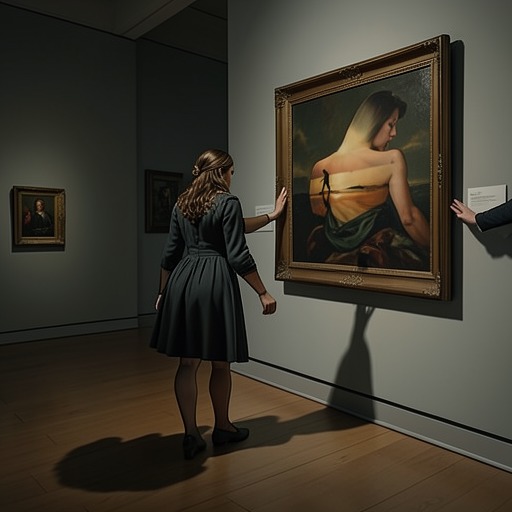
The second canvas is twice as long and presents a related seascape: a lonely beach, a small boat drawn onto the sand, and the same beautiful young woman standing with her back to the painter. One hand reaches toward an angry ocean boiling beneath a thunderous, slate-gray sky. Connie touches the canvas tentatively, as though the sea might still be wet or the sand might cling to her fingers. The recurrence of the woman and the ocean links the two works as part of a coherent artistic world, while the paintings’ concealed location makes their discovery feel like the recovery of lost treasure.
Connie initially offers one thousand dollars. Ryan, recognizing both her intense attachment to the paintings and his own financial leverage, counters with three thousand dollars in cash for both. Connie experiences the decision as immediate possession: when she looks down at the canvases, she knows that they are hers. She leaves the thousand dollars as a deposit and promises to return with the remaining two thousand within the hour.
The missing money creates the purchase’s sharpest immediate risk. Connie has no spare cash, and the only bank in town is crowded with tourists. At the counter, she requests a two-thousand-dollar withdrawal. The bank staff discovers that the account is a joint nursing-home account used by Connie and her sister, Jean, to pay for their mother’s care outside Exeter. Their mother’s expenses have been covered only through the daughters’ weekly contributions and additional deposits from Connie’s employer, with little left over. A further payment is due in a week, and the bank warns that insufficient funds would produce charges. Connie nevertheless assures the teller that the money will be replaced in time, receives the cash, and returns to Ryan’s office.
The act is neither a simple investment nor an innocent indulgence. Connie knowingly borrows against a care account because she believes the paintings possess a value that exceeds their immediate price. Duncan Cartwright doubts the purchase and argues from conventional financial logic, but Connie’s inner certainty prevails. She chooses the canvases over his judgment, even while understanding that the money belongs to a fragile family economy.
Value, Recognition, and Reversal
Ryan counts the cash with miserly precision, while Connie’s response to the paintings has already shown that their importance cannot be measured by his price. The later reversal comes when Connie returns to confront him after discovering what the paintings are worth. She politely explains that the original three-thousand-dollar payment was based on her first impression of their value, then tells him that she now understands their fair value and offers an additional forty thousand dollars.
This second payment changes the moral shape of the transaction. Connie does not exploit Ryan’s ignorance once she understands the paintings’ significance. Instead, she turns her new knowledge into a voluntary correction of the price, while retaining control over the decision. Ryan’s earlier pressure secured the cash he needed to escape the bank’s demands; Connie’s later payment acknowledges that the works deserved more than the desperate bargain could express. The purchase thus becomes both an act of self-assertion and an act of artistic justice.
The paintings also expose the instability of the art world’s systems of recognition. They have been hidden, separated from their proper public context, and sold through a grocery-store office rather than an established gallery. Their worth is not initially guaranteed by a visible signature, exhibition history, or institutional endorsement. Connie’s bodily reaction precedes formal certification: she recognizes the works through their atmosphere, composition, recurring imagery, and emotional intensity before the market confirms their importance.
Consequences for Connie and Blake McGrath
The purchase eventually reconnects Connie with Blake McGrath, whose concealed identity and lost paintings alter her understanding of what she has acquired. Blake has withdrawn from public artistic life, and his connection to the paintings belongs to a history of self-imposed isolation, grief, and artistic silence. His nightly pattern with Ned makes that withdrawal visible: at sunset, they go to the beach and send a rose into the sea, while Ned waits on the empty shore until sunrise for Chloe. The paintings’ beaches and turbulent water therefore carry more than decorative scenery; they belong to Blake’s unresolved relationship with the ocean and with Chloe’s death.
When Connie later shares the pain surrounding Chloe’s drowning, Blake feels a burden lift. The grief remains and cannot disappear, but an older self begins to rise from the darkness of despair. The discovery and circulation of the paintings participate in that recovery because they give his buried artistic identity a path back into the world without erasing the trauma that produced the images.
For Connie, the paintings provide the first concrete possession that is wholly aligned with her own judgment rather than Duncan Cartwright’s control. Her later conduct confirms the direction of that change. She returns to Hoyt Harbor, replaces her phone, contacts Jean and the nursing home, and begins planning a new studio in a shop near the grocery store. The object she bought in secret becomes the foundation of a public professional life: she can organize exhibitions, make decisions about artists, and shape a gallery according to her own vision.
Public Return and Artistic Renewal
The purchase ultimately contributes to the opening of the Connie Dixon Gallery of Fine Art. At the gallery opening, Connie thanks the attendees and describes the doors opening as the completion of a dream. She specifically credits Blake with allowing her to show his lost works and his new portrait, linking the concealed paintings to the fulfillment of the career that Duncan Cartwright had promised but never delivered.
The paintings also help Blake return to art after blindness. In his speech, he explains that he had thought going blind was the end of his art career and that he painted Connie’s portrait because he wanted redemption. He then announces that he will return to the easel, not to repeat his earlier seascapes or portraits, but to paint emotion. The hidden paintings thus mark a transition rather than a mere recovery of the past: they bring Blake’s former work into public view while opening the possibility of a different artistic future.
Connie’s purchase is therefore a pivotal action of recognition, risk, and redistribution. It begins with a ten-inch square painting, a larger companion canvas, a thousand-dollar deposit, and money taken from a nursing-home account; it expands into an additional forty-thousand-dollar payment, a new gallery, Blake McGrath’s renewed artistic life, and Connie’s release from Duncan Cartwright’s imposed definition of her worth. What she first experiences as the acquisition of two beautiful seascapes becomes the material form of a larger decision: to trust her own perception, protect the value she has recognized, and build a future in which art is no longer used to own her but becomes the means by which both she and Blake McGrath can begin again.