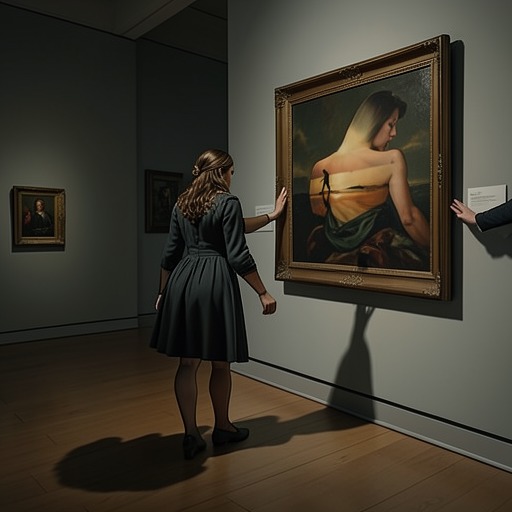
Connie discovers the Bill Mason paintings
The light house: A love storyConnie Dixon discovers the Bill Mason paintings at a craft gallery in Hoyt Harbor and recognizes them as more than anonymous local artwork: their emotional force and distinctive technique lead her toward the hidden identity of Blake McGrath. The discovery is the decisive hinge between Connie’s trapped life in New York and the new artistic, professional, and personal future she will build in Maine.
The Discovery in Hoyt Harbor
Connie arrives in Hoyt Harbor while attempting to escape the debt and coercion that have consumed the four years since Duncan Cartwright promised to support her artistic career. Instead of exhibitions and recognition, Duncan has made her dependent on him, employed her selling other artists’ work, and used her mother’s nursing-home expenses to draw her back whenever she tries to leave. She comes to Maine for two weeks to make decisions while some part of her freedom remains, not yet knowing that the coastal town will redirect her life toward the artist she has been seeking without realizing it.
Inside a small gallery, Connie sees a painting no larger than her handbag. Its ominous sky, desolate coastline, black glistening rocks, and pounding surf contain a tiny young woman standing with her back to the artist, apparently filled with tragic yearning. The scale of the canvas contrasts with the breadth of feeling Connie finds in it. The waves, solitude, menace, and figure seem to exceed technical accomplishment and enter the realm of lived emotion, producing the same shock of recognition she once experienced before Vermeer’s Woman in Blue Reading a Letter at the Rijksmuseum in Amsterdam. That earlier encounter had awakened her passion for art and determined her future; this painting renews that vocation on the Maine coast.
The painting’s unsigned state intensifies rather than resolves the mystery. Acting on a reckless impulse, Connie removes it from the wall, turns it over, and examines its edges under the gallery light. There is no signature, mark, or identifying information. Her disappointment becomes incredulity: she feels that the absence of a name has concealed something essential, while the painting’s brushwork and emotional authority suggest an artist of exceptional power. The unsigned canvas therefore becomes both an object of desire and a clue. Connie does not merely want to buy it; she wants to identify the person capable of making it.
From Anonymous Canvas to Bill Mason
When Connie asks who painted the work, an old man identifies the artist as Bill Mason, a local man. The answer initially leaves her empty because it appears to reduce the mysterious painter to an unknown resident rather than the celebrated figure she suspects. Yet the recognition returns almost immediately. Connie conceals her excitement, gives the man her business card, and claims that she represents the Cartwright Gallery in New York and is in Maine looking for new artists to represent. Her professional language is partly a lie, but it converts private astonishment into a plausible commercial inquiry.
The old man refuses to reveal where Bill Mason lives, though he names Warren Ryan as someone who may know more and may be willing to sell Mason’s paintings. Connie then learns that the unsigned work is not unique: two other paintings by the same artist exist. This information changes the discovery from a solitary encounter into the possible recovery of a concealed body of work. The number matters because it confirms a pattern, promises further evidence, and gives Connie a practical reason to pursue Mason even as her deeper motive remains the need to find the artist behind the paintings.
Her investigation is driven by a collision between professional instinct and personal hunger. Connie has spent years inside the art business without being allowed to live as an artist herself, while Duncan Cartwright has controlled access to money, exhibitions, and recognition. The Mason paintings offer a different model of artistic value: their authority exists before institutional approval, signature, or publicity. Connie’s response suggests that she can still distinguish genuine artistic experience from the gallery system that has exploited her, and that this judgment may become the basis of her independence.
The Hidden Connection to Blake McGrath
The discovery ultimately leads Connie to Blake McGrath, although the supplied scene presents the recognition first as suspicion and revelation rather than as a public identification. Blake’s work is later discussed in terms that match the qualities Connie noticed in the anonymous canvas. His oils do not depend on thick accumulation of paint to create texture and dimension; instead, the paint appears to melt into the canvas. He describes this as a distinctive way of working, influenced by the old masters but not deliberately adopted as a program. The technique gives material form to the very quality Connie had sensed before she knew the painter’s name.
The connection is also shaped by the setting. Blake lives beside the sea, yet Hoyt Harbor does not represent freedom to him. When Connie calls it a piece of paradise, Blake answers that it feels like a prison. His relationship with the coast is inseparable from the death of Chloe. Each evening he and Ned go to the beach at sunset and send a rose into the sea, while Ned waits on the empty beach until morning. Blake leaves the lights on so Chloe might find her way home. The seascapes Connie discovers are therefore connected not only to artistic mastery but also to grief, ritual, and an environment that serves simultaneously as muse, memorial, and source of trauma.
Ned’s movement toward the beach when the clock chimes makes the ritual part of the household’s ordinary structure. The dog’s nightly departure is a physical repetition of mourning, while Blake’s concealed paintings preserve another kind of repetition: the return of feeling through images of water, sky, solitude, and longing. Connie initially reads the canvas as a revelation of an unknown genius; as she learns Blake’s history, the painting becomes legible as an expression of a life organized around loss and unable to leave the shore behind.
Consequences for Connie’s Future
The discovery changes Connie’s direction before it changes her circumstances. She has come to Maine exhausted by debt, emotional manipulation, and the collapse of her ambition. After finding the paintings, she begins to imagine a future not guaranteed by Duncan Cartwright or by the established New York gallery. She later tells Blake that she once wanted fame, major exhibitions, and critical applause, but changed her dream to owning a gallery devoted to great art without pretension. The Mason paintings help restore the seriousness of that dream by giving her an encounter with art that does not depend on publicity.
Connie’s renewed future is uncertain. After returning toward Hoyt Harbor at night, she feels both elation and fear: the new life has no promises or guarantees, and the only thing carrying her forward is the dream of her own small gallery. She nevertheless tells herself that uncertainty is another word for adventure. The discovery has thus shifted the value at stake from dependence to possibility. What begins as the recognition of an unsigned masterpiece becomes the first concrete sign that Connie can make decisions on her own behalf.
That possibility eventually becomes material. Connie and Blake celebrate by carrying a folding table to the beach, eating grilled steaks beneath the moon and stars, and talking until mist rolls in from the ocean. The following morning Connie phones the landlord, and the Connie Dixon Gallery of Fine Art is born. The gallery’s origin is therefore tied directly to the earlier anonymous painting: the work that first reawakened Connie’s artistic judgment helps lead her from selling other people’s art under coercion to creating a space shaped by her own choices.
Artistic and Narrative Significance
As a plot event, Connie’s discovery combines recognition, reversal, and pursuit. She expects a vacation in which she can think about a life that has been drained by Duncan’s control; instead, an unsigned seascape produces an encounter powerful enough to revive her artistic identity. The revelation that two more paintings exist supplies the investigative momentum, while the name Bill Mason opens the path toward Blake McGrath and the private history behind the work.
The paintings also establish the book’s central contrast between art as commodity and art as emotional experience. Duncan has treated Connie’s career as something he can purchase and possess, while the Mason canvases communicate before they are authenticated or marketed. Their lack of signatures initially frustrates the commercial question of authorship, but it also emphasizes that Connie’s first response is bodily and emotional: awe, tears, trembling, and a sense of connection with the artist. Her later work with Blake will continue that movement from hidden art toward public recognition, culminating in Blake’s decision to return to painting after blindness and to paint emotion rather than seascapes or portraits. Connie’s discovery is the first moment in that larger transformation when the concealed power of Blake’s art reaches someone capable of recognizing it and building a future around it.