Hoyt Harbor Gallery and Gifts
The light house: A love storyHoyt Harbor Gallery and Gifts is the discreet waterfront gallery through which Connie Dixon first encounters the lost work of Bill Mason and finds a possible route out of the life Duncan Cartwright has controlled. Hidden between tourist shops, it is at once a commercial storefront, a repository of local art, and a threshold where Connie’s dormant judgment, ambition, and hope become active again.## Setting and Appearance The gallery is easy to miss. Connie Dixon discovers it only after leaving the crowded waterfront, where former fishermen’s space has been converted into cafés, seasonal stalls, and tourist commerce. Wedged between two similar gift shops, its glass door bears the words “Hoyt Harbor Gallery and Gifts,” while a second story rises above the commercial frontage that she had assumed contained only offices. The entrance therefore marks a small break in the visual and social texture of Hoyt Harbor: the gallery is present in plain sight but concealed by the town’s louder vacation economy.
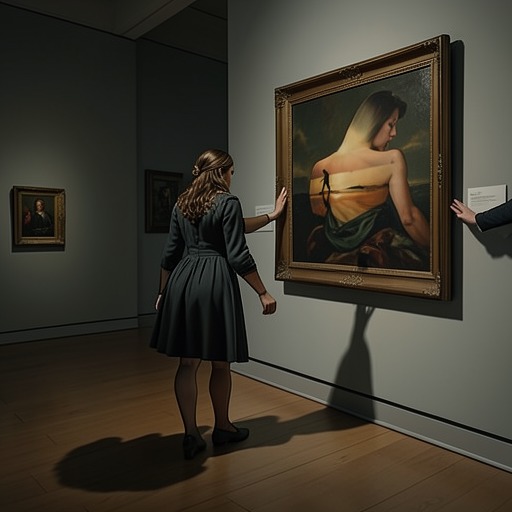
Inside, a narrow staircase leads to a white-walled room with polished wooden floorboards and local paintings. A waist-high glass counter stands at the far end, backed by a closed door apparently leading to storage. At first the space seems deserted, and Connie hears the hollow echo of her footsteps as she moves past the paintings. The gallery’s physical narrowness and silence contrast with the crowded promenade below, giving it the quality of a private enclave hidden inside a public marketplace.
The main display is disappointing to Connie’s trained eye. The harbor paintings are poorly executed, mixing weak abstractions with vague landscapes. Although one work is painted in oils on canvas, its colors are starkly layered and its paint badly applied, without either feeling for the subject or command of craft. The gallery thus initially appears to embody the gap between the sale of art and the achievement of art: it offers objects for visitors to buy, but most of those objects lack the force Connie believes genuine work should possess.## The Concealed Alcove and the Masterpiece The decisive space is an additional alcove at the far end of the gallery, part of the building’s L-shaped plan and scarcely more than ten square feet. It may once have been a bathroom before renovation. Three large watercolors occupy one wall, while several small charcoal portraits of elderly people hang opposite them. Connie dismisses these works almost at a glance, expecting no more from the alcove than from the main room.
Her judgment changes when another woman steps aside and reveals a small painting on the wall ahead. The work is no larger than Connie’s handbag, yet Connie experiences it as a masterpiece. Its beauty and emotional power overwhelm her before she can analyze its technique: she struggles to breathe, feels a flush rise in her cheeks, teeters with sensuous vertigo, and finds tears in her eyes. The painting’s importance is therefore established through bodily shock as well as professional recognition. It is not merely better than the other works in the gallery; it restores Connie’s confidence that an artwork can contain something beyond competent craft, something intangible and powerfully evocative.
The painting also triggers recognition. As Connie stares at it, incredulity gives way to dawning realization about both what the work is and who created it. She experiences the discovery as a mixture of nausea, chill, disbelief, and giddy joy. The gallery’s hidden alcove consequently becomes the place where a suppressed artistic identity re-enters the story. What looked like an obscure local display conceals work connected to the elusive artist known as Bill Mason, later revealed as Blake McGrath.## Custody, Secrecy, and Access Connie Dixon takes the painting under her arm and reaches for a telephone, only to remember that she no longer has her phone. Before she can make contact, the door behind the counter opens violently and a middle-aged woman enters in visible horror. Seeing the painting beneath Connie’s arm, the woman tries to snatch it back; Connie drops the telephone and catches the woman’s wrist. The scene turns the gallery from a place of passive viewing into a contested site of custody, where the question of who may possess, display, or disclose the painting becomes immediate.
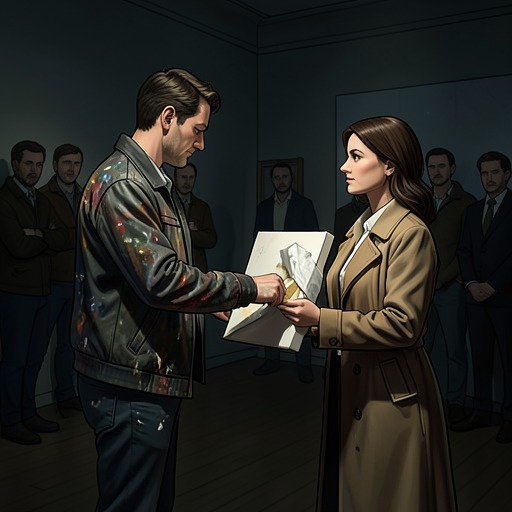
The old gallery owner subsequently makes the limits explicit. He returns the painting to Connie’s attention but tells her that it is not for sale and refuses to say where Mr. Mason lives, explaining that Mason values his privacy. Connie’s persistence does not dissolve that barrier. She asks instead to take photographs, and after a reluctant consultation with his wife, the owner permits it. Connie photographs the whole painting, the haunting girl in the foreground, and close details of the artist’s unusual technique and brushwork. Even when denied ownership, she converts the encounter into evidence and preserves the work through careful visual study.
The owner directs her to Warren Ryan at the grocery store, suggesting that Ryan may know more about Mason and may possibly be willing to sell paintings. This referral extends the gallery’s function beyond exhibition. It is the first link in a chain of local knowledge, guarded disclosures, and private transactions that leads Connie toward the hidden body of Mason’s work. The owner’s reluctance also reinforces the gallery’s atmosphere of secrecy: the paintings are not simply merchandise waiting for a buyer but fragments of a concealed history.
Connie Dixon’s Turning Point
Connie arrives in Hoyt Harbor after four years in which Duncan Cartwright has converted her artistic hopes into dependence. He had promised exhibitions and recognition, then used financial support, sexual access, debt, and threats involving her mother’s nursing-home care to keep her attached to him. She comes to Maine for two weeks to escape, think, and make decisions while she still possesses some will to be free. The gallery appears during that search for an answer, and the masterpiece gives her a concrete object around which a new future can form.
The discovery does not immediately free Connie, but it changes the direction of her agency. She pursues information, photographs the painting, seeks Warren Ryan, and later pays Ryan an additional forty thousand dollars after learning the true value of the two paintings she bought from him. The gallery is therefore the origin point of a practical as well as emotional transformation: Connie’s eye, once subordinated to Duncan’s control, becomes the basis for negotiation, investment, and an independent artistic enterprise.
Her later relation to the place is marked by contrast. Connie calls Hoyt Harbor a piece of paradise, while Blake McGrath says that the coastal setting feels like a prison. The same broader environment carries different emotional histories: for Connie, the town offers escape and the possibility of a gallery of her own; for Blake, the sea and its surroundings remain bound to Chloe’s drowning, the sunset ritual with Ned, and the nightly wait on the empty beach. Hoyt Harbor Gallery and Gifts stands between these readings. It belongs to the town’s tourist economy, yet its hidden paintings open onto private trauma, artistic exile, and the possibility of recovery.
From Hidden Display to New Beginning
The gallery’s significance grows retrospectively as Connie begins creating the future she imagined. After returning to Hoyt Harbor at night, she recognizes that the new life has no promises or guarantees beyond her dream of a small gallery. Her movement through the town’s lights and waterfront crowds gives that dream a public setting, while the earlier discovery at Hoyt Harbor Gallery and Gifts supplied its artistic foundation.
The contrast between the two galleries is decisive. Hoyt Harbor Gallery and Gifts is cramped, concealed, and dominated by weak local work with one extraordinary secret at its center. Connie’s later Connie Dixon Gallery of Fine Art is born when she rents a shop on the town’s main street, only a few doors from the grocery store, and turns her accumulated knowledge and relationships toward a new institution. She plans the space with Blake McGrath, maps its layout in the sand, and celebrates the decision with him on the beach before phoning the landlord the following morning. The movement from hidden alcove to planned storefront transforms art from something guarded by others into something Connie can organize and offer to a community.
At the opening of the Connie Dixon Gallery of Fine Art, Connie thanks the visitors and presents the gallery as the completion of a dream. She also thanks Blake for allowing her to show his lost works and his new portrait. That public event gives communal recognition to what began as a solitary shock in the concealed alcove of Hoyt Harbor Gallery and Gifts. The earlier gallery remains important not because it becomes Connie’s institution, but because it is where she first recognizes the value of Blake’s hidden art and begins the chain of choices that makes her own gallery possible.