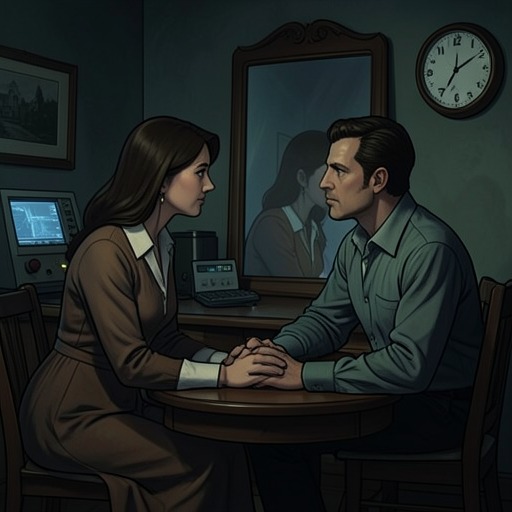
Lady of the Light House
The light house: A love storyLady of the Light House is the portrait Blake McGrath creates of Connie Dixon at the moment when painting, grief, love, and artistic survival converge. Its final title joins Connie’s image to the “light house,” the perpetually illuminated Mason house that Blake keeps visible to the sea in the hope that Chloe will find her way home. The portrait therefore carries two kinds of remembrance at once: it presents Connie as a living woman whose longing can be seen, and it preserves the emotional world of a father still addressing his lost daughter. When the painting later dominates the opening of the Connie Dixon Gallery of Fine Art, it becomes the public emblem of Blake’s return to painting and of Connie’s dream of establishing a gallery independent of Duncan Cartwright’s control.
Commission and Condition
The portrait is proposed after Blake agrees to allow Connie to exhibit his old paintings once she establishes her gallery. His permission comes with a condition: he will paint her. Connie does not accept the assignment as a simple professional opportunity. She asks why Blake wants to paint again after so many years and why he has chosen her, forcing him to disclose the crisis behind the work. Blake tells her, “Connie, I’m going blind,” and identifies painting her as his “last chance for redemption.” The portrait is thus conceived under a severe temporal pressure. It is not merely a likeness commissioned for display; it is the work Blake believes must be completed before the loss of sight closes the career he abandoned after Chloe’s drowning.
The circumstances also distinguish Blake’s portrait from the artistic ambitions Connie once surrendered. She had come to Hoyt Harbor after Duncan’s promises of exhibitions and fame had collapsed into debt, coercion, and sexual exploitation. Her dream of becoming a famous artist had died during four years in which Duncan treated his financial support as ownership of her body and future. By the time she meets Blake, she has changed that dream into the more practical desire for a gallery of her own, a place for great art that she can be proud of. Blake’s portrait gives that revised ambition a center: it is both the work that may inaugurate her professional independence and the work through which he tries to reclaim his own artistic identity.
Making the Image
The painting begins with a carefully staged photographic process rather than a conventional sitting alone. Connie recreates the pose Blake had planned for her at the studio window, placing her hands on the sill while he searches through the rags in his painting box and retrieves a camera. He explains that he will take all the reference photographs that morning and project the final image so that he can begin painting that afternoon. The procedure reflects the urgency of his failing sight, but it also shows his effort to preserve exact visual information while converting a living pose into a durable artistic memory.
When the portrait is finished, Blake recognizes the result as beautiful even before showing it to Connie. He has rendered her face as an expression of longing, with a secret sadness seeming to rise behind her eyes and the rose in her hand. The light across her face and arms is so convincing that the canvas appears almost backlit, translucent, and alive. Blake signs his name across the bottom, marking the image as his work while the emotional content remains inseparable from Connie’s presence and from the intimacy that has developed between them.
The first public presentation is staged with playful ceremony. Blake rearranges the studio for forty minutes, moving the easel and furniture to display the finished work from its most advantageous position. He emerges holding a blindfold, and Connie responds with teasing mischief before demanding that he stop the speeches and reveal the painting. When the blindfold comes away and her gaze reaches the canvas, she gasps as though the breath has been struck from her. The image appears to her as a perfect twin, not because it merely reproduces her features but because it captures an essence of yearning with a power that grows as she approaches it.
Naming the Painting
The painting’s title is itself a small artistic conflict between Blake’s indifference and Connie’s insistence that great works require names. When she asks what he will call it, Blake offers “Woman Standing By a Window,” a functional description that leaves Connie mortified. He then invites her to name the work. She first suggests “Woman at the Light House,” connecting the woman at the window to the illuminated house whose lights can be seen by fishermen for miles out to sea.
Blake supplies the final title, Lady of the Light House, and Connie likes it best. The change from “woman” to “lady” gives the figure a heightened dignity, while “light house” retains the local phrase and its private emotional history. Thad Ryan has explained that the residents call the Mason house the light house because every light remains on night and day, allowing fishermen to see it far out at sea; no one knows why the lights are always lit. The title turns that unexplained local oddity into an artistic and emotional key. It makes the portrait a figure of illumination, return, and waiting, even though the woman depicted is Connie rather than Chloe.
The title also holds an important paradox. The house is a beacon for someone who will not return, and Blake experiences the seaside home as a prison even while maintaining its lights. To Connie, Hoyt Harbor and its shore can look like a piece of paradise; Blake replies that he hates the place and that what may once have been paradise now feels like confinement. Lady of the Light House preserves both perceptions. Its beauty is real, but the radiance surrounding it is made from captivity, grief, and the repeated attempt to guide an absent beloved home.
Grief, Memory, and Reconciliation
The portrait’s emotional logic becomes clearer when Blake explains the ritual connected with the sea. He and Ned go to the beach at sunset to send a rose into the water, while Ned returns every night to sit on the empty beach until sunrise, still waiting for Chloe. Blake leaves every light in the house burning because he wants Chloe to find her way home and return to him. The house, the rose, the beach, and the portrait form a network of continuing attachment rather than separate symbols: each keeps a relationship with the dead active in the present.
Blake has also altered five earlier paintings by adding a beautiful raven-haired young woman, imagining how Chloe might have looked if she had grown up. He sent those paintings into the world so that she might one day see herself in one of them and know that she was remembered and loved. Lady of the Light House extends this practice of making the absent visible, but its model is now Connie, a living woman whose actual face and emotional presence give Blake a way to paint beyond the imagined adult Chloe. The new portrait does not erase Chloe; it provides Blake with a form through which memory can coexist with renewed human intimacy.
That coexistence reaches its most decisive point in Blake’s farewell to Chloe. At the beach he kisses a rose, throws it into the foaming waves, and tells her, “Goodbye my darling girl,” before declaring that she will always be his little girl lost. He says he cannot grieve any more and will instead celebrate her smile in sunshine and listen for her laughter on the wind. Connie waits on the porch, embraces him, and weeps with him. Afterward, they turn off the lights one by one until the light house is no more. The portrait survives this closing of the ritual as its transformed remainder: not a replacement for Chloe, but an artwork through which Blake can carry love forward without continuing to wait for the impossible return.
Public Meaning and Artistic Return
The portrait receives its fullest significance at the opening of the Connie Dixon Gallery of Fine Art. Connie and Blake celebrate the completed work with grilled steaks on the beach, watching the moon appear to rise from the ocean and talking beneath the stars until mist rolls in and turns the world pearlescent grey. The following morning Connie phones the landlord, and her gallery is born. The private painting therefore directly precedes the institutional realization of her dream; its completion and the gallery’s founding are treated as linked acts of beginning again.
At the gallery opening, visitors crowd around the portrait four deep, unable to move past it. Connie tells Blake that the painting is stopping them and that they stare as though hypnotized. She is also fielding purchase offers for the old seascapes, so the new portrait functions simultaneously as an aesthetic attraction, a commercial anchor, and the emotional culmination of her long-suppressed ambition. The work makes Blake’s lost paintings newly valuable while giving Connie the public success she had once been denied.
Blake’s own speech reveals the portrait’s ultimate role. He says that going blind had seemed to mark the end of his art career and that he painted Connie’s portrait because he wanted redemption. Yet the work does not end his career. Instead, he announces that he will return to the easel, no longer to paint seascapes or portraits but to “paint emotion.” Lady of the Light House is the hinge between those positions: it is technically a portrait, but its importance lies in the feeling it makes visible—longing, tenderness, grief, and the possibility of release. Its public triumph turns Blake’s private act of farewell and recovery into the first evidence of a new artistic language.