The portrait of Connie
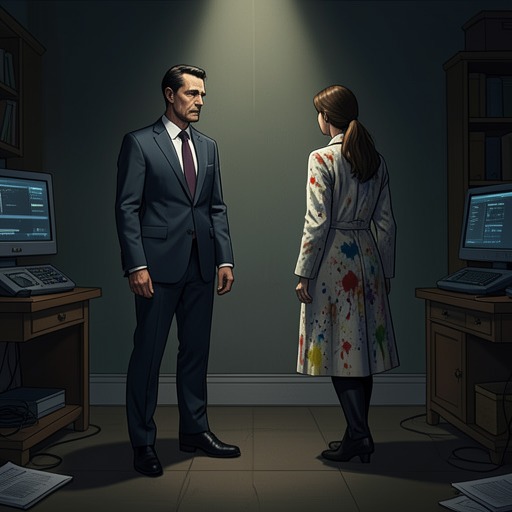
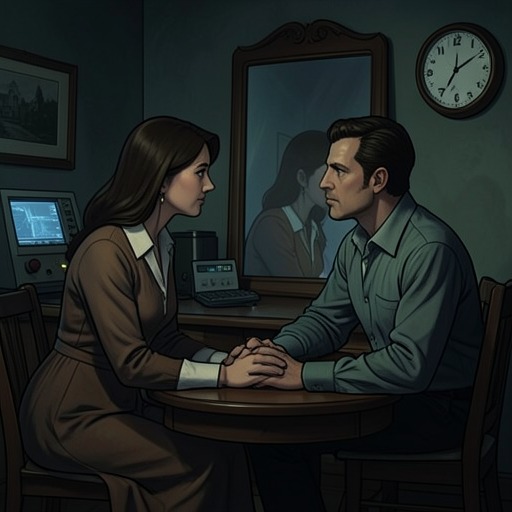
The light house: A love storyThe portrait of Connie is the decisive artistic and emotional work of Blake McGrath’s late career. He agrees to paint Connie at a moment when he is losing his sight, naming the portrait his “last chance for redemption.” The work begins as an intimate exchange between two people who have learned to trust one another, but it becomes larger than a likeness: through the rose, the light house motif, and the finished figure’s expression of longing, the painting gathers Blake’s grief, Connie’s renewed life, and the possibility of an art no longer dependent on ordinary vision.
Commission and Condition
Blake offers Connie an exhibition of his old paintings once she establishes her gallery, but he attaches a condition: he wants to paint her portrait. The request unsettles Connie because Blake has withdrawn from painting and has never painted portraits. She asks why he wants to paint again and why he has chosen her, forcing him toward the private truth he has avoided exposing. Blake finally tells her that he is going blind and that painting her is his last chance for redemption. The portrait is therefore not a routine commission or a promotional image for Connie’s future gallery. It is undertaken under the pressure of a vanishing capacity, with Blake treating the act of painting as a final reckoning with the artist he was and the man grief has left behind.
The request also reverses the exploitative artistic arrangement that once defined Connie’s life with Duncan Cartwright. Duncan had promised her exhibitions and fame, then used financial support and the absence of opportunities to make her dependent, claiming that she owed him for everything he had done. By contrast, Blake’s condition gives Connie a place within a reciprocal creative relationship. She is not being bought, displayed, or used as proof of another man’s power; she becomes the subject through whom Blake risks his own vulnerability.
Method, Rose, and Intimacy
Blake begins practically. At the studio window, he positions Connie and takes reference photographs, explaining that he will project the final image so he can work from the most detailed possible representation rather than spend days struggling with a sketch. He presents the projector as a sensible tool for a realism artist: viewers care about the finished painting, and the device saves time. Yet the mechanical procedure quickly proves insufficient. After studying the first photographs, Blake sees that the images isolate Connie without capturing the quality he needs. Looking at a scene and looking at a photograph are not the same act of perception.
His solution is the fresh rose brought by Thad Ryan with the weekly groceries. Blake gives it to Connie without explanation, and both understand its significance. The flower links the portrait session to the rose he and Ned send into the sea at sunset for Chloe, making the object a material carrier of memory, loss, and trust. Connie clutches it as something precious. When Blake asks her to remove her shirt, the instruction is part of his effort to shape the image, but the atmosphere has already moved beyond technical direction. His fingers pass across her cheek; he becomes absorbed in her eyes; the shared gaze reveals desire on both sides. He kisses her, and the session becomes a moment of physical and emotional surrender. The portrait’s making thus depends not only on photographic reference or trained hand but on a newly acknowledged intimacy between subject and painter.
The contrast between the camera and Blake’s touch is central to the episode. The camera isolates and tests an image, while Blake’s direct attention discovers the emotional relation the photograph cannot provide. His blindness is approaching, but the work’s deepest perception comes through a form of looking that is already more than visual: memory, grief, desire, and trust give the face its meaning.
Fourteen Days of Work
For fourteen days Blake works on the portrait, and each brush stroke carries both technical recovery and passion. His abilities return after the first days of methodical effort, honed and sharp, as though the portrait reopens a practice he had believed closed to him. He covers the canvas after every session, refusing Connie’s pleas to see the progress. The concealment protects the work’s developing magic and creates a delayed revelation in which Connie will encounter not a series of corrections but a finished vision of herself.
The painting is made alongside a renewed life outside the studio. In the afternoons Connie draws Blake onto the beach, where they run through the surf, fall laughing onto the hot sand, and explore the rocky cliffs with Ned circling them. These scenes place artistic labor beside bodily movement and shared pleasure. The portrait does not isolate Blake from life; it becomes possible because Connie helps interrupt the pattern of withdrawal that had bound him to the beach, the house, and his grief. At the same time, the beach remains charged by Chloe’s absence: Blake and Ned still go there at sunset to send a rose out to sea, and Ned waits through the night for Chloe to return. The portrait’s warmth therefore develops beside an unresolved memorial ritual rather than replacing it.
When the work is complete, Blake recognizes its beauty and signs his name with a flourish. Connie’s face holds longing, with a secret sadness seeming to rise behind her eyes, while the rose and the light across her face and arms are rendered with almost translucent realism. The image is not merely a technically successful likeness. Its emotional expression makes the canvas seem alive, as if the visible surface were carrying an interior state that ordinary representation could not fully contain.
Revelation and Naming
Blake blindfolds Connie before showing her the finished work and guides her into position in front of the canvas. He begins to explain what he hoped to achieve, but Connie interrupts him impatiently because she already trusts his brilliance. When the blindfold comes off, her first response is physical shock: the beauty of the painting seems to strike the breath from her. As she approaches, the illusion grows stronger rather than dissolving. She experiences the painted woman as a perfect twin, recognizable as herself yet endowed with an intensity and grace she cannot claim to possess.
Connie says that Blake has captured her essence, even her soul, but she cannot reconcile the figure’s perfection with her own self-image. Blake answers that he painted her as he saw her, “through adoring eyes.” The statement identifies the portrait’s governing principle. Its realism does not mean neutral transcription. The work is accurate precisely because affection has selected, organized, and intensified what Blake perceives. The portrait gives form to a relation: Connie is represented not only as she appears but as she exists within Blake’s loving vision.
The title completes that transformation. Connie first proposes “Woman at the Light House,” but Blake suddenly offers “Lady of the Light House,” a name she prefers. The title connects the portrait to the illuminated house whose lights he keeps burning so Chloe can find her way home. It also shifts the image from a descriptive scene toward a figure of presence and guidance. The rose in Connie’s hand, the light house, and the expression of longing bind romantic hope to mourning; the painting holds both the woman who has arrived in Blake’s life and the lost child for whom he continues to leave a path home.
Blindness and Artistic Renewal
The portrait becomes especially important after Blake’s sudden blindness. He reacts with rage and despair, groping through the house, taking up the cane from a spare-room closet and wielding it like a sword before stumbling down to the beach in the rain. The cane initially appears as an instrument of revolt against a body and world he can no longer control. Later, at Connie’s gallery, it becomes a practical means of participation: Blake uses it to move carefully around the walls, count paces, and memorize the space while Connie handles the preparations. The difference shows that blindness changes the conditions of his work without simply erasing his agency. Space, assistance, memory, and design must be reorganized, but artistic presence remains possible.
At the gallery opening, Connie thanks Blake for allowing her to exhibit his lost works and the new portrait, identifying the painting as the work that makes her dream of a gallery possible. Blake then explains that he had believed blindness was the end of his art career and that he painted Connie’s portrait for redemption. The portrait has altered that conclusion. He announces that he will return to the easel, not to paint seascapes or portraits, but to paint emotion.
This proposed future clarifies the portrait’s historical role in his art. Blake once painted scenes that evoked feeling through nature, especially dramatic seascapes and sunsets across the beach. Sightlessness prevents him from recreating those images to his own standards, but it also redirects his artistic attention inward. He now wants to portray love, loss, hope, and sadness through raw movement and color, without visible images serving as emotional support. The portrait is the transitional work between the old visual practice and this new, sightless ambition: it is still a recognizable image of Connie, yet its true subject is the feeling Blake has learned to make visible through her face.
The work consequently stands at the intersection of disability, intimacy, and artistic transformation. Blake’s blindness is not treated only as a tragic symbol or a problem awaiting repair. It imposes concrete changes: he needs a cane, maps spaces through counted paces, and depends on Connie’s assistance in the gallery. But the narrative also shows how adapted practice and altered perception can produce a new artistic direction. The portrait does not cure blindness. It gives Blake a form through which blindness, grief, desire, and renewed purpose can be reorganized into work.