Amenemhab
Theodosia and the Serpents of ChaosAmenemhab enters the story through the material traces he left behind: a Book of War, battle images, a curse, and a cache in his tomb. Together, these remains present him as a ruler whose authority reaches beyond death. His military memory and the warning attached to the Heart of Egypt converge in a single threat: whoever removes the sacred object from its land will bring catastrophe upon the people who take it.
Identity and Surviving Record
Amenemhab is characterized not through a living encounter but through objects interpreted long after his death. The narrator intends to study his Book of War for a possible clue to the problem of the Heart of Egypt, treating the text as a practical source of knowledge rather than merely a relic. The writing is also called Amenemhab’s Art of War, connecting it to the martial scenes preserved in the tomb and making the ancient record relevant to an immediate danger.
This indirect characterization matters: Amenemhab’s presence is assembled from evidence. A book offers words, a stele presents images and inscriptions, and a cache preserves artifacts. Each fragment supplies a different aspect of his legacy, but none gives a complete biography. The story instead makes the reader encounter him as an enduring force through what survives in his tomb and through the consequences those remains describe.
The Warrior in Text and Image
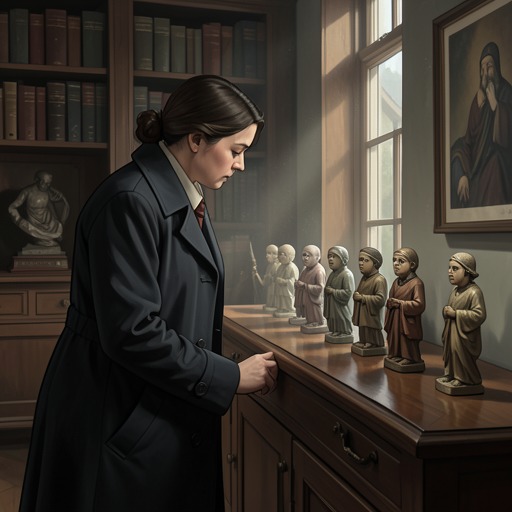
The stele’s images show the pharaoh’s army arranged in long rows, armed with spears, swords, and daggers. Beheaded enemies lie at the soldiers’ feet. Faced with this scene, the narrator wonders whether the Shabti Figures might rise not only in the afterlife, as expected, but whenever someone disturbs the tomb. The question links the depicted violence to a possible present danger, while leaving the threat uncertain at this point.
The words remembered from Amenemhab’s Art of War sharpen that uncertainty into a declaration of lasting vengeance: “But let them remember, to be afraid, even after his death.” The passage presents retribution as an extension of military power across time. His enemies are not simply defeated in the images; the writing insists that fear of him should continue after his death. The tomb’s art and text therefore work together: one shows the violence attributed to his army, while the other turns remembrance itself into a warning.
The Curse on the Heart of Egypt
A separate inscription makes the stakes of removing the Heart of Egypt explicit. It calls down “the agonies of a thousand deaths” on whoever takes the heart from the land, then names the punishments: pestilence, famine, and a destructive flood. The threat is not confined to the individual who commits the act. It spreads outward to the taker’s land and its people, turning the removal of the object into a national calamity.
The carved scenes give these words a human cost. One stele depicts emaciated people resembling the haunted faces the narrator has seen in Seven Dials; another shows people marked by pox and writhing on the ground. The inscription continues with disease and divine retribution, and concludes by demanding that the Heart of Egypt be returned to its rightful resting place. Its condition is precise: the devastation ends only when the object is restored. Amenemhab’s legacy thus binds the protection of the heart to an image of collective suffering, not merely to the defense of a tomb or its possessions.
The Tomb and Amenemhab’s Continuing Force
Amenemhab’s cache is encountered amid an active search through the tomb. The narrator finds piles of artifacts scattered across the ground, with only rudimentary sorting begun; the material is so extensive that examining it could take hours. The disorder conveys the scale of what remains to be understood, while the urgency of the search makes the cache more than a background collection. It is a repository of possible answers, including the knowledge needed to deal with the Heart of Egypt.
Across these appearances, Amenemhab’s military identity, written warnings, and burial legacy reinforce one another. His army’s violence is visible in the tomb; his text demands that fear survive him; and the curse threatens lands beyond the tomb if the heart is taken away. The character’s narrative significance lies in that posthumous reach. The surviving record makes the past an active participant in the present crisis, with the possibility of relief tied to obeying the demand preserved in his inscriptions: return the heart to its rightful resting place.