Bastet statuette
Theodosia and the Serpents of ChaosThe Bastet statuette is a black Egyptian cat figure whose curse first announces itself through Theodosia’s bodily dread, then appears as writing that moves across the surface in moonlight. Its danger lies not only in the magic it contains but in the possibility of redirecting that magic: Theodosia’s attempt to remove the curse instead transfers it to Isis, while the statuette is left looking peaceful.
Identity and Arrival
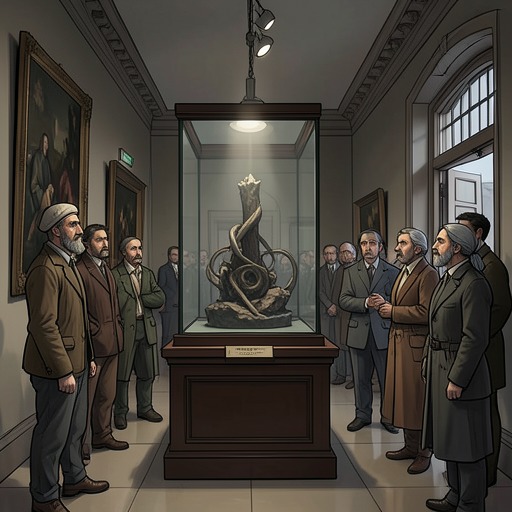
The artifact is introduced as an especially fetching black statue of Bastet, the Egyptian fertility goddess. It arrives in a crate sent by Henrietta Throckmorton, and Alistair Throckmorton lifts it out while trying to discover what the shipment contains. Theodosia has slipped a small protective amulet into his pocket, but the gesture does not prevent her immediate recognition that the new object is dangerous.
Her first warning is physical rather than analytical: looking at the statuette produces the sensation of icy-footed beetles marching down her spine. Isis, who had been hiding beneath the workmen’s bench, also reacts at once. After a loud meow, the cat bolts away. The two responses establish the statuette’s threat before anyone else in the room understands it; Nigel Bollingsworth asks whether Theodosia is cold, while Clive Fagenbush watches her suspiciously.
The object’s appearance therefore works in two registers. To the museum staff it is an attractive antiquity, but to Theodosia and Isis it is already a source of alarm. Her recognition that Henrietta Throckmorton has sent an artifact steeped in curses turns the crate’s unveiling into the beginning of an occult problem, not simply the arrival of a new museum piece.
The Curse Made Visible
The curse becomes legible in the workroom after dark. In pale moonlight, an intricate pattern of sacred words and symbols writhes across the statuette’s surface like restless vipers. The writing is not a fixed inscription that can be studied at leisure: it appears to move, and its changing visibility makes the object difficult to inspect safely. Theodosia has to draw near to identify the signs, although she knows that handling it will expose her to them.
Among the symbols she recognizes Anubis, the god of the underworld, and Seth, the god of chaos. Another sign seems to represent the demonic spirits of the restless dead. These discoveries rule out her hope that the curse might be relatively small. The statuette is saturated with Egyptian black magic, and the combination of divine and demonic signs gives its surface the character of an active threat rather than a merely historical decoration.
The danger is material as well as visual. Theodosia knows that gloves will not provide sufficient protection: the hieroglyphs seem capable of pushing through them and onto her hands. Her caution reflects the uncertainty she associates with Egyptian magic, whose spells may renew themselves after a full moon or become visible only under particular seasonal or astronomical conditions. The statuette’s moonlit writing makes that broader uncertainty immediate: seeing the curse does not mean controlling it.
Attempt to Remove the Curse
When Theodosia attempts a remedy, the statuette becomes the center of a carefully prepared transfer. She forms a small figure from collected wax scraps and carves the correct hieroglyphs into its base. The replica looks more like a slender tree trunk with ears than a cat, but its purpose is functional: the curse is supposed to leave the statuette for the wax figure, which Theodosia can then burn. She uses a rag to keep a barrier between her fingertips and the artifact.
The procedure depends on exact words and delivery as well as the right recipe. Theodosia believes the spoken part is working when the statuette begins to vibrate, the sulfur smell intensifies, and the hieroglyphs rise to the surface in a buzzing frenzy. As she dabs the potion onto the statue, the symbols shrink away from the treated places. By the time the potion runs out, they have diminished to half their original size, and the writing appears to pull itself free of the surface in response to her chanting.
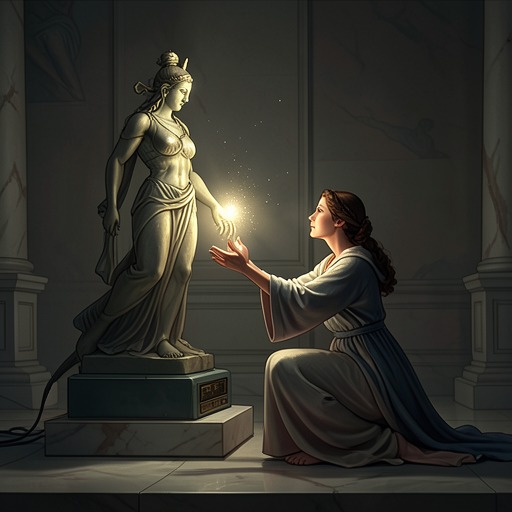
For a moment, the operation seems to follow its intended course. The hieroglyphs detach with dull pops and hover above the statuette like a swarm of angry bees, while Theodosia holds out her warded hands. But the sulfur fumes are overpowering, and Isis swipes at her ankle as Theodosia reaches the part of the words directed at the cat. Theodosia looks down to answer the interruption. That brief break in concentration is decisive: instead of streaming toward the wax figure, the symbols fly directly to Isis.
The transfer changes the cat almost immediately. The hieroglyphs dance along her fur; her eyes grow wild, her ears flatten, and she gives an unholy yowl. She is no longer behaving as Theodosia’s beloved pet but as a creature under the curse’s control. Isis swipes at Theodosia again, cutting through her woolen stockings and into her shin, then retreats beneath a bookshelf and continues to make low, demonic yowls. The episode recalls Nectanebus’s warning that concentration matters and distractions must be avoided, but recognition comes only after the crucial mistake.
Consequences and Significance
The statuette’s changed appearance provides a stark counterpoint to Isis’s condition. Once the symbols have transferred, the black statue sits as peacefully as before; the visible writing and its swarm have vanished from its surface. That calm is not evidence that the attempted rite went according to plan. The curse has moved, but it has reached the wrong recipient, leaving Theodosia to face the consequence rather than the resolution she intended.
Theodosia collapses into a chair, looks from the bookshelf where Isis is hidden to the now-quiet statuette, and realizes that the transfer must be reversed. The evidence here does not show the reversal itself, but it establishes the immediate problem that now governs her response: the cursed object appears settled while the danger has become a living, familiar animal. The statuette thus functions both as the source of the magic and as the first stage in its passage to another body.
Its role also depends on the difference between museum value and occult risk. Clive Fagenbush calls it an interesting artifact, says that Alistair Throckmorton has not noticed its disappearance, and admits that he has plans for it. His interest places the statuette in a conflict over possession as well as a struggle to contain its curse. Across its first appearance, moonlit revelation, and failed removal, the figure moves from collectible object to active magical instrument: its smooth, attractive form conceals writing that can leave its surface, evade protection, and turn a moment’s distraction into immediate harm.