Level Six
Theodosia and the Serpents of ChaosLevel Six is the hidden operations floor inside Society of Antiquaries' Somerset House: a modern, crowded workplace where antiquarian research, telegraph traffic, and practical responses to curses meet. Its disorderly desks and display of unusual objects make it both a center of organized work and a place where Theodosia can put her knowledge to immediate use.
Access and Arrival
Lord Wigmere takes Theodosia there through an unassuming entrance. They walk down a hall to a small, narrow door marked PRIVATE, NO ENTRY; he disregards the warning and goes inside, with Theodosia following. The room beyond is scarcely larger than a closet. Heavy curtains cover its east wall, concealing a flat metal door with no handle and only a seam down the middle. When Wigmere presses a wall button, the door opens to reveal a lift.
The lift makes the concealed arrangement feel less like an ordinary office and more like a deliberately hidden layer of the building. A man operates the control panel; at Wigmere’s request, he sends them to Level Six. The ascent or descent is described through its physical jolt: the world seems to fall away, and Theodosia’s stomach lurches. Gears grind as the lift arrives, and she is relieved to step onto solid flooring. The abrupt transition prepares a contrast between the cramped, secret entrance and the extensive working world beyond it.
The Operations Floor
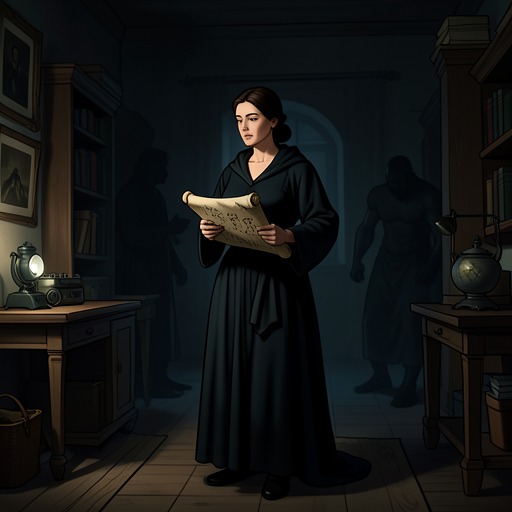
The first impression is of bustle on a scale that quickly eclipses the lift. Dozens of desks stand in tidy rows, but the rest of the room appears thoroughly untidy. Men work among old parchment, papyrus scrolls, and clay tablets; telegraph machines tap out messages while staff hurry past carrying files and books. The mixture of ancient materials and fast-moving communications gives the floor the character of a research library built for active operations rather than quiet reading.
The lighting reinforces that combination of old and new. There is not a gas lamp in sight: the room is lit electrically. Theodosia estimates that somewhere between twenty and thirty men are present, though their constant movement makes an exact count difficult. Worktables and workstations sit amid artifacts that seem to spill across the space, creating a disorder she finds delightful even as she notices the faint smell of curses lingering in the corners. Wigmere identifies the place with pride as the heart of his operations, while his brisk, limping pace carries him through a room Theodosia is eager to inspect.
Its objects are not merely archival. Along their route stand large quartzite basins and an enormous alabaster sarcophagus; nearby is an ordinary clawfoot bathtub filled with thick, reddish mud. The sudden shift from impressive antiquities to household plumbing captures the floor’s practical, improvised character: objects and materials are gathered not only to be studied, but also to be used.
A Workshop for Managing Curses
Wigmere explains that the mud comes from the Nile River and can sometimes absorb curses and nullify them. His question about what happens when a curse escapes an artifact and enters a person brings Isis to Theodosia’s mind. She answers evasively that such a thing has never happened, reasoning that Isis is not a person. The exchange shows that Level Six’s staff are thinking beyond cursed objects to the danger that their effects may spread to living bodies.
That danger becomes immediate when operatives drag an injured man from a small office toward the mud-filled tub. His hand is hissing, bubbling, and blistering up to the wrist, and the air carries the foul stink of sulfur. The staff submerge his arm in the Nile mud. As the blisters and boils continue upward toward his elbow, Lord Wigmere angrily challenges the operative’s failure to establish the nature or power of the cursed object before touching it. The floor’s role as an operational center thus includes the risks of investigation as well as the resources assembled to respond to them.
Theodosia intervenes with an amulet. Without touching the injured man’s skin, she loops its leather cord around his upper arm like a tourniquet. The curse surges against the boundary and retreats, then surges again and is repelled again. The amulet buys time, but Theodosia warns that it will not hold all day and calls for wax. Her knowledge of curse remedies turns her from a visitor observing the room into an active participant in its work. After she explains that an ancient writer’s account had led her to try the method, Wigmere acknowledges her quick thinking; once the operative is out of danger, he motions her toward the infirmary.
Place in the Story
Level Six gives a physical setting to the work that Wigmere has been inviting Theodosia to witness: an organization’s hidden operations, crowded with people, communications, research materials, and artifacts. Its concealed lift and guarded entrance separate that work from the visible corridors above, while the electric lights and tapping telegraphs make the secrecy compatible with modern administration. The floor is not presented as orderly mastery of the supernatural; its busy, jumbled character coexists with curses that can escape control and injure the people investigating them.
The response to the operative’s injury also makes the room a testing ground for Theodosia’s particular value. Nile mud is already kept there as a possible means of absorbing curses, but it does not by itself prevent the blisters from advancing in the scene. Theodosia’s amulet checks the curse temporarily, and her request for wax prompts the next step in the attempt to save the man. Level Six therefore joins institutional resources to improvisation: its significance lies not only in what it stores, but in how its staff and Theodosia combine what they know when a curse becomes bodily danger.