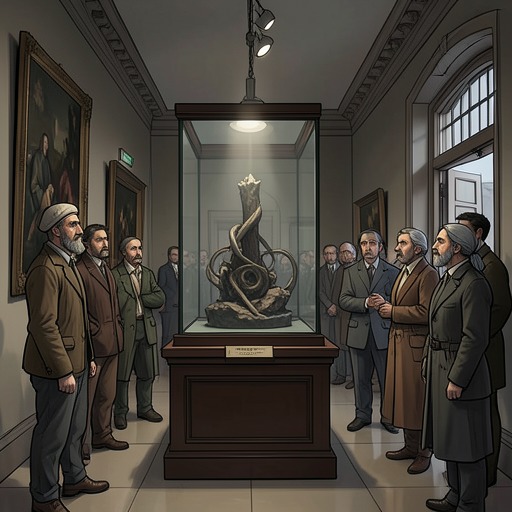
Lord Wigmere
Theodosia and the Serpents of ChaosLord Wigmere is the elderly head of the clandestine Brotherhood of the Chosen Keepers, a network of highly trained operatives whose work brings him into the struggle over the Heart of Egypt. Initially a formidable authority who weighs what to disclose and what to ask of Theodosia, he becomes her ally: he entrusts her with consequential missions, gives her a protective amulet, and ultimately makes her an honorary member of his society. His arc joins secrecy and national duty to a growing recognition that Theodosia’s knowledge and courage are indispensable.
Identity and Authority
Wigmere is older than Theodosia’s father, with a shock of white hair, a luxuriant white mustache, and deeply lined features. Theodosia notices a gold-and-lapis ring on the third finger of his right hand, its beveled surface carved with small hieroglyphs; it reminds her of a ring associated with Ramses H that she has seen in the British Museum. The ring makes his interest in ancient Egypt visible even before his role in the Brotherhood becomes clear.
His bearing combines physical frailty with command. He uses a cane and limps, but can move surprisingly quickly when events require it. His striking blue eyes seem deep to Theodosia, and his face appears to carry the weight of the world. At first, that impression is supported by his composure: while writing at his desk, he tells Theodosia he will attend to her in a moment, despite the urgent news she has brought. Yet when she reports that a stabbed man sent her with a message about forces and chaos, Wigmere snaps to attention and immediately demands to know where it happened. His calm is not indifference so much as the discipline of a man accustomed to assessing danger.
The Brotherhood and the Threat
Wigmere identifies himself as the head of the Brotherhood of the Chosen Keepers, a clandestine society of highly trained operatives. He is careful about what he reveals, but explains that events in Britain are serious and that Theodosia is involved. Her parents’ reputations, and the remarkable properties of artifacts her mother brings into the country, lead him to ask how many similarly powerful objects are in their museum. He also makes clear that he may need to draw on Theodosia’s talent.
His account of ancient magic places that talent in a wider historical frame. Wigmere distinguishes modern readers of ancient Egyptian texts, who merely copy what the texts say, from ancient Egyptians, who lived in closer contact with their gods. He does not treat this speculation as a solution to the immediate crisis; he turns back to practical action. The distinction nevertheless helps explain why he takes Theodosia’s abilities seriously rather than dismissing them as childish curiosity.
When the Heart of Egypt crisis threatens to intensify, Wigmere gives Theodosia a stark measure of the stakes: mishandled, the situation could topple the entire nation. He describes a period of danger lasting until the Brotherhood can sort out the crisis. The warning reveals the scale of his responsibility: he is not pursuing an isolated museum theft, but trying to prevent an artifact’s consequences from destabilizing Britain. Even as he issues orders for Stokes’s care, Wigmere hurries toward the lift, moving briskly despite his cane and the burden he seems to carry.
Missions, Judgment, and Protection
Wigmere’s trust in Theodosia takes concrete form when he asks her to perform another service for her country. After the Heart of Egypt has been recovered, he places it back in her hands and instructs her to return it to its rightful resting place in Egypt. The assignment is not a symbolic gesture: the Brotherhood has sent all its operatives to Germany in pursuit of Von Braggenschnott, whom it believes to have the artifact, and contacting those agents without exposing them would take weeks. With the organization’s capacity temporarily committed elsewhere, Wigmere relies on a child to carry out a task of national importance.
His judgment of Theodosia’s family is more painful. Wigmere tells her that the Brotherhood believes the theft of the Heart of Egypt was an inside job and fears her mother may have been involved. He immediately distinguishes suspicion of the act from blame of her mother: in his view, prolonged exposure to black magic in the pyramids has affected her. He compares that damage to a pudding left in the rain, gradually dissolved and pitted. The explanation does not erase the shock of his allegation, but shows Wigmere trying to account for a terrible possibility without treating it as deliberate betrayal.
He also gives Theodosia a tiny wedjat-eye amulet on a thin gold chain and insists that she wear it at all times, even if she must hide it beneath her collar. He describes it as very old and says it is rumored to have been fashioned by Horus and given to the first Egyptian king as a sign of divine favor. The instruction makes the gift more than an ornament: Wigmere places protection around Theodosia as he continues to depend on her in dangerous work.
Theodosia’s Ally and the Wider Conflict
After Theodosia’s Egyptian adventures, Wigmere visits her workroom, limping to a chair and asking to hear what happened. When she wonders how he entered the house, he explains that, as head of a clandestine society of highly trained operatives, he could make his way to her office. His actual method is deliberately mundane: he told the watchman, Flimp, that he was a doctor consulted by her parents. The exchange gives his secretive authority a dryly practical edge, while the visit itself shows that he wants a full account directly from Theodosia.
He listens intently, then reacts with anger when she confirms that the German operatives escaped. Wigmere suspects they had help, perhaps from nearby backup, but does not turn that suspicion into certainty. More importantly, he rejects Theodosia’s sense of failure. He tells her she has served her country in a time of great need and saved them all, while acknowledging that the fugitives’ unknown whereabouts remain a problem. His response recognizes both the success of her actions and the unfinished danger they leave behind.
Theodosia then gives him information that changes the scale of the conflict: Germany is only the beginning, and the Serpents of Chaos intend to plunge the entire world into disorder before dominating it. Wigmere admits that he knew the enemy had a grand design but did not know its nature. He calls her intelligence invaluable to the Brotherhood’s future efforts. The scene reverses their earlier relationship in a subtle way: Wigmere, who first assessed whether Theodosia’s talent might be useful, now depends on her understanding to see the full scope of the threat.
Recognition and Continuing Duty
Wigmere’s final recognition of Theodosia is institutional as well as personal. He tells her that the Brotherhood believes she has earned the right to become an honorary member because she has played her part. The honor does not end his practical concerns: the German operatives have escaped, and he says the Brotherhood will have to keep an eye out for them. Membership therefore marks not a retirement from danger but Theodosia’s acknowledged place in a continuing struggle.
His surprise when Theodosia asks whether honorary membership entitles her to one of the Brotherhood’s tattoos, followed by his amused refusal, briefly eases the gravity of their work. Across the novel, Wigmere remains the organization’s guarded commander, but his dealings with Theodosia move from cautious inquiry to reliance, protection, praise, and formal inclusion. The progression gives the Brotherhood a human face while establishing that its fight against the Serpents of Chaos will outlast the immediate recovery of the Heart of Egypt.