Stokes
Theodosia and the Serpents of ChaosStokes is Lord Wigmere’s operative in the struggle over the Heart of Egypt, an artifact whose disappearance draws him into a dangerous effort to prevent it from falling into hostile hands. His role is revealed through the consequences of that effort: he is badly injured, survives long enough to identify the man responsible, and later sits up in the infirmary while Lord Wigmere and Theodosia Elizabeth Throckmorton discuss the risks facing the Brotherhood. Stokes is thus introduced less through biography than through a sequence of evidence about his loyalties, vulnerability, and practical knowledge.
Role and the Heart of Egypt
When Theodosia first challenges Lord Wigmere about his associate, she describes a man who struck someone and took an object that did not belong to him. Lord Wigmere immediately asks whether Stokes obtained the Heart of Egypt. Theodosia confirms that he did, but explains that the men who attacked him took it away. This exchange establishes the central complication in Stokes’s part of the affair: he had the artifact, but possession did not secure it, and the attempt to protect it brought him into direct conflict with its pursuers.
Lord Wigmere’s response presents Stokes’s conduct as protective rather than acquisitive. He assures Theodosia that Stokes was trying to keep the Heart of Egypt from reaching the wrong people. The distinction matters because the initial account can make Stokes’s actions look like another theft in a confused chain of competing claims. Lord Wigmere’s explanation instead places him on the side of safeguarding the artifact, even though the operation has failed and the object has been taken again.
The stakes become visible when Theodosia reports that Stokes is down in St. Paul’s churchyard, badly injured and perhaps dead. Lord Wigmere does not leave the response to chance: he sends three men to fetch both Stokes and Theodosia’s brother, Henry, and directs that Stokes be taken to Level Six, where a doctor will be waiting. The arrangements show that Stokes is not a disposable participant. His organization moves quickly to retrieve him and secure medical care, while the simultaneous instruction to bring Henry back reflects the wider circle of people drawn into the incident.
Survival and identification
Theodosia later sees Stokes in the infirmary and is shocked by how unwell he appears. Her uncertainty about whether he is alive shapes the scene: Lord Wigmere sits beside the bed and calls to him, but at first receives no response. Stokes eventually makes a sound, confirming that he is still alive. The episode gives his recovery no easy or immediate triumph. Instead, it begins with silence and uncertainty, and makes even a small sign of response consequential to those waiting beside him.
When Lord Wigmere asks whether Stokes knows who attacked him, Stokes nods and, after gathering enough strength, names Von Braggenschnott. His answer is brief, but it changes what the injury means for the investigation: the assailant is no longer unidentified. Lord Wigmere recognizes the name with alarm, while Theodosia realizes that she has heard it before. Stokes’s identification therefore connects his personal ordeal to a larger threat already emerging around the Heart of Egypt.
The injury continues to shape Theodosia’s thoughts after the immediate crisis. While waiting and worrying about events elsewhere, she recalls the German attacker and the assault on Stokes, and tries to stop herself dwelling on the scene. That recollection confirms that Stokes’s condition remains a source of concern even when he is not present in the action. Later, however, he is sitting up in bed when Theodosia returns to Lord Wigmere’s rooms. The change from a patient whose survival is uncertain to a participant in conversation marks a clear, if limited, recovery; the evidence does not suggest that he has yet returned to field work.
Place in Lord Wigmere’s circle
Stokes’s connection to Lord Wigmere is both personal and operational. Lord Wigmere calls him his man, goes to his bedside, and responds to his injury by arranging medical help and personally seeking information from him. Their exchange in the infirmary is not merely a formal interrogation: Lord Wigmere waits for Stokes to become able to answer, and Stokes’s eventual identification supplies information that matters to the group’s understanding of the danger.
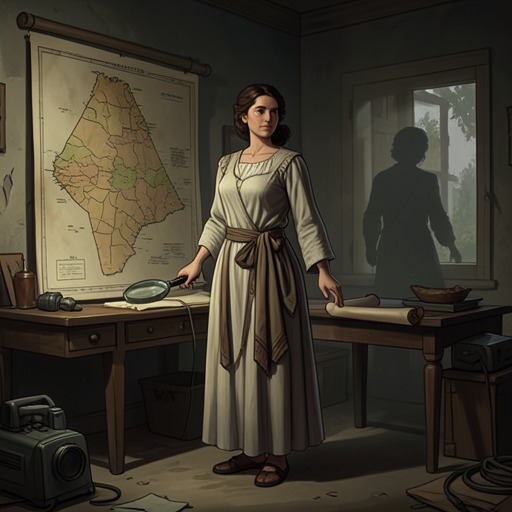
Stokes also appears alongside Lord Wigmere in the organization’s discussions with Theodosia. When she enters the room, Stokes is sitting up in bed beside a table spread with a large map and many small pins. The map establishes a practical, investigative setting, although the evidence does not specify what its markings represent or what task Stokes is performing. His presence nevertheless places him within the group’s continuing work even as he recovers. He is not simply the subject of the rescue; he remains part of the circle that is trying to understand and respond to the threat.
That membership also exposes the danger attached to the organization’s knowledge. Lord Wigmere warns Theodosia that confronting the men alone could lead to injury or death, while Stokes adds that capture could mean being forced to surrender secrets or betray colleagues and the organization. The warning gives Stokes a perspective grounded in the risks of operative work. His concern is not limited to the immediate struggle for an artifact: the group’s people and information are also at stake.
Safeguards and significance
When Theodosia suspects that the people around Lord Wigmere might themselves have been corrupted by the dangerous artifacts they handle, Stokes answers gently that the members wear protection at all times, that it is ingrained into their skin, and that they take additional precautions several times a month. His explanation presents protection as a continuing discipline rather than a one-time remedy. The wording offers no further account of how the safeguards work, but it does establish that Stokes regards them as essential to the group’s routine.
Theodosia does not accept the assurance without proof. She asks to see the protection for herself, treating Stokes’s claim as something to be examined rather than taken on trust. The exchange makes him an important source of information about the Brotherhood’s methods, but it also preserves the gap between what the organization asserts and what an outsider can verify. Stokes speaks as an experienced member; Theodosia responds as a cautious investigator.
Across these scenes, Stokes’s characterization is deliberately concentrated in acts and testimony. He tries to keep the Heart of Egypt from hostile hands, is taken out of action, identifies Von Braggenschnott when he can speak, and explains the protective practices and risks of the organization he serves. His recovery does not erase the cost of the attempt, while his survival ensures that the attack yields both a witness and a source of knowledge. Through Stokes, the struggle over the artifact becomes a human and organizational conflict as well as a contest over possession.