The Serpents of Chaos’ Program of Chaos
Theodosia and the Serpents of ChaosThe Serpents of Chaos’ Program of Chaos is a scheme to provoke a European war and exploit its disruption to capture world power. Its crucial distinction is between serving Germany and using it: the group intends to encourage the ambitions of Kaiser Wilhelm, draw a chain of rival nations into conflict, and act while their attention and strength are consumed by war. The confession to Theodosia connects that political design to the curses associated with Thutmose III and Amenemhab, making disorder both a geopolitical objective and a force already at work in the story.
A hidden power behind Germany
The plan becomes explicit when Theodosia asks why the conspirators are working for Germany. The answer overturns her premise: the speaker insists, “I'm not working for the Germans. I'm working for the Serpents of Chaos.” Germany is not the master of the arrangement but its instrument. The distinction makes the group’s allegiance less a matter of national loyalty than of opportunity: it will cooperate with a state whose ambitions can be directed toward a much larger crisis.
When Theodosia asks why the group has chosen Germany rather than Britain, von Braggenschnott makes the arrangement’s logic plain: “We aren't working for Germany. We are letting Germany work for us.” The group’s apparent partnership with the German cause is therefore a means of concealment and leverage. It considers Kaiser Wilhelm’s ego and expansive ambitions useful because they can propel Germany into confrontation without requiring the Serpents of Chaos to openly command it. The scheme relies on a powerful actor believing that its own national interests are driving events.
This is a strategy of manipulation, not simply alliance. The Serpents of Chaos need Germany to act forcefully, but they describe themselves as the hidden beneficiaries of that action. The distinction also explains why their purpose cannot be reduced to ordinary competition between Britain and Germany: weakening one nation is only an intermediate step toward taking advantage of a crisis that will engulf many nations.
How the war is meant to spread
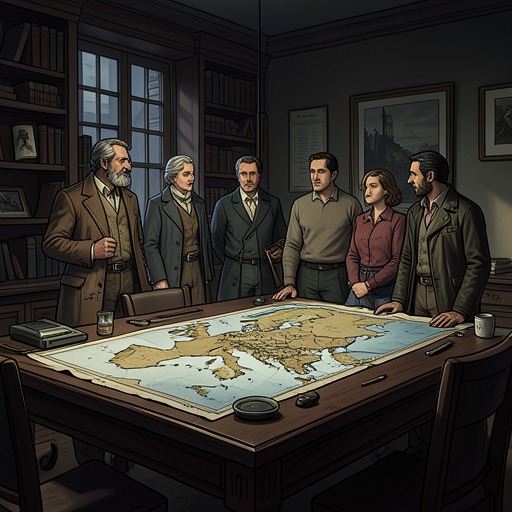
Von Braggenschnott describes a chain reaction beginning with Germany putting Britain under pressure. He expects Britain to become defensive and make hasty decisions; Austria will then support Germany, Serbia will feel threatened, France will stand by Britain, Russia will join, and Italy will be drawn in as well. Each country’s response becomes the condition for the next. The imagined war is not presented as one isolated declaration or a single decisive battle, but as an escalating sequence of entanglements in which one power’s involvement makes another’s involvement seem necessary.
The progression gives the plan its scale. Germany’s conflict with Britain is the opening move; the Serpents of Chaos expect alliance and counter-alliance to widen it until “All of Europe will be barking and snapping at each other's necks like rabid jackals.” The animal image compresses the group’s political vision into a picture of contagious aggression: states that might otherwise act independently become absorbed in a collective struggle. The group intends to make that struggle the cover for its own movement.
The intended opportunity comes while the nations are occupied with one another. Von Braggenschnott states that the Serpents of Chaos will “slip in, unobserved, and seize the tattered reins of world power.” The language joins concealment to appropriation: the group expects not to win power through open military leadership, but to take control when the existing order has been damaged and attention diverted. The plan’s ambition is accordingly greater than victory for Germany or defeat for Britain; its proposed result is a transfer of power on a global scale.
Ancient Egypt and the timetable
The conspiracy’s political design is joined to the story’s Egyptian magic. When Theodosia interrupts the description by identifying the objective as “Chaos,” von Braggenschnott agrees and asks where the group can find the powers it needs. His answer is ancient Egypt, where, he says, chaos is “merely a curse or two away.” The phrase makes the supernatural dimension part of the program’s practical calculation: curses are not incidental horrors but forces the conspirators believe can help create the conditions for their political scheme.
He claims that the plagues of Thutmose III and Amenemhab have already fallen upon Britain and that Britain has begun to weaken. According to his account, Britain will be forced within days to sign a treaty that serves both Germany’s ambitions and those of the Serpents of Chaos. This is the conspirator’s explanation of how magical affliction and political pressure fit together: the curses weaken Britain, the treaty advances the immediate German interest, and the larger war is meant to grow out of the resulting imbalance. His confidence and compressed timetable reveal how close he believes the plan is to its intended turning point; they do not, by themselves, establish every prediction as fact.
The Egyptian element therefore gives the conspiracy a second register of power. The Serpents of Chaos aim to manipulate states and their rivalries, but von Braggenschnott also presents curses as a way to alter the balance on which those rivalries depend. Ancient Egyptian forces are folded into a modern political crisis, so that the threat to Britain is at once national and supernatural. In the villain’s account, neither kind of power is sufficient alone: the magical weakening is supposed to assist a political sequence that can then spread beyond its original target.
Exposure and the meaning of chaos
The program is revealed in a confrontation in which Theodosia questions von Braggenschnott about his allegiance and purposes. She asks whether Britain could pay the group as much as Germany, then presses him to explain what the group actually wants. Von Braggenschnott answers at length, converting what might have appeared to be German collaboration into a declared project of deliberate, continent-wide disorder. The exchange makes Theodosia’s questions the means by which the hidden design is exposed to the reader.
The plan turns on a contrast between visible conflict and concealed intention. Germany is supposed to appear as an actor pursuing its ambitions; the Serpents of Chaos expect to remain unobserved behind the resulting struggle. What looks like a contest between nations is, in their design, a diversion that will let them seize power. Their term “Total chaos” names both the condition they intend to produce and the cover under which they expect to act.
The scheme’s scale also sharpens the stakes of the Egyptian curses. Von Braggenschnott does not describe them as an end in themselves, but as part of a wider attempt to make political order collapse across Europe and open the way to the group’s rule. His account is a villain’s explanation of his own intentions, and the distinction matters: it establishes what the Serpents of Chaos say they are trying to accomplish, rather than proving that every stage of their forecast will unfold as predicted. What it does establish is the governing logic of the program: provoke conflict, let it widen through the actions of rival powers, and use the resulting disorder to make a concealed seizure of authority possible.