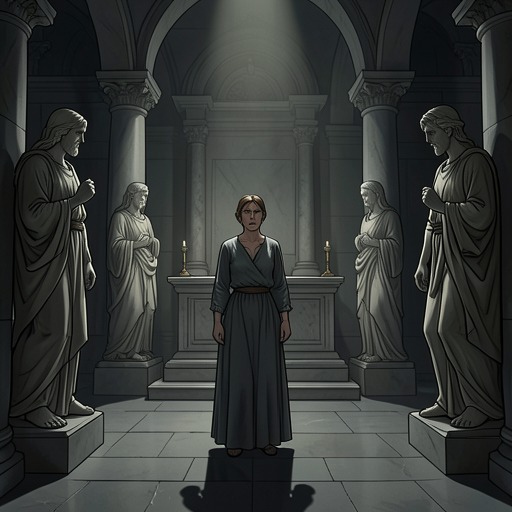
The return of the Heart of Egypt and the tomb confrontation
Theodosia and the Serpents of ChaosThe confrontation in Amenemhab’s tomb brings Theodosia’s pursuit of the Heart of Egypt to its decisive turning point: trapped by the men seeking the relic, she uses the tomb’s magic to fight back, then restores the Heart to the wall where it belongs. The same struggle exposes a previously unknown annex and brings the Was scepter to light, joining an immediate fight for survival to Theodosia’s first discovery as an archaeologist.
The Execration Figure and the First Reversal
Three men have Theodosia cornered, and Von Braggenschnott warns that she cannot escape; if she refuses to cooperate, he will have her sealed inside a sarcophagus. With no weapon at hand, she searches the altar and finds small figures made of wax and clay. One has bits of hair protruding from it and a fragment of ancient papyrus bearing writing. Recognizing it as an execration figure, she sees a chance to use its magic against the men, even if she can only slow them down.
The figure offers a weapon, but not a simple one. Theodosia scratches into the wax a symbol to invoke power and another to smite her enemies. To make the spell work, she must also identify her targets correctly. She is nearly certain that the man doing the talking is Von Braggenschnott, and suspects one of the others is Tetley, but suspicion alone is not enough. The scene makes knowledge part of the danger: the magic depends not only on courage, but on naming the enemy accurately.
When Tetley appears beside an Anubis statue, Theodosia finally has the certainty she needs. She moves around the statue and toward a funerary chariot, buying a little time while she carves Tetley’s name into the wax figure and whispers the execration rites. His head reappears just as she finishes the final hieroglyph. With the men closing in and only one route left open, she runs for the back wall, carrying the figure—and the possibility of turning the pursuit against its pursuers—with her.
The Figure Turns Pursuit into Counterattack
Tetley emerges from behind the funerary chariot and advances on Theodosia, wearing a smile that reflects his anger at the trouble she has caused him. With no time to test the spell by any gentler means, she waits until he has taken two more steps, grips the wax figure’s left leg, and chants the ancient words of power as she snaps it off. Tetley screams and clutches his own left leg as it folds beneath him. Theodosia breaks the figure’s right leg as well; Tetley howls and crumples to the floor. The little image has turned the pursuer’s body into the spell’s target, buying her a moment against the men who had cornered her.
Bollingsworth moves toward her, but von Braggenschnott holds him back. When the struggle brings von Braggenschnott close, Theodosia twists around and flings sandstone dust into his face. Its effect is far worse than ordinary grit: it eats into his skin like burning acid, leaving small pits and lines and burning flecks around his left eye. Blinded and screaming, he lunges in her direction. Theodosia throws herself backward into the wall; it gives way, and she falls through an opening into a long, narrow shaft. The fall leaves her dizzy and disoriented, but the startled shouts from above mean that, for a few minutes, her attackers have lost the advantage.
At the bottom, Theodosia finds herself in a narrow corridor, about ten feet long, which opens into what appears to be an old, cluttered closet. The incongruity supplies the clue: Egyptian tombs do not have closets, so the space must be something else. She recognizes that she has discovered a previously unknown annex to Amenemhab’s tomb—her first archaeological discovery. The reversal is immediate but precarious: the fall has carried her out of the attackers’ reach for the moment and into a discovery, while the corridor noises grow louder and leave her little time to find a plan.
The Heart Returns to Its Place
The corridor offers Theodosia no lasting refuge. As she searches the wall for another way out, her hand catches on a sharply cut indentation; its outline is exactly that of the Heart of Egypt. The shape makes the answer clear before she has time to act on it. Von Braggenschnott appears only ten feet away, and the Heart has slipped from beneath her collar during the struggle. When he reaches for its chain, she tears it from her neck and thrusts the relic toward the matching hollow in the wall.
Von Braggenschnott tackles her knees, knocking her down, and she is left with a useless left arm and pain so fierce she can barely think. While he scrabbles to pull the Heart free, the chamber changes around them: magic thickens in swirling eddies, the smell of frankincense rises, and the stone glows with a warm inner light. The flare lasts only a second. When it fades, the wall has closed around the Heart, seated in the place its outline was made to receive—and Von Braggenschnott’s hand is trapped against it. The restoration is at once a reversal of the theft and a physical restraint on the man trying to take the relic again.
The return gives Theodosia a moment to escape, but not a clear path. Bollingsworth is at the corridor doorway, his face badly injured by the sandstone and a knife in his hand. Theodosia grabs a stick and swings upward, knocking the knife away; on the return swing she strikes Bollingsworth on the head. He drops, and the force of the blow sends another wave of pain through her shoulder. Von Braggenschnott accuses her of killing him, but she cannot tell whether Bollingsworth is dead and recoils from the stick as though it were responsible for the violence.
The weapon itself yields another discovery. As it hits the ground, its wooden casing breaks into chunks, exposing gold beneath. Theodosia kicks away the remaining pieces and uncovers a long gold staff: the Was scepter. In the same chamber, the attempt to restore the Heart has ended Von Braggenschnott’s immediate chance to remove it, while the struggle has brought an ancient object concealed inside a stick into view. The confrontation’s discoveries are not separate from its danger: the Heart’s rightful place becomes apparent as Theodosia fights to survive, and the scepter emerges only after the final blow leaves her shaken and unsure of its consequences.
Recognition and Rescue
Theodosia’s discovery is recognized as she is reunited with her parents. Henrietta reaches the bottom of the ladder, hurries to Theodosia, takes her face in her hands, and kisses both cheeks. Theodosia is still holding the Was scepter, and has to take care not to strike her mother with it.
Alistair first notices the object Theodosia is carrying. Henrietta identifies it as the Was scepter, and Alistair praises his daughter’s achievement before turning his attention to her injuries and asking to see where she has been hurt. The scene brings the confrontation back from the tomb’s violence to family care: Theodosia emerges not only with the Heart returned to its place and a major archaeological discovery, but visibly injured and still in need of help.