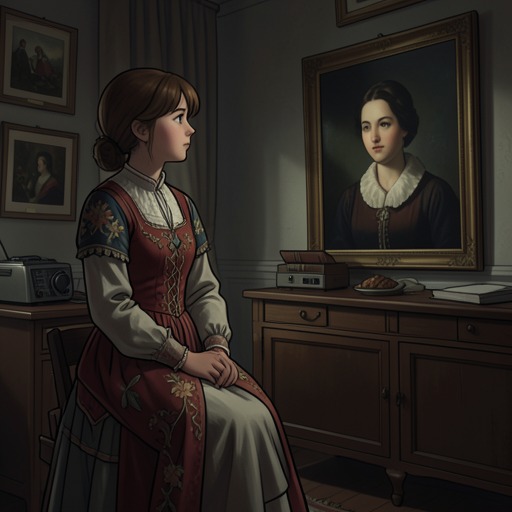
Theodosia and Henrietta Throckmorton's relationship
Theodosia and the Serpents of ChaosThe relationship between Theodosia and Henrietta Throckmorton is tested when suspicion turns an archaeological theft into a question of whether a daughter can trust her own mother. Lord Wigmere raises the possibility that Henrietta was compromised by prolonged exposure to black magic, and Theodosia finds herself entertaining doubts she had not wanted to have. The evidence also shows her watching, questioning, and testing Henrietta—not simply accepting the accusation, but not yet able to dismiss it either.
A Suspicion Entered into the Family
Lord Wigmere tells Theodosia that an inquiry has led the Brotherhood of the Chosen Keepers to suspect an inside job in the theft of the Heart of Egypt. The possibility he raises is not that Henrietta knowingly stole it: he says the theft is not her doing, and instead attributes the danger to the black magic she may have encountered throughout her adult life. His explanation rests on her work in the pyramids, where he says she spent month after month among artifacts in an undisturbed state. He compares the effect to rain dissolving a pudding, leaving pits and fissures behind. The image makes his allegation intimate as well as alarming: the suspected damage is not confined to an artifact or a distant excavation, but may have altered the person Theodosia knows as her mother.
Theodosia’s reaction unfolds beyond the room where Wigmere makes the claim. Walking home in the rain, she recalls that Henrietta knew von Braggenschnott and had said he helped her get the Heart of Egypt out of the country. Theodosia recognizes that this connection proves nothing by itself; she can imagine another explanation, that von Braggenschnott wanted a British citizen to bring the curses back to British soil. But Henrietta’s apparent lack of concern when Theodosia reported seeing a man follow her at the station now seems newly significant. Theodosia also remembers that her mother was a wonderful actress, a thought that turns even familiar confidence into a possible reason for doubt. Her horror lies in recognizing how far suspicion has travelled: Wigmere has not merely accused Henrietta; his explanation has begun to shape Theodosia’s own reading of her.
Watching and Testing
At dinner, Theodosia repeatedly looks at Henrietta, trying to detect a sign of the corrosion Wigmere described. The scrutiny is difficult to separate from ordinary change: Henrietta has been away for a long time, and Theodosia knows she may have changed without knowing whether any difference has to do with betrayal. When Alistair Throckmorton notices the staring and snaps at her, Theodosia drops her fork, scattering peas across the white tablecloth. The small domestic mishap occurs amid a larger strain: Alistair is already in a bad mood because the Heart of Egypt is missing, and Theodosia believes that keeping the secret will not make him any happier. Her silence therefore places her between a troubled household and a suspicion she has not resolved.
After dinner, Theodosia asks Henrietta when she expects to return to Egypt. Alistair objects that Henrietta has only just come back, while Theodosia presents the question as a way of planning her year. The exchange gives her a chance to test her mother without openly repeating Wigmere’s accusation. It also shows how suspicion changes the ordinary terms of their relationship: a question about travel becomes an attempt to read Henrietta’s intentions, while Theodosia’s stated reason conceals what she is actually trying to learn.
Theodosia later redirects Henrietta’s attention to a stele she has been studying. She points out that Henrietta brought home nearly everything depicted on it, and Henrietta acknowledges the observation, praising Theodosia for working it out. The artifact provides a shared subject that briefly replaces scrutiny with an exchange grounded in their archaeological knowledge. Yet Theodosia has introduced it while anxious to get Henrietta’s concerns off her, so even this moment of recognition sits within the larger effort to manage what her mother notices.
The Was Scepter as a Test of Allegiance
Theodosia then recounts a conversation she and Henry Throckmorton overheard at Alistair’s British Museum. Lord Snowthorpe was discussing an expedition to find the Was scepter and treating it as nearly as valuable as the Heart of Egypt. Theodosia does not offer this as neutral news: she has watched Henrietta and now uses the rival expedition to provoke a response. Henrietta rises in indignation, insisting that the dig belongs to their side and that outsiders cannot simply barge in because they want something. Her anger supplies Theodosia with a different kind of evidence from Wigmere’s theory of corruption. It reveals, in the moment, Henrietta’s forceful attachment to the excavation and its claim against interference.
Theodosia presses the point by asking whether that has ever stopped the rivals before. The remark turns the conversation toward the recurring contest over who may control access to the dig. It also leaves Henrietta responding as an archaeologist defending her work, rather than as a suspect answering a direct accusation. Theodosia has not announced her doubts or obtained a definitive answer to them; instead, she arranges a conversation in which her mother’s priorities can show themselves through a subject they share.
Trust Under Pressure
These encounters establish neither a simple return to unquestioning trust nor proof of Henrietta’s guilt. Theodosia has reasons to be unsettled: Wigmere’s account offers a supernatural explanation for how long exposure might affect Henrietta, and details from the past acquire a more suspicious cast once she hears it. At the same time, Theodosia distinguishes association from proof. Henrietta’s knowledge of von Braggenschnott and her response to the station encounter trouble her, but do not settle the question; her mother’s apparent distress at the theft remains part of what Theodosia must weigh against the possibility of deception.
The relationship is therefore shown through acts of interpretation. Theodosia watches at dinner, asks about a return to Egypt, redirects attention to a stele, and raises the Was scepter expedition. Each action offers a different route to understanding Henrietta without making their private family bond disappear beneath the investigation. The evidence leaves the doubt active: Theodosia has begun to suspect her mother, and the domestic conversations have become tests, but Henrietta’s reaction to the threatened dig also makes clear that she remains deeply engaged with the work they share.