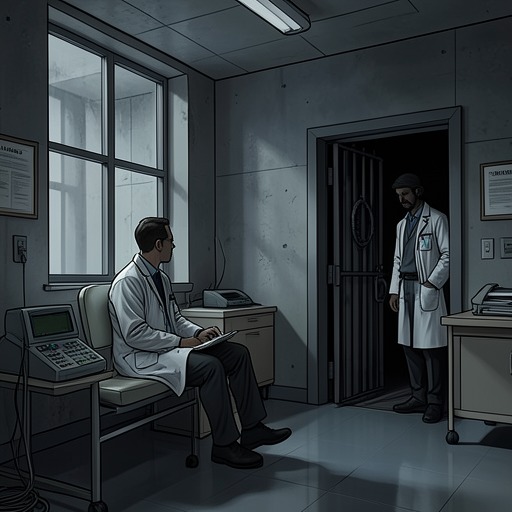
“There will be a bus full of dead kids and kids with brain damage, and that bus is going to have their name on the side.”
This Is Going to HurtThe expression imagines a bus full of dead or brain-damaged children bearing the names of the doctors connected with their care. A senior doctor uses the image to tell students that such a record of harm may accumulate over a medical career, and warns that those unable to live with that possibility are in the wrong job. Its significance in the memoir sharpens after a birth in which the baby dies and the mother suffers a life-threatening crisis: the narrator has been told that he did nothing wrong, yet experiences the event as a personal failure and cannot simply resume his former way of working.
The warning and its image
The senior doctor tells students that “there will be a bus full of dead kids and kids with brain damage, and that bus is going to have their name on the side.” The image makes an abstract occupational risk concrete: the bus stands for the patients harmed or lost over time, while the names on its side make clinicians’ responsibility visible. It is not presented as a prediction of one particular accident. Rather, the warning asks future doctors to contemplate the cumulative burden of outcomes they may not be able to prevent.
That formulation also holds a tension between responsibility and control. The doctors’ names appear on the bus, but the memoir’s central crisis is one in which the narrator says he followed the rules and that other doctors would have acted as he did, with the same result. The warning therefore speaks to the moral weight clinicians can carry even when an outcome does not follow from a breach of duty. Its bluntness offers no promise that competence or good intentions will spare them from grief, regret, or the possibility of imagining what might have gone differently.
Humor beside risk
The warning belongs to a memoir that repeatedly uses jokes to handle the absurdities and pressures of medical work. An early patient dies after a sudden emergency, and the narrator’s account mixes his uncertainty about what to do with an incongruous comparison to a home-renovation television programme. In another episode, an alarming-looking result is traced to a patient having eaten two large jars of beetroot; the specialist doctor jokes that the narrator should taste the contents before referring a similar case. Such episodes make clinical uncertainty comic without making every danger harmless.
The contrast is especially clear in a patient-safety meeting. Staff are told that a patient’s healthy left kidney had been removed and that British surgeons had drilled into the wrong side of patients’ skulls fifteen times in three years. The narrator jokes about a patient with an arrow tattoo on the wrong leg; the hospital subsequently tells staff to cover such a tattoo and draw a new arrow on the correct side. Humor here sits beside serious procedural safeguards, and can even expose a practical detail that management adds to the rules. The bus warning is different in scale and effect: it does not turn a mishap into a punchline, but makes the possibility of cumulative tragedy impossible to dismiss.
The crisis that gives it force
The saying appears in the narrator’s reflection on a devastating birth. The baby dies despite efforts to save it, and the mother loses a life-threatening amount of blood before senior staff intervene and she is moved to intensive care. As the person others turn to on the ward, the narrator begins to write his notes but instead cries for an hour. Colleagues tell him that it was not his fault and that he could not have done more; he nevertheless keeps returning to what might have happened differently and concludes that he failed.
The warning illuminates why reassurance alone cannot settle that conflict. The narrator had seen patients and babies die before, but says this was different because he was the most senior person present and felt answerable to everyone looking to him. He had not broken a rule, yet could not accept that the same outcome would have followed from another doctor’s actions. The bus image gives institutional form to that burden: the name on the side represents an association with the loss, whether or not the individual doctor could have prevented it.
The cost of carrying on
After the crisis, the narrator returns to work the next day and changes his practice. If a baby’s heart rate falls even slightly, he decides he will perform a caesarean section, knowing that some women will undergo operations they do not need. He explains this choice as a way of trying to ensure that everyone leaves the room alive. The memoir shows how the fear represented by the bus can shape care: an experience that cannot be undone produces a more interventionist approach to future risk.
But returning to work is not the same as recovering. The narrator says that in the following six months he does not laugh, that his smiles are not real, and that he is broken by the experience. He says he should have been able to talk to someone and that the hospital should have ensured he received help, but describes a code of silence that keeps support from those who need it. Staff are kind, yet the rota leaves little room for absence and everyone still expects him to come in the next day. The senior doctor’s warning that those unable to deal with such outcomes are in the wrong job thus sits beside the narrator’s account of a workplace that expects doctors to endure them without adequate space to recover. He considers asking to work part-time and thinks about retraining as a general practitioner, but neither offers a clear way out: part-time work is refused unless he is pregnant, and retraining would mean starting again. The saying becomes more than a caution to students; it frames the cost of a profession in which the possibility of future tragedy is treated as inevitable, while the means of coping with it remain uncertain.