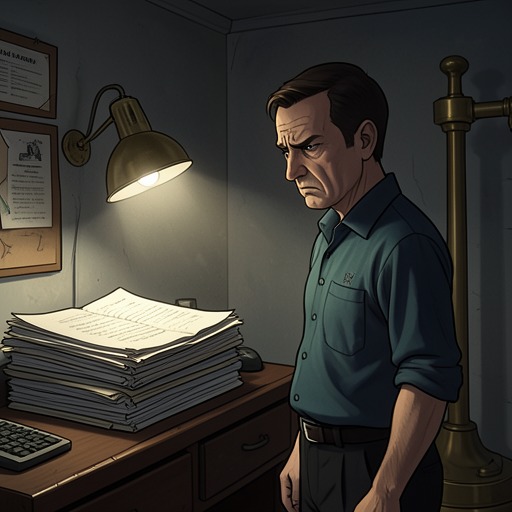
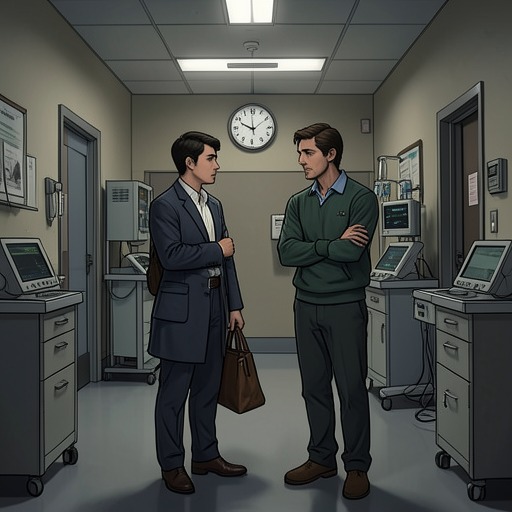
Adam Kay and H
This Is Going to HurtAdam Kay and H’s relationship runs alongside Kay’s early years as a doctor, and its history is told less through declarations than through the plans work interrupts: a packed lunch on his first day, Christmas postponed until a day off, an anniversary holiday compromised by the rota, and an overdue Valentine’s dinner. By November 2010, Kay is cancelling even the task of collecting his belongings from their home. The diaries make the pressure on their partnership visible in repeated, specific losses, while leaving the full circumstances of their breakup unstated.
Beginning and everyday care
On Kay’s first day in the National Health Service, H is already his partner and makes him a packed lunch. The entry places an intimate, practical gesture beside the new equipment and email address that mark his arrival at work. The lunch is a small sign of ordinary support at the threshold of an unfamiliar professional life; the later diary entries show how little room that life would leave for ordinary shared time.
The Christmas period offers an early measure of the intrusion. After a shift, Kay falls asleep and wakes in the hospital car park, having effectively remained at work. He finds eight missed calls from H and a Christmas text with no kiss. The diary does not explain H’s feelings or the calls’ purpose, but the details register a holiday passing at a distance. Kay says they will celebrate Christmas on his next day off, 6 January, and tries to make the delay sound cheerful by imagining how cheap the crackers will be. The joke acknowledges the absurdity without changing the arrangement: even a shared celebration has to fit around his work.
Plans repeatedly displaced by work
In July 2008, as their fifth anniversary approaches, Kay looks forward to a two-week holiday with H on a beach far from the labour ward. He also hopes he has not forgotten how to be in a relationship sustained by text messages saying sorry. That hope makes the holiday more than a break: it is a chance to be together beyond brief communications and workplace demands.
The chance is compromised by an email requiring Kay to work the middle weekend of the trip. No colleague can swap with him. He knows other doctors have returned early from honeymoons or missed family funerals, and reports that the proposed solution is for him to travel 6,000 miles back to England for the weekend. His account shows the imbalance between a plan made by a couple and a rota that appears immovable. The holiday is not simply shortened in the diary; the proposed return journey makes clear how completely work claims the right to interrupt it.
There are moments of reunion, but their scarcity is part of the pattern. On Valentine’s Day 2010, Kay says it is the first time in four years that he and H have spent the day together. He jokes that dating a doctor is like having a birthday on 29 February. They go to a Thai restaurant, where a wooden box contains two heart-shaped sweets; Kay eats his whole before discovering it is a candle. The comic mishap gives the evening a particular, affectionate detail, while the four-year interval behind it explains why this ordinary date feels exceptional.
The wider cost of a rota
The diaries place H’s experience within a broader pattern of work displacing personal commitments. In 2005, Kay cancels Ron’s stag do at the last minute despite trying to arrange a shift swap. He loses the £400 he had paid and will never wear the T-shirt printed with Ron’s face. Five years later, Ron tells him that work has also kept him from the first half of the wedding, his father’s funeral, and his daughter’s christening. Kay admits that he has been a poor friend, even as he insists that the job is exceptionally busy and does not stop.
This parallel does not make H’s experience identical to Ron’s, but it shows that the interruptions are not confined to one relationship. Kay’s schedule repeatedly turns advance plans into cancellations, leaving the people close to him to absorb the consequences. His own account of the anniversary holiday captures the same mechanism more directly: even a long-planned trip can be broken into pieces by a demand for cover. The private cost is cumulative, and an apology by text cannot restore the time that the rota takes away.
Breakup and the unfinished account
On 18 November 2010, Kay is meant to finish at 7 p.m. but leaves the labour ward at 9:30. Because of work, he has to text H to cancel picking up all his belongings from the house. In the same entry, he states that they have broken up and that he is living in a tiny flat, only ten minutes from the hospital. The proximity is practical rather than restorative: the diary records a new living arrangement organized around access to work, not a reconciliation.
The entry does not identify a single cause for the breakup or describe H’s perspective. Its placement nevertheless connects the separation to the recurring conflict documented across the relationship: work takes the time intended for shared holidays, celebrations, and even the transition out of a shared home. That connection should not be mistaken for a complete account of why they separated. What the record establishes is narrower and stark: after five years together, Kay’s work still determines when he can leave, and a late shift prevents him from collecting his things on the day he planned.
Significance in the diary
H’s role in these entries is both personal and structural. The packed lunch, delayed Christmas, rare Valentine’s dinner, and cancelled holiday give the relationship concrete moments of care and anticipation; missed time and apologies show how those moments are repeatedly subordinated to hospital work. The contrast between the couple’s fifth-anniversary plans and the rota’s demand for a weekend shift makes the conflict especially legible without turning H into a mere symbol of Kay’s private life.
The diary offers no tidy resolution and no account of what followed the breakup. Instead, the relationship’s ending appears within a sequence of ordinary logistical failures: a shift that cannot be exchanged, a celebration moved months beyond its date, and a late departure from the ward that cancels one last errand. The partnership’s significance lies in that accumulation. It reveals the personal cost of a working life that repeatedly treats time outside the hospital as available to be reclaimed.