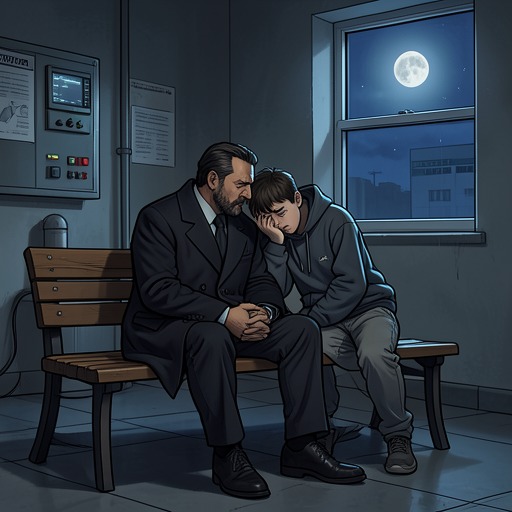
Adam Kay intervenes in Simon’s suicidal crisis
This Is Going to HurtAdam Kay’s intervention in Simon’s suicidal crisis begins not in a clinic but on Facebook during a quiet night shift. A farewell post prompts Kay, who barely knows Simon, to reach out; a two-hour phone call ends with a plan to get Simon to his mother’s house and see his GP. The encounter becomes an ongoing, informal helpline, showing how a doctor’s impulse to help can extend beyond the ward while leaving him anxious about the limits of what he can offer.
The post and the first response
On Monday, 3 April 2006, Kay’s night shift is unusually quiet. He spends part of it looking through Facebook profiles, initially in the vein of his dry, self-mocking account of checking whether former partners are unhappy without him. Then a post appears from Simon, the younger brother of one of Kay’s school friends. Its farewell wording—“Goodbye everyone. I’m done.”—makes the possibility of immediate danger impossible for Kay to ignore.
Kay thinks that, at two in the morning on a Monday, he may be the only person reading the post. Although he does not know Simon well, he sends a private message asking whether he is all right. He tells Simon that he is awake, identifies himself as a doctor, and gives him his mobile number. The response is direct and personal: rather than passing the message on or waiting for someone else to act, Kay makes himself reachable.
Simon calls. He is drunk and crying, and explains that he and his girlfriend have just split up. The breakup supplies the immediate circumstance of the crisis, but the account does not claim that Kay knows the full extent of Simon’s distress or can assess it with specialist expertise. Kay admits that his training in this area is minimal. What he has to work with is the fact that Simon trusts him enough to talk.
A two-hour conversation and a practical next step
The call lasts two hours. By the time they hang up, Simon has agreed to take a taxi to his mother’s house and see his GP in the morning. Those concrete arrangements give the conversation a direction beyond reassurance: Simon will not be alone at home, and professional help is part of the plan for the next day. The account does not describe a formal intervention or suggest that Kay provides treatment; it records a conversation that helps Simon reach those immediate steps.
Kay describes feeling the rush that follows a medical emergency. He is tired, but positive, and believes he has done something good. The encounter stands out against the ordinary work of the shift: he thinks he may have made more of a difference to Simon than to any of his patients that night. The contrast gives the episode its force. A message read in private on a social network leads to a crisis conversation whose significance, for Kay, feels more immediate than the clinical work around him.
The night does not end with that call. At five in the morning, Kay answers a call from the ward and goes to see a pregnant woman with a mild rash. She assumes he will be less busy than he would be later in the morning. This brief return to routine places the emotionally charged conversation beside the demands of a working night shift: the doctor who has just spent two hours listening to Simon is still expected to respond to patients on the ward.
From one call to a recurring helpline
By Saturday, 7 October 2006, Kay says he has spent six months as Simon’s mental-health helpline. From the first Facebook post onward, he has told Simon to call whenever he starts to worry, and Simon does. Kay has also repeatedly urged him to keep seeing his GP, but Simon does not seem to follow that advice. The support therefore recurs without becoming a substitute for the professional care Kay recommends.
The arrangement brings its own strain. Kay does not know when the phone will ring with bad news, and the uncertainty feels too much like being at work. He recognizes that Simon could receive better help from someone who did not have to search online for what to say to a person who wants to die. Still, Kay judges that talking to him is better than nothing, and is glad Simon is still alive. A missed call can make him panic: he fears that if he calls back too late, Simon may have killed himself, and wonders whether that would make him responsible. The diary makes visible the burden contained in the promise to be available at any time.
That evening, Kay and Simon speak again. Kay listens and tells him that the way he feels will pass. Their conversation seems to repeat the same pattern, but repetition does not make it meaningless: Kay understands that Simon wants to know someone cares. His reflection locates the help not in a single decisive solution but in the continued act of listening and answering. The crisis becomes an ongoing relationship of support, even though Kay cannot ensure that Simon follows every recommendation or promise a lasting recovery.
Informal care and its limits
The episode shows Kay acting at once as a doctor and as a person connected to Simon through a school friendship. He invokes his medical status when he first contacts Simon, yet candidly acknowledges that he lacks the relevant training. His mobile number and willingness to listen open a route to immediate human contact; the GP remains the professional help he urges Simon to seek. The account preserves that tension rather than presenting Kay as either a trained crisis specialist or a complete solution to Simon’s distress.
Elsewhere in the book, Kay describes a catastrophic birth in which a baby dies, the mother loses twelve litres of blood, and he is left crying after the patient is moved to intensive care. He later says that he returned to work the next day, changed his clinical decisions out of fear of another tragedy, and should have been offered help by the hospital. He identifies a culture of silence that keeps support from those who need it. That later account is distinct from Simon’s crisis, but it sharpens a contrast in the book: Kay can offer Simon the simple, direct availability that his workplace fails to provide him after trauma. The two episodes do not resolve each other; together, they show both the personal importance of reaching out and the vulnerability of relying on informal care when sustained support is needed.