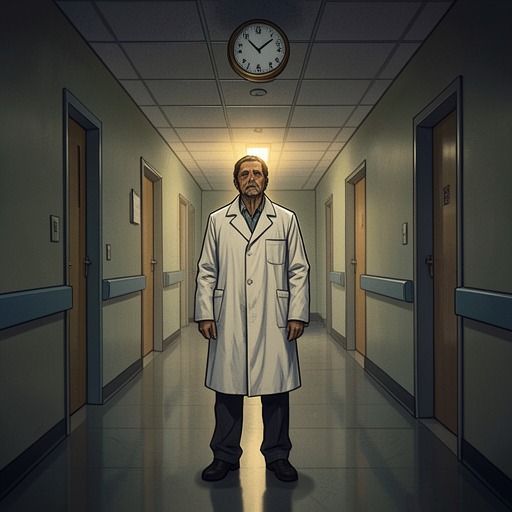
Adam Kay’s departure from the medical profession
This Is Going to HurtAdam Kay’s departure from medicine is the decisive break in his account of a career shaped by clinical responsibility, exhausting work and a habitual comic response to its absurdities. After a catastrophic birth, he returned to work but says he was broken by the experience; months later, he hung up his white coat. The departure was not presented as a clean escape: Kay kept its reason to himself, missed important parts of medical work, and continued to understand himself as a doctor.
A career built around women’s health
Kay chose to work in women’s health, caring for patients in labour and dealing with infertility. He valued the possibility of helping babies arrive and supporting couples who could not conceive. He also understood that the work’s emotional range was unusually stark: the highs of helping patients were inseparable from the depth of the lows when things went wrong.
The diary’s earlier episodes show the demanding and often unpredictable setting in which that commitment took shape. On one shift, Kay was told that patients with greater urgency would have to be seen first, and that one patient might wait six hours; by morning, a nurse praised his work, prompting an exhausted, unintended expression of affection. The moment combines the strain of triage with a rare experience of recognition. Elsewhere, an apparent emergency involving a pregnant patient was eventually explained by the beetroot she had eaten, while another emergency call brought a ceiling down after a midwife pulled the cord too hard. Such episodes supplied material for the book’s humour, but they also show a job in which the ordinary could turn alarming before the explanation arrived.
The pressures around the work
Kay’s account describes pressures that were not confined to difficult clinical decisions. Junior doctors moved between hospitals every six to twelve months, leaving familiar colleagues and starting again among strangers. Kay notes that the shared changeover day, Black Wednesday, was associated with increased death rates; his response in the diary is darkly matter-of-fact. The rotation system appears as a recurring disruption to continuity, while the remark about deaths exposes the grim humour through which he registers danger.
Other episodes show how responsibility could outrun preparation or formal sign-off. A midwife tells Kay that he need not be signed off to perform a procedure because he is a doctor. Later, a doctor brought in from another hospital to cover a night shift admits that he has never performed a caesarean section. Kay realizes that no one had checked whether the doctor had labour-ward experience; he sends him home and calls his boss, anticipating that he will have to work another twelve hours without pay. These incidents do not establish a single cause for Kay’s eventual departure, but they place it within a professional environment where staffing gaps, uncertain support and expectations of endurance were part of the narrative.
The turning point and its aftermath
The decisive rupture followed a birth in which the baby died and the patient was moved to intensive care. Kay was told to expect the worst. After the crisis, he began writing notes but instead cried for an hour; the experience marked the end of his diary entries. The hospital staff were kind and told him that he was not at fault and could not have done more. Nonetheless, the reassurance did not restore his previous way of working.
Kay returned the next day, describing himself as physically the same but a different doctor. He became unwilling to accept even a small risk when a baby’s heart rate fell and chose caesarean sections in circumstances where he knew they might not be needed. He understood this change as a response to the possibility of another terrible outcome, and recognized that senior doctors’ caution could grow from what they had already witnessed. The shift matters to the account of his departure because it shows the event changing not just his feelings but his clinical threshold for action.
He says that, for the next six months, he did not laugh and that his smiles were not real. Rather than describing a recovery, he distinguishes between carrying on and dealing with what had happened: he had continued working, but had not recovered from the experience. He believed that another terrible event could not be avoided forever. A senior doctor’s warning to students that, over a career, they would be associated with children who died or suffered brain damage sharpened the prospect he was trying to live with. Kay reflects that hearing such a warning earlier might have made him reconsider becoming a doctor.
Leaving, silence and what remained
Kay asked whether he could work part-time, but was told that this was not possible unless he was pregnant. He considered retraining as a general practitioner, but that would mean starting training again, and he was unsure that he wanted the role. A few months later, he left medicine. His account does not offer a formal explanation given to colleagues: he says that he told no one why he was leaving, and that he might have been understood if he had. When he told his parents, they reacted as though he had announced a deeply troubling decision.
At first, Kay found the subject impossible to discuss; later, he simply avoided discussing it. He changed the subject and told funny stories about patients instead. Some of his closest friends, he says, would encounter the sad account for the first time in the book. He connects this private silence to a broader silence at work: he believed he should have been able to talk to someone and that the hospital should have ensured support, but describes a culture that withheld help from those who needed it. The departure therefore follows not only a devastating clinical event but also his account of lacking a reliable way to address its effects.
After leaving medicine, Kay worked as a writer. He contrasted a bad day involving a computer failure or poor review with the medical version of a bad day, which he did not miss. But he did miss the good days: the doctors he had worked with, helping people, and the sense on the drive home that he had made a difference. He concludes that leaving did not erase his professional reflexes. He would still help someone who had fallen from a bicycle and respond to pregnant friends seeking advice. The ending holds departure and continuity together: Kay left the job, but not every practice or attachment that had made it meaningful.