Christmas
This Is Going to HurtChristmas appears in Adam Kay’s diary less as a protected pause than as a calendar date the hospital can claim. On Christmas Day in 2005, he is due to work on the labour ward; after an exhausting shift, he falls asleep in his car in the hospital car park and wakes there the next morning. The episode joins fatigue, duty and domestic disappointment in one scene: he is already at work, but has still overslept and arrives ten minutes late. His planned celebration with H has to wait until his next day off, 6 January.
Christmas on the hospital rota
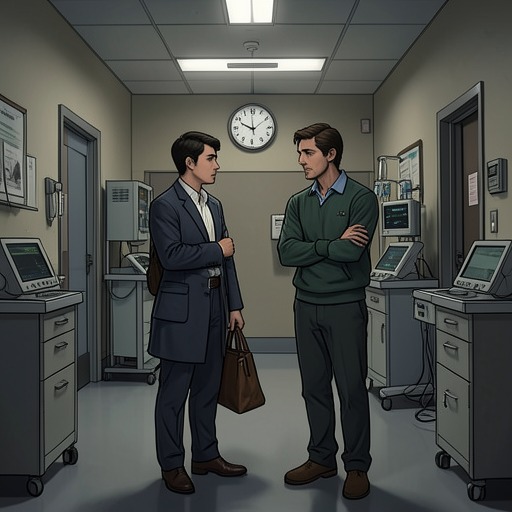
The Christmas Day entry begins with a blunt reversal of the expected holiday. The day itself is the good news; working on the labour ward is the bad news. Then his boss calls because Kay has not set an alarm and has failed to appear. At first, he takes time to understand where he is and why: he has fallen asleep in his car after the previous shift and is parked at the hospital. The car has become an improvised place to sleep, but it does not separate work from rest. Instead, it leaves him already on site and only briefly out of reach of the next shift.
Kay hurries from the car, takes a shower and reaches the ward ten minutes late. The smallness of that delay sits beside the larger strain of having slept at work after an earlier shift. Christmas does not suspend the labour ward’s demands, and the diary’s matter-of-fact sequence makes the holiday’s usual boundary between work and private time seem almost absent. The episode is not framed as a dramatic emergency; its force comes from how ordinary the rota makes this dislocation appear.
A celebration deferred with H
The same entry records the private cost of working. Kay has eight missed calls from H and a message wishing him a merry Christmas, but no kiss. That detail gives the missed celebration an intimate measure: contact has occurred, yet the message also registers a lack of the affection he hoped for. The account does not explain H’s absence or turn the exchange into a dispute; it leaves the contrast between the greeting and its omission to carry the disappointment.
The couple’s Christmas celebration is moved to Kay’s next day off, 6 January. He tries to make the delay sound cheerful by joking that the crackers will be cheaper then. The joke offers a practical, deliberately minor consolation rather than restoring the day they meant to share. Its placement beside the missed calls and the night spent in the hospital car park makes the diary’s humor double-edged: he can make light of the inconvenience, but the need to postpone a shared occasion remains.
The episode belongs to a wider pattern of work interrupting personal plans. Kay elsewhere describes having to cancel Ron’s stag weekend at short notice after attempts to exchange shifts fail, and later recalls missing part of Ron’s wedding and other important occasions because of work. Those absences are not Christmas events, but they clarify why the holiday entry is more than a single scheduling mishap. The rota repeatedly decides when Kay can join the lives of people close to him; even a celebration planned for Christmas has to be fitted around his next available day off.
The season in the clinical diary
Christmas also enters the book through the unusual cases associated with the holidays. Kay remarks that patients insert unusual objects into their bodies during holiday periods, then recalls a patient with a stuck fairy and a woman who injured herself after putting a string of Christmas lights to an unusual use. The details turn festive decorations into clinical material, while the diary’s humor depends on the gap between familiar seasonal objects and the unexpected circumstances in which they appear. The account does not present Christmas as a cause of these incidents; it is the setting against which their incongruity becomes legible.
That comic register differs from the Christmas Day entry’s quieter account of fatigue and distance. In one strand, the season brings absurd cases and wordplay; in another, it is a workday that keeps Kay from celebrating with H. The two uses of Christmas show how the diary repeatedly draws humor from the collision between ordinary expectations and hospital life, without making the personal cost disappear. Christmas remains recognizable as a time for shared celebration, but in Kay’s account its timing is vulnerable to the rota, and even its familiar objects can acquire a clinical afterlife.