Chronic overwork and unsafe working conditions for NHS junior doctors
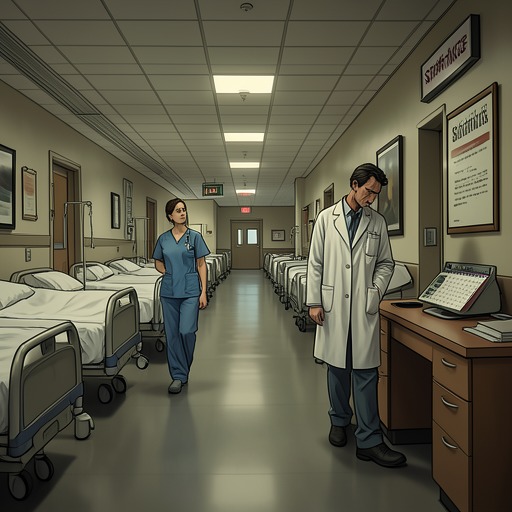
This Is Going to HurtChronic overwork and unsafe working conditions for NHS junior doctors shape both the clinical risks and the private losses in Adam Kay’s account. The pressure is not confined to exceptionally bad shifts: unpaid extra hours, rotating placements, inadequate cover and restricted leave recur as ordinary features of the job. They make care depend on exhausted people filling gaps, while leaving little room for recovery, relationships or even the practical demands of professional training.
A working life built around excess hours
On 6 December 2004, Adam Kay is asked to complete a form about the extra hours he has worked that week, although he will not be paid for them. The arithmetic is stark: he has seen H for less than two hours and worked ninety-seven hours in total. The form records the labour without compensating it, and the contrast between time at work and time with his partner gives the number an intimate as well as occupational cost.
The pressure also governs social plans. Before Ron’s stag do, Adam Kay tries to exchange shifts, but the replacement doctor withdraws, citing an issue with a child whose existence Adam Kay doubts. He has to cancel at the last minute, losing £400 and a T-shirt printed with Ron’s face. He is left working sober on the ward while his friends struggle to understand why plans made in advance so often collapse. To apologize, he buys Ron a bottle of whisky he cannot afford; they arrange to meet after Adam Kay’s run of night shifts, and he takes on extra hours to help cover the cost of the missed celebration. The episode shows how a rota can impose costs beyond lost leisure: it makes a friend’s important occasion into a debt to be paid back with still more work.
The job also makes professional advancement expensive in time and money. On 4 February 2007, Adam Kay reflects that junior doctors make life-and-death decisions after six years at medical school and must continue taking examinations while often working more than one hundred hours a week. He compares his hourly pay unfavourably with the parking meter outside the hospital. When he and Ron compare exam experiences, Ron’s employer has reduced his hours to allow study, provided a month off before the examination and paid his fees. Adam Kay, by contrast, studies after work, gets only a week away from the rota, and spends about £300 on books, £500 on a course and £400 on the exam. His stolen pencil becomes the sole practical return on more than a thousand pounds of costs; passing only qualifies him to sit the next set of exams. The comparison makes clear that the same achievement is supported very differently in the two jobs.
Rotas, turnover and gaps in cover
Junior doctors must move to a different hospital every six to twelve months. Adam Kay describes the move as arriving at a school full of strangers just as he has become accustomed to a workplace and its people. Since all junior doctors change hospitals on the same day, the transition is known as Black Wednesday (NHS doctors’ rotation day). The institutional routine repeatedly disrupts local familiarity, and Adam Kay notes that death rates are known to rise on that day. His response that this takes the pressure off is darkly comic, but it also exposes the unsettling normalization of risk during a predictable staffing transition.
Staffing gaps can leave doctors responsible for work they have not been prepared to do. On 16 October 2008, after a day without a break, Adam Kay is handing over to a doctor brought in from another hospital to fill a rota gap. The newcomer looks frightened and asks whether he will have to perform caesarean sections; he has never done one. Adam Kay discovers that nobody asked whether the doctor had worked on a labour ward before. He sends him home and calls his boss, already anticipating that the response will require another twelve unpaid hours from him. The immediate decision protects patients from an inexperienced doctor working beyond his competence, but it transfers the staffing failure back onto an already exhausted clinician.
Rota control can remain decisive even when the consequences are personal and foreseeable. Adam Kay and H plan a two-week holiday to celebrate five years together, hoping for time away from labour ward. An email then tells him he must work the middle weekend; no one can swap, and the proposed alternative is for him to fly roughly 6,000 miles back to England for the weekend. Other doctors have reportedly returned early from honeymoons or missed family funerals, so he understands that the rota will not be changed for his trip. On another transition between hospitals, his last night shift is due to end at midnight while his new job, ten miles away, begins an hour earlier. At 12.10 a.m., his swipe card no longer opens the ward: the system has ended his access at the scheduled finish even though the shift has run on. He spends fifteen minutes banging on the doors, unable to return to the ward until someone notices him. The contrast is pointed: staffing, chairs and computers may be inadequate, yet the access system acts promptly when it is time to lock a doctor out.
Fatigue as a patient-safety condition
The memoir places organizational safety procedures beside evidence of how serious clinical errors can be. At a mandatory patient-safety talk, staff hear that a patient’s healthy left kidney was removed, leaving the useless right one, and that British surgeons drilled into the wrong side of patients’ skulls fifteen times in three years. A new rule requires a large black-pen arrow on the correct leg of every patient going to surgery. Adam Kay asks what staff should do if a patient already has an arrow tattooed on the wrong leg. His boss calls him a clown and the room laughs, but hospital management emails the next day to say that such tattoos should be covered and a new arrow drawn on the correct leg. The suggestion becomes part of the official rules, and management thanks him. The sequence gives the joke a practical consequence: a small question about how a safety rule works in real circumstances becomes a formal addition to that rule.
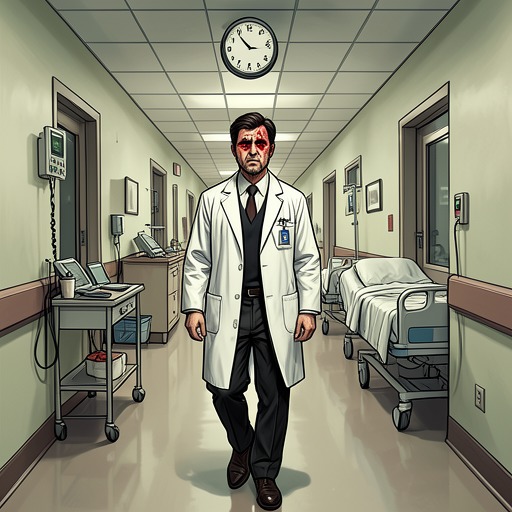
But procedures cannot remove the danger created by exhaustion. After twelve hours without sitting down or closing his eyes, with his dinner still in his locker, Adam Kay performs an emergency caesarean. The baby is limp at first, then responds to urgent care; while closing the patient, he is relieved that the birth has ended well. Another doctor then tells him that his knife cut the baby’s cheek during the operation. The cut is not severe and is not expected to scar, but Adam Kay returns to apologize to the parents and gives them information on how to complain. They decline to complain and say they understand that the baby had to be delivered quickly. His relief does not erase his responsibility: he thinks about how a slightly higher or deeper cut might have taken the baby’s eye, caused major blood loss or left a scar, and remembers that babies have died this way. He says he has never made such a mistake before and doubts it would have happened at the start of the shift, when he was less tired.
He completes the notes and a form, expecting to be reprimanded, but fears that no one will address the underlying problem: long hours endanger staff and patients alike. This concern recurs in the book’s account of clinical work, where being a doctor is treated as a reason to perform tasks even without formal sign-off. At the end of a shift, a midwife tells Adam Kay that doctors do not need to be signed off to do things. The exchange captures an informal expectation of competence and availability that sits alongside, and may strain, more cautious professional limits.
The private cost of an always-on job
The effect on friendship accumulates over years rather than in a single cancellation. In 2010, Ron confronts Adam Kay about repeatedly using work as an explanation for absence: he missed the stag do, the first half of Ron’s wedding, Ron’s father’s funeral and his daughter’s christening. Ron asks how difficult it can be to swap a shift for something that really matters. Adam Kay places his hand on his heart and assures Ron that he loves him and would never lie to him; he also acknowledges being a poor friend. He says he has still seen Ron more than almost anyone else because the job is so busy that it does not stop. Yet he admits that he lied about the christening. His account preserves both sides of the rupture: genuine affection and a pattern of absence that love alone cannot repair.
A gathering with five other former medical-school friends suggests that these pressures are shared, not peculiar to one career. Their attempt at a drinking game becomes a kind of group therapy: all six have cried because of work, five have cried at work, all have felt unsafe during a shift, three have had relationships end because of work, and all have missed important family events. The figures are presented alongside a joke about sex with nurses, retaining the memoir’s black humour without making the underlying pattern less serious. The group can recognize one another’s experiences, but the tally also shows how routinely distress and missed commitments have become part of their working lives.
The private strain reaches home as well. After a day that keeps him at labour ward until 9.30 p.m., despite being meant to finish at 7 p.m., Adam Kay has to text H to cancel collecting his belongings from their house. They have broken up, and he is living in a tiny flat ten minutes from the hospital. The passage connects an ordinary overrun shift to a changed domestic life without claiming that work alone explains the separation. It shows, instead, how work repeatedly takes precedence over the time and practical arrangements through which a relationship is maintained.
Silence, responsibility and public testimony
After a devastating event at work, the hospital staff are kind to Adam Kay, tell him it was not his fault and send him home for the rest of the shift. Yet the expectation is that he will return the next day and carry on. The difficulty is structural as well as personal: bad things happen too often for doctors to take a month to recover, there is not enough space on the rota for a sick day, and no one can wear black every time something goes wrong. Adam Kay describes the professional survival mechanism as telling oneself that terrible events are simply part of the job. He had seen patients and babies die before, but this event was different because he was the most senior person on the ward, the one others turned to, and he felt that he had failed. The gap between colleagues’ reassurance and his own sense of responsibility shows how a supportive response can coexist with a work system that offers almost no time to absorb what has happened.
In his later reflections, Adam Kay connects such experiences to public debate about the National Health Service. In 2016, he says, the government forced doctors to work harder for less money, while politicians described them as greedy. He rejects that account, arguing that doctors care about their patients’ best interests. The junior doctors lose their dispute, and he concludes that the workforce’s quiet voice had been drowned out; the public must hear more clearly what the work actually involves. He would not wish the job on anyone, but retains respect for those on the front line, acknowledging that the work became too much for him.
Writing six years after leaving medicine, he observes that colleagues’ hospital stories still describe a troubled service and that changing careers has become far more common than it was when he left. Doctors who once did anything for the job, even missing the morning of their own wedding, now move abroad or into the City because of the stress and difficulty. When they recall the sad and bad events, they remember details so vividly that their voices shake. Adam Kay presents his book as one doctor’s point of view rather than a substitute for those other stories, and asks readers to consider the toll borne by doctors, nurses and midwives. The account’s central contrast is not between caring clinicians and uncaring ones, but between their commitment to patients and working conditions that repeatedly require that commitment to compensate for inadequate time, cover and recovery.