National Health Service
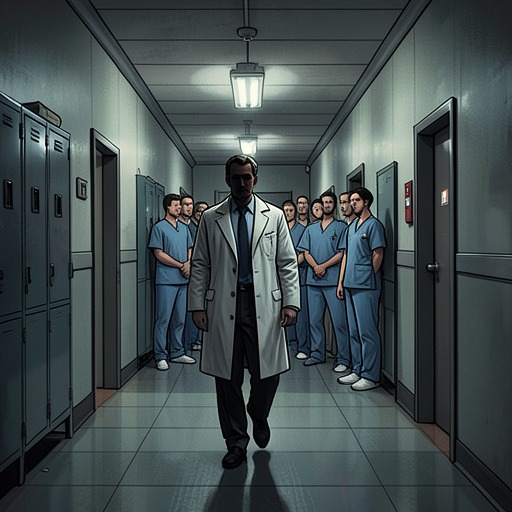
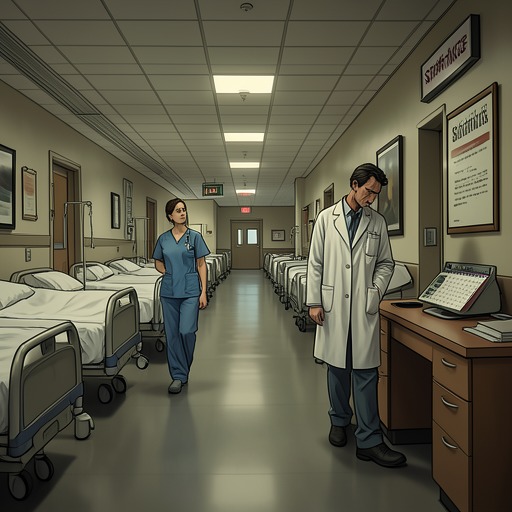
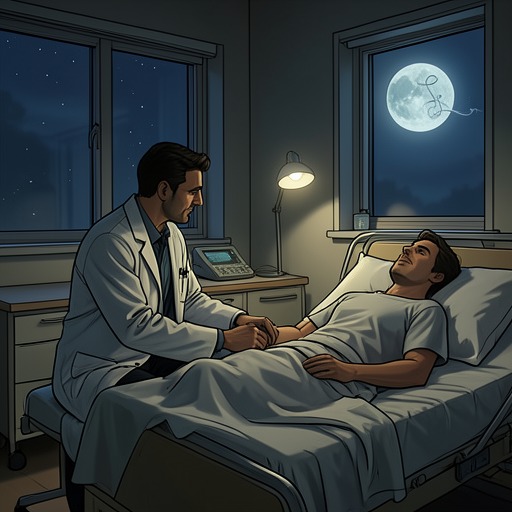
This Is Going to HurtThe National Health Service is the setting and central institution of Adam Kay’s account of medical work: the place where he trains, treats patients, and gradually recognizes the cost of a career shaped by relentless demands. The memoir presents it through concrete encounters rather than an institutional survey. Its wards contain acts of care, procedural safeguards, absurd mishaps, and serious failures; its staff are devoted to patients, yet can be left to bear the consequences of unsafe conditions with too little support. In the book’s closing appeal, the National Health Service is both worth defending and in need of public scrutiny.
The Service as Workplace and Clinical Setting
The memoir begins with Kay starting work in 2004, equipped with new medical tools and a packed lunch made by his partner, H. The National Health Service is immediately more than an employer: it becomes the setting that reorganizes his time and daily life. Kay’s later reflections describe long hours that he had once simply endured, and he explains that he kept his diaries to show what work on the wards involved and how it changed him.
The clinical episodes range from comic misunderstandings to emergencies. In one early case, a patient develops a serious medical crisis, and Kay’s senior colleague takes charge while Kay remains present. The patient dies, leaving the practical aftermath of the shift alongside the loss. In another episode, a patient’s alarming-looking toilet contents prompt hours of investigation and an urgent request for advice; a specialist eventually identifies beetroot as the explanation. These contrasting cases establish the service as a place where staff must respond to uncertainty, distinguish danger from benign causes, and continue working amid events that can be frightening, exhausting, or unexpectedly ridiculous.
The memoir’s humor often comes from the distance between clinical urgency and ordinary absurdity. A midwife pulling an emergency buzzer brings part of the ceiling down; a conversation with a patient about the normal course of labour is framed around an imprudent meal. Such episodes make the wards’ pressures legible without making every incident a tragedy. But the humor has limits: Kay later says that after a devastating obstetric experience he did not laugh for six months. The contrast marks how sharply an individual crisis could alter his experience of the same workplace.
Patient Safety and Institutional Procedures
The National Health Service is also shown responding to preventable error through formal rules. After a patient’s healthy left kidney is removed instead of the unusable right one, staff attend a patient-safety meeting. The discussion places that mistake in a wider context: British surgeons had drilled into the wrong side of patients’ skulls fifteen times in three years. The episode turns a general warning about safety into a question of specific checks and human fallibility.
A new procedure requires a large black arrow to be drawn on the patient’s left or right leg to identify the correct side for surgery. Kay asks what should happen if a patient already has an arrow tattoo on the wrong leg. His boss dismisses the question as a joke, but hospital management later emails him with a formal answer: the tattoo should be covered and a new arrow drawn on the correct leg. The rule is amended to include this complication, and management thanks him. The sequence shows a practical suggestion moving from informal discussion into official guidance, while also exposing how a safety policy must anticipate misleading marks as well as create a clear one.
Later, an exhausted Kay accidentally cuts a newborn’s cheek during an emergency caesarean. He apologizes to the parents, who understand that the baby had to be delivered quickly, and completes the required notes and form. He believes fatigue contributed: he had been awake and on his feet for twelve hours, and doubts the mistake would have occurred at the beginning of the shift. He worries that the resulting review will focus on reprimanding him rather than confronting the danger of long hours. The incident connects an individual error to a working condition that, in his view, exposes both patients and staff to risk.
Workload, Commitment, and Personal Cost
Kay’s account presents heavy workloads not as an occasional inconvenience but as a recurring force. He describes a shift extending well beyond its expected finish and records that work makes him cancel a plan to collect his belongings from the home he had shared with H; the relationship has ended, and he is living in a small flat ten minutes from the hospital. He also considers the difficulty of leaving the profession while talking with Ron, who is preparing to take a better job. Kay contrasts Ron’s range of possible jobs with the limited alternatives he imagines for a doctor trained in highly specific skills. The exchange shows how occupational identity can make departure seem hard to picture even when the work is wearing him down.
The cost becomes more serious after the later obstetric crisis. Kay returns to work the next day but changes his approach: if a baby’s heart rate drops even slightly, he will opt for a caesarean, despite knowing that some women will undergo one unnecessarily. He understands this as a way of avoiding another terrible outcome. In retrospect, he recognizes that continuing to work was not the same as coping. For six months he did not laugh, and his smiles felt false. He says that he should have been able to speak to someone and that the hospital should have ensured support, but describes a culture of silence that withholds help from those who need it. The memoir thus makes psychological distress part of its account of working conditions, not merely a private weakness detached from the institution.
Public Advocacy and the Memoir’s Critique
Kay’s view of the National Health Service is shaped by both loyalty to its workers and anger at the conditions under which they work. In 2016, he sees the UK Government as demanding more work for less money from doctors. He rejects the claim that doctors are motivated by greed, arguing that their concern is for patients, and he describes the junior doctors’ campaign as a lost struggle in which their quieter voice was drowned out. The episode shifts the memoir from clinical recollection toward public argument: if doctors cannot make their working reality heard, the public may accept a distorted account of their motives and circumstances.
Writing six years after leaving medicine, Kay says that former colleagues’ stories still suggest a service in a sad state. He observes that doctors now change careers far more often than when he left, with some moving abroad or into the City, and recalls that people once committed to the work could miss even the morning of their own wedding. He also notes how clearly former colleagues remember the sad and bad experiences, often with visibly shaken voices. He does not claim to tell their stories; he presents his own as one doctor’s perspective and as a glimpse of what the job involves.
The memoir’s final appeal asks readers to consider the toll that work takes on doctors, nurses, and midwives, including what they carry between the hospital and home. The National Health Service emerges neither as an abstraction nor as a simple villain: it is a public service whose workers try to do their best, while the conditions described in the book can make that effort dangerous and personally devastating. Kay’s insistence that the public listen is therefore part of his defense of the institution’s staff, and a demand that the realities of their work not be hidden behind political claims or professional silence.