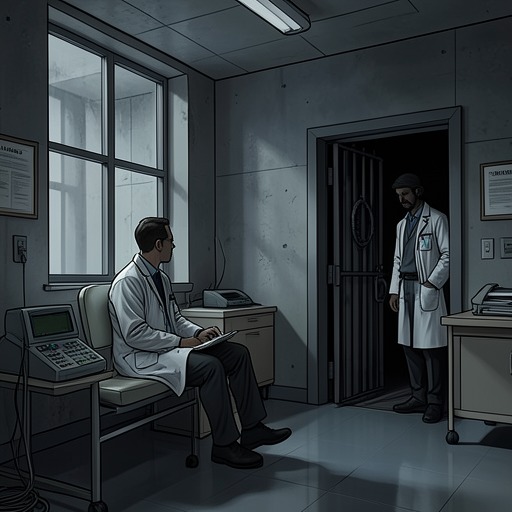
The culture of silence in medical work
This Is Going to HurtThe culture of silence in medical work is the gap between being told that a doctor is not to blame and being expected to carry on as if nothing has happened. Adam Kay’s account shows how this gap is sustained not only by unspoken professional expectations but by practical conditions: busy rotas, limited leave and no dependable space to recover. In its starkest form, distress is acknowledged in passing, then returned to the individual to manage alone.
The everyday habits of medical work
Before the most consequential crisis, the diary establishes a working life in which exhaustion, confusion and alarming incidents are repeatedly absorbed into the next task. On an early shift, Kay is present when a patient begins bleeding suddenly; his senior colleague takes charge, the patient dies, and Kay changes out of his wet clothes. The entry records the immediate aftermath, but the workday’s logic is already visible: the event is followed by practical actions rather than a description of any structured support for the junior doctor.
Other episodes are less grave but show how pressure and uncertainty become ordinary. In June 2006, an alarming-looking change in a labour ward patient’s condition leads Kay to investigate possible causes and seek another doctor’s advice; the eventual explanation is beetroot eaten the night before. In another shift, an emergency call brings staff rushing to a room after a midwife has accidentally brought part of the ceiling down while pulling the alarm. The diary can turn such moments into absurd comedy, just as it can make a blunt joke about the indignities of labour. That humour gives the account a way to register the strangeness of clinical work, but it should not be mistaken for evidence that its pressures have been resolved.
Praise, training and the hidden expectation to cope
The diary also records how junior doctors learn what is expected through daily encounters, not only through formal instruction. After a night of urgent work, a nurse tells Kay that he has done well and is a good doctor. The praise affects him so much that, still in shock and exhausted, he mistakenly ends the call with an expression of love. The moment shows how scarce affirmation has been since he started the job, and how much emotional weight a small kindness can carry.
The institution’s practical arrangements make that reliance on individual kindness consequential. Junior doctors move to a different hospital every six to twelve months, leaving familiar colleagues and starting again among strangers. Kay notes that all the doctors move on the same day, known as Black Wednesday, and that death rates are known to rise then. Elsewhere, a midwife tells him that being a doctor is enough reason to undertake a procedure without having been signed off to do it. These episodes do not by themselves establish that colleagues deliberately silence one another. They do show a working culture in which inexperience, risk and discomfort can be treated as things to endure while the work continues.
After the catastrophe
After a catastrophic obstetric emergency, colleagues are kind to Kay. They tell him that the outcome was not his fault and that he could not have done more, and he is sent home for the rest of the shift. But the reassurance does not alter the expectation that he will return the next day. Staff ask whether he is all right, while the rota offers no room for a sick day and the work is too frequent for a month away whenever something goes wrong. The contrast is central: concern is expressed, yet the conditions for recovery are absent.
Kay describes the professional response as a rule of endurance. Doctors, he says, find it difficult to admit how badly terrible events affect them; survival comes from telling themselves that such events are simply part of the job. In his own case, this posture conceals rather than heals the injury. He replays the possibility that he might have prevented the tragedy, despite knowing that he had broken no rules and that other doctors would have acted as he did. He returns to work the next day and becomes more willing to perform caesarean sections at the slightest sign of a problem, accepting that some women would undergo operations they did not need. The change in his practice makes visible how unprocessed fear can shape clinical decisions.
Silence beyond the hospital
The effects continue after Kay leaves the ward. For the next six months, he does not laugh; his smiles are not genuine. He says that the hospital should have ensured he could speak to someone, but that a code of silence keeps help from those who need it. He considers working part-time and changing specialties, but neither offers a straightforward way to remain in medicine. A few months later, he leaves the profession.
At first, he does not tell anyone why. When he tells his parents he is leaving, they react with alarm; later, when friends might have asked about his departure, he changes the subject and offers funny stories about patients instead. Some of his closest friends, he writes, will encounter the sad story for the first time in the book. The gap between the jokes and the withheld explanation gives the memoir’s comic style a particular significance: humour can help recount the daily absurdities of medicine, but it can also stand in for a conversation that never takes place. After this event, the diary’s jokes stop. The silence is therefore both a feature of the workplace and a pattern that follows Kay out of it.