The personal cost of medical work
This Is Going to HurtThe personal cost of medical work in Adam Kay’s account accumulates across unpaid hours, exhausted bodies, missed occasions, and a professional culture that expects doctors to continue after terrible events. It is not a single sacrifice but a pattern: work repeatedly takes precedence over relationships and recovery, while the damage is treated as an ordinary condition of the job. A catastrophic birth makes that pattern impossible for him to contain, and he eventually leaves medicine.
Work, hours, and financial cost
The imbalance is visible early in the arithmetic. Asked to record his extra hours, Adam Kay calculates that in one week he has seen H for less than two hours and worked ninety-seven hours in total; none of the additional time will be paid. The form makes the labor countable without making it compensable. The contrast between time given to the hospital and time available for a partner is already stark.
Pay and training deepen the disparity. By February 2007, Kay argues that the sums do not add up for a junior doctor whose work involves life-and-death decisions, six years of medical school, continuing examinations, and weeks that often exceed one hundred hours. He measures his hourly rate against the parking meter outside the hospital and finds the meter better paid. Passing an examination brings no immediate rise: it only permits him to take the next set.
His comparison with Ron shows how the cost extends beyond salary. Ron’s bank reduced his working hours so he could study and gave him a month off before his exam; Kay requested a week but had to work because the rota had a gap. Ron’s employer paid his exam fees, while Kay spent about £300 on books, £500 on a course, and £400 on the exam. The small compensation he could claim for himself was the pencil he had taken after using it to fill in the paper. The joke turns a thousand-pound outlay into an image of a system in which the doctor pays for the next step in a career that has not yet rewarded him.
The rota in private life
The rota repeatedly converts plans into cancellations. Kay has to abandon Ron’s stag do at the last minute, losing £400 and a T-shirt printed with Ron’s face. He has tried to swap shifts, but a colleague withdraws because of a problem with a child; Kay suspects the explanation may not even be true. He spends the weekend sober on the ward. His friends struggle to understand why plans made in advance can still be undone, while the rota-makers show no concern for his social life.
A holiday with H offers a different measure of the same pressure. The two-week trip is meant to celebrate five years together and give them time away from the labour ward, after a relationship Kay describes as kept alive by apologetic text messages. Then an email assigns him work during the middle weekend. Nobody can swap, and the suggested solution is for him to fly 6,000 miles back to England. The episode makes clear that even a long-planned anniversary holiday is provisional when staffing needs intervene.
The losses accumulate in Kay’s friendship with Ron. By 2010, Ron points to the stag do, the first half of his wedding, his father’s funeral, and his daughter’s christening as occasions Kay missed because of work. Ron asks why he could not swap a shift for something he truly wanted to attend. Kay insists that he loves Ron and knows he has been a poor friend, but also says the job does not stop. His account includes an admission that he lied about the christening, a sharper sign of how strained explanation and loyalty have become. The relationship is not presented as a simple lack of affection: Kay’s devotion to the friendship coexists with repeated absences he cannot repair by declaring that devotion.
By November 2010, work has also overtaken the practical business of separation. Kay is meant to finish at 7 p.m. but leaves the labour ward at 9.30, cancelling the collection of his belongings from the house he shared with H. They have broken up; he is living in a tiny flat ten minutes from the hospital. That proximity offers convenience to work, not a remedy for what work has taken from his private life.
Fatigue as a risk to patients and staff
The cost is physical as well as social. In June 2010, Kay wakes to an old man tapping on his car window with an umbrella and asking if he is all right. Kay has fallen asleep while waiting at a red light. Earlier, he had nearly dozed off on a stool while waiting for a patient. He describes the difficulty of switching between night work and daytime sleep, and the rule that staff must stay awake throughout a shift even when a hospital room is empty and the work is quiet.
He compares the effects of exhaustion to having had three pints: he worries that he cannot react quickly enough, although a doctor who arrived drunk would likely be sent home. After leaving work at 9.30 in the morning, he takes an hour to write his notes because he cannot find the words. He fears that one day he will fall asleep at the wheel and run someone over. These are not abstract complaints about comfort. They connect impaired concentration directly to the safety of patients and the public.
The danger also appears in a clinical mistake. Kay writes that he has never done anything like it before and believes it would not have happened at the start of a shift, when he was less tired. The baby is not seriously harmed, but a small difference in the cut could have injured her eye, caused a scar and major blood loss, or proved fatal. Kay completes the notes and a form, expecting to be told off; he fears that the response will address his individual error without confronting the long hours he identifies as dangerous to staff and patients alike.
A catastrophe and its aftermath
The most devastating cost comes when Kay is the senior doctor on the labour ward during an emergency birth. The baby is delivered dead, and efforts by the baby doctors to save it fail. The mother suffers catastrophic bleeding. Kay tries to stop it, eventually holding her womb in both hands, while colleagues arrive and the most senior doctor has to remove her womb. She is moved to Intensive Care, and Kay is told to expect the worst.
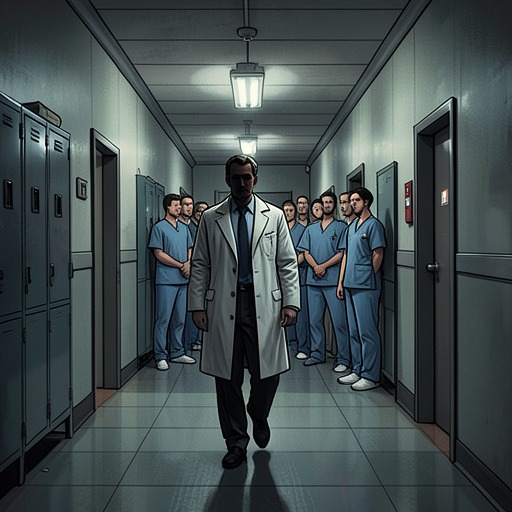
Instead of finishing his notes, Kay cries for an hour. He is sent home for the remainder of the shift, and colleagues tell him that he is not at fault and could not have done more. Yet the reassurance does not settle his own judgment. He had seen patients and babies die before, but this is different because he was the most senior person present and the one everyone turned to. Although he believes he broke no rules and that other doctors would have acted in the same way, he keeps returning to what might have been done differently and to the possibility that he could have prevented the tragedy.
The next day he returns to work changed. He decides that even a tiny fall in a baby’s heart rate will lead him to perform a caesarean section, accepting that some women will undergo operations they do not need if that is what it takes to ensure everyone leaves the room alive. In retrospect, he understands why senior doctors fear risk: they too may have lived through events that leave them imagining what might have happened. His new caution is an effort to protect patients, but it is also shaped by the burden of a consequence he cannot stop replaying.
Silence, departure, and the wider cost
The hospital’s kindness does not become sustained recovery. People ask whether Kay is all right, but everyone still expects him at work the next day, carrying on as though nothing has happened. He describes the practical and cultural limits: doctors cannot wear black every time something goes wrong, take a month off after each event, or readily be replaced when the rota has no room for a sick day. He concludes that doctors learn to treat catastrophe as part of the job because admitting how deeply it affects them is difficult. He also says the hospital should have ensured that he could talk to someone, but that a code of silence keeps help from those who need it.
The consequences last beyond the immediate crisis. For the next six months, Kay does not laugh; his smiles are not real. He says he is broken by the experience, even as he continues working. A few months later, he hangs up his white coat and leaves medicine. At first he cannot talk about why he has gone; then silence becomes a habit, and he changes the subject with funny stories about patients. Some close friends, he notes, will learn the sad story only by reading his book. The contrast between the jokes and the withheld account gives his departure its particular weight: leaving ends the work, but does not make the experience easy to tell.
Kay’s later reflections place his experience within the conditions facing doctors across the National Health Service. In 2016, he supports junior doctors during a dispute over being made to work harder for less money, arguing against the claim that they are motivated by greed and insisting on their concern for patients. The doctors lose the battle, and he concludes that those working in the service must make the realities of their work more audible. Written six years after he quit, his account also records how former colleagues remember distressing events in exact detail, their voices shaking as they recount them. His respect for frontline doctors remains, but so does his admission that the work became too much for him. The personal cost is therefore both individual and institutional: it is borne in one doctor’s lost relationships, exhaustion, and departure, and in a profession expected to absorb recurring harm without enough space to stop.