All stories have an end
Three Bags Full“All stories have an end” is Miss Maple’s defiant answer to the flock’s wish to stop investigating George’s death. More than a claim that events eventually conclude, the expression makes an unfinished story a reason to keep looking: uncertainty does not excuse the flock from seeking what happened.
The Unfinished Story
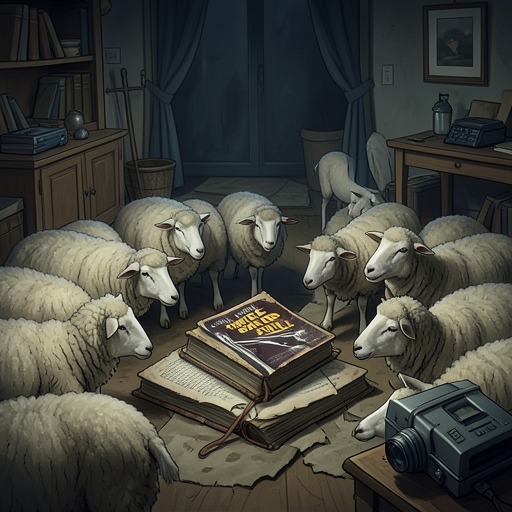
Miss Maple first frames the problem through George’s abandoned detective story. If he had finished it, she argues, the flock would know how it ended; because the mystery around them has also begun but remains unresolved, she wants an answer to that story as well. Her insistence that “There must be an end to the story” joins a desire to know with the expectation that events should be understood in relation to their outcome.
The other sheep do not share her confidence. Cordelia admits that human things are difficult to understand and that no one is there to explain the words to them. Sir Ritchfield urges the flock to graze rather than ask questions, reasoning that not everything can be discovered. Against both resignation and confusion, Miss Maple treats the mystery not as a puzzle that can safely be discarded, but as something that has happened and therefore calls for attention.
Story Against Forgetting
When Cloud suggests that forgetting would make things simpler, the flock agrees: forgetting is familiar as a way for sheep to move past sorrow, especially when an incident is strange or disturbing. Miss Maple sees a cost in that comfort. “But if we forget everything there won’t be any more stories,” she says, making memory the condition for preserving what happened and giving it a shape that can be shared.
The expression therefore resists two different forms of escape. The flock can set aside its questions because the answers seem beyond its grasp, or it can forget the troubling event altogether. Miss Maple rejects both responses. A story needs an ending, in her view, but reaching one requires remaining with the events rather than erasing them before they can be understood.
From Principle to Action
Miss Maple sharpens her argument by recalling George’s frightening story of The wolf in sheep’s clothing. The image makes inattention dangerous: the flock could fail to notice a threat among them. She warns, “Either you find the wolf or the wolf will find you. It’s as simple as that!” In this context, an ending is not merely a satisfying conclusion. Finding out what is happening may matter to the flock’s safety.
Her final comparison between abandoning an investigation and “throwing the book away in the middle of it” makes the expression a challenge to keep reading the evidence, even when its meaning is unclear. The others do not answer, and Cloud’s plea that the flock needs a shepherd does not persuade Miss Maple to stay. She flicks her tail and goes to stand apart from the others in the dark, determined to find out for herself. The expression thus marks a change from shared discussion to solitary resolve: if the flock will not pursue the story’s end with her, she will continue alone.