Beth
Three Bags FullBeth is Glennkill’s outspokenly devout villager and one of the few people who tries to make George answer to a moral world beyond his pasture. The sheep know her through recurring visits to George’s shepherd’s caravan, where she urges him to do good works and presses religious pamphlets into his hands. After his death, she moves from familiar visitor to an isolated advocate for asking what happened: she says she alone in the village spoke to the police, and she understands the killing through both the physical evidence and the fate of George’s soul.
Identity and Background
The sheep recognize Beth by her religious campaigning, which George calls Bible-thumping. She regularly turns up outside George’s shepherd’s caravan with appeals that he undertake good works. The sheep do not understand the phrase and wonder whether it means that George should work in someone else’s vegetable garden, a distinctly pastoral misreading of Beth’s moral vocabulary. To them, the contrast is plain: George already has a garden of his own, and he does not want to do what she asks.
Beth and George had known each other since childhood, but the available account presents their adult contact chiefly through her visits and his refusals. Each time he declines her appeal, she leaves him a bundle of tracts intended to convert his sinful soul. He does not read them aloud to the sheep, yet he seems pleased to receive them. On the evening after Beth brings them, he cooks baked potatoes over a small, flickering fire. The repeated exchange is therefore not simply a contest between a preacher and a resistant listener: it becomes part of the ordinary pattern by which the sheep remember George’s evenings and Beth’s presence in his life.
Faith and Public Presence
At George’s funeral, Beth is among those present. The sheep recognize her when she voices a prayer for mercy on his soul. Her public religious language makes her concern unmistakable, though it does not mean she has a clear account of what happened. Her faith supplies a vocabulary for death and judgment, while the mystery of George’s actual killing remains unresolved around her.
A later encounter shows Beth at a picnic with an unnamed woman. She does not eat; instead, she repeatedly reaches to her breast and closes her hand around a small, glittering object, making the mayonnaise pot wobble. The object is not identified in the scene. Beth sighs that belief is never easy, and her companion replies that other people’s beliefs are easy to judge. Beth’s gesture and her unease lend the exchange a private tension: religion is not only the public certainty for which the sheep know her, but also something she experiences as difficult.
The Murder and Its Interpretation
Beth tells Rebecca that she spoke to the police and, as she sees it, was the only person in the village to ask them about George’s death. She reports the sequence they gave her: George was poisoned first and fell asleep peacefully; the spade came afterward, when he was already dead. For Beth, that account sharpens rather than settles the question. She insists on asking why he was killed and fears that the village will smother the matter in silence.
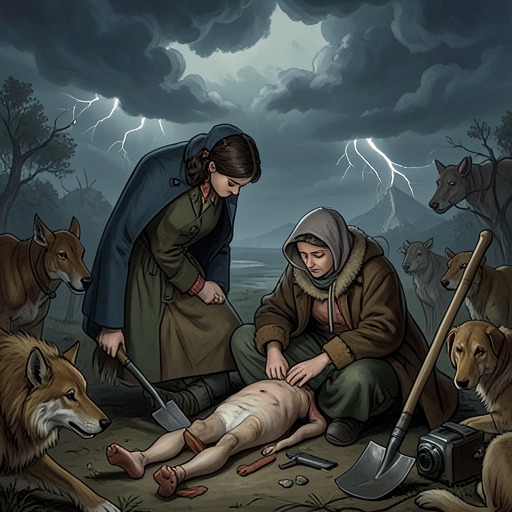
Her explanation is at once investigative and theological. Beth invokes a superstition that the Devil’s hounds guard a body during the first hour after death, waiting to swallow the dead person’s soul. Because she believes George’s soul belonged to the Devil, she imagines the horror he must have faced beside his body and the spade. She also speaks of Glennkill as unable to live again until the black sheep has left the flock. That language turns an unsolved murder into a moral crisis for the whole village, though her interpretation does not identify the murderer.
Beth’s suspicions extend to Ham. She urges Rebecca to begin with him, describing his pious manner and his butcher’s shop CCTV camera, which he had installed long before such equipment seemed ordinary in the village. To Beth, the camera’s presence in a butcher’s shop, even when the bank has none, suggests that Ham is afraid and has something to hide. She recalls challenging him at the Christmas collection; he turned red, an unusual sign of embarrassment for him. Her suspicions remain suspicions, but they show how she uses small details of conduct and equipment to probe the silence she distrusts.
The Warning and Beth’s Regret
Beth later tells Rebecca about an object she found one morning on the steps of George’s shepherd’s caravan during the week before the conversation. George was away, as he had been often lately, and Beth took the object with her. Because local boys had called George the Goblin King, she assumed it was another silly prank and decided it was not worth troubling him over. She does not identify the object in this account, nor does she explain what it meant when she found it.
After George’s death, Beth revises her judgment: she now thinks the object was a warning and blames herself for not conveying it. Her regret is qualified by her belief that George would not have listened to warnings anyway. The admission captures a recurring difficulty in their relationship: Beth tries to reach him, but his resistance makes her unsure whether she could have changed anything. Her account makes her both a witness to a missed opportunity and a person who cannot know whether acting differently would have mattered.
Narrative Role
Beth’s presence connects the sheep’s domestic memories of George with the village’s uneasy response to his death. Her tracts and baked potatoes belong to the repeated, almost companionable pattern of her visits; her report of the police findings and her fear of communal silence belong to the murder investigation. The contrast gives her religious insistence a practical force: she is not content to let the village’s routines or economic interests close over the question of George’s death.
At the same time, Beth does not function as an all-knowing interpreter. She offers a reported forensic sequence, a religious account of the soul, suspicions about Ham, and a belated reading of an object she had dismissed. These explanations do not collapse into a single answer. Her significance lies partly in that gap: she keeps asking what others leave unasked, yet her faith and remorse cannot by themselves resolve the mystery.