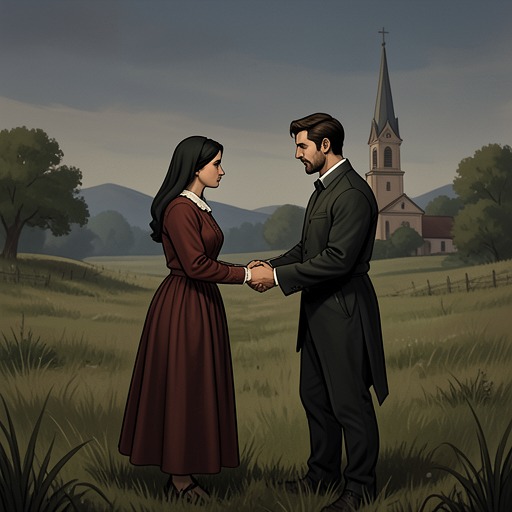
Beth Jameson
Three Bags FullBeth Jameson is at once the keeper of a secret and the person who eventually makes that secret speakable. Her connection to George Glenn is marked by books, a handkerchief, and a hope she cannot bring herself to abandon; after his suicide, she helps him die as he wished and allows the circumstances to look like murder. Her eventual confession recasts the case not as a simple act of concealment, but as a painful mixture of devotion, fear, and remorse.
Identity and Connection to George Glenn
At the reading of George Glenn’s will, Beth sits in the third row and is described as “Bible-thumping.” When the lawyer announces that George has left her his Bible, she begins sobbing uncontrollably, covering her mouth with her hand. The bequest makes her grief visible in a public, formal setting: George’s last arrangements name her, and the book is an object associated with a faith that will matter again when his death is discussed.
The sheep later interpret Beth’s attachment through their own understanding of souls. Miss Maple reasons that Beth wanted a soul more than anything and recalls that she came to George’s caravan year after year, bringing him books because she knew he liked them. In Maple’s reading, Beth hoped that George would come to love her enough to give her his soul. This is the flock’s interpretation, not a statement Beth makes about her own past. Still, her repeated visits and carefully chosen gifts give that interpretation a concrete basis: she kept returning to a relationship whose hoped-for outcome remained uncertain.
The Unanswered Question of Wesley McCarthy
After George’s death, Beth offers Rebecca a place to sleep. Rebecca refuses to return to the village and, after a silence, asks who Wesley McCarthy was. She says she has examined newspaper files from seven years earlier, when Beth was in Africa, and found that McCarthy had been murdered in the stone quarry. The case produced no suspects or arrest and soon disappeared from the headlines. Rebecca suspects that this is the matter Beth had been looking for.
Beth comes out of her thoughts with a start at the question. The exchange establishes that Rebecca has connected Beth’s past and McCarthy’s unsolved killing to her inquiry into George, but the available conversation does not record Beth answering or confirm what she knew about the case. Her startled reaction therefore leaves a question open rather than resolving it. That gap matters: Beth is shown as someone with a concealed history, but the scene does not license a definite account of her role in McCarthy’s murder.
Confession and George’s Death
Beth’s most consequential disclosure comes at the sheep contest. When the event’s presenter announces a brief intermission for a charity appeal, Beth does not join him on the platform. She sits at the stage’s edge, smooths her skirt and a piece of cloth, and begins speaking about George. The hall grows quiet. She attracts attention without a performance; her stillness and the cloth in her hands become the setting for a personal account. At first, she speaks about herself rather than about George.
Beth admits that she could not give George the courage to go on, and that she helped him do things as he wanted because she feared he would otherwise not be buried. She says he did not want her to die with him. He told her he would end his life in the meadow within an hour, and she went there in pouring rain; by the time she arrived, he was already dead. Her account makes clear that she did not prevent his suicide. It also places her assistance within the aftermath and presentation of his death, while leaving the precise mechanics of that assistance unstated.
When Ham asks why it had to be the spade, Beth answers that George insisted on it, saying it would give people something to think about. She could not persuade him otherwise and describes the choice as terrible. Ham corrects the focus: it was George, not the spade, that mattered. Beth responds with anger that is also vulnerable, comparing her feelings to those she had when she gave George the handkerchief. She describes hope so great it becomes difficult to bear, and fear that grows greater still. George had waited too long for Europe; she suggests that perhaps he no longer had the courage to discover whether he could truly make the journey.
The Handkerchief, Guilt, and Belated Truth
The cloth Beth handles during her public account is connected to the handkerchief she says she gave George. The sheep notice that it stinks, while Beth continues to smooth and stroke it; as her voice falters, her fingers can no longer follow its lines, and she clasps her hands together for comfort. The object is not merely a keepsake in the scene: her repeated attention to it accompanies the movement from guarded recollection to confession. Its physical presence gives her account a focus even as she struggles to continue.
Beth’s disclosure changes the meaning of her earlier silence without making her choices simple. She says she helped George carry out the death he wanted, yet her account also emphasizes that she could not give him the courage to continue living and could not dissuade him from the spade. Her explanation joins care to complicity: she wanted to honor his wishes and feared that the truth would leave him without burial, but she now speaks publicly about what she did. The unresolved question raised by Rebecca and the confession about George remain distinct; the former points toward an unconfirmed connection, while the latter gives Beth’s own account of her role in George’s death.