Beth’s embroidered handkerchief
Three Bags FullBeth’s embroidered handkerchief is both a personal gift that Beth once struggled to give George and the cloth the flock turns into a prop for its public performance. Its passage from a carefully embroidered offering to a dirt-stained, scent-laden rag and then back into Beth’s hands binds private regret to the sheep’s attempt to make a hidden story visible.
Making and Giving the Handkerchief
Beth recalls that she embroidered the handkerchief for George long ago, staying up all night to finish it. She knew in advance what it would look like, and completing it filled her with a buoyant sense that she could do or say anything. The object therefore preserves more than the effort of its making: it marks a moment when Beth felt ready to express what she could not ultimately say.
When the moment came, Beth put the handkerchief in George’s hand without speaking. He looked at her as if he did not understand, and she could neither explain nor act. The cloth carried an intended message, but the silence surrounding its delivery left that message uncommunicated. Beth later identifies this failure as the great mistake of her life, distinguishing it from what she calls the other thing. The handkerchief’s importance comes not from an explicit declaration written on it, but from the gap between the care invested in making it and the words absent when she gave it away.
The Cloth as a Sheep’s Prop
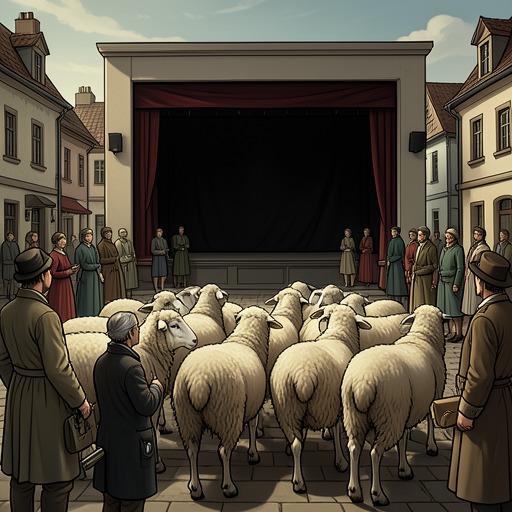
During the flock’s performance, the handkerchief appears as a rag used to represent Beth’s scent. Maude detects a faint, sourish smell on a rag in the toolshed that resembles Beth’s. To strengthen it, the sheep bury the rag overnight in dirt, cover it with chewed sorrel the next day, and wrap it around a recently deceased shrew that Heather found, leaving it there for a time. Sir Ritchfield undertakes the laborious chewing of the sorrel. The resulting smell is not exactly Beth’s, but the sheep consider the resemblance clear enough for them to identify her and hope it will register even with human noses.
Mopple the Whale shakes the rag during the performance, sending its sharp, pungent scent through the hall. The flock has also prepared a glittery pendant on a chain like Beth’s, but Miss Maple’s thick fleece hides the chain when the sheep try to place it around her neck. Instead, Miss Maple carries the small cross between her teeth, while Mopple follows with the rag. The performance thus presents the cloth alongside a second object associated with Beth: one stands in for her scent, while the other recalls her chain. Their improvised staging depends on the sheep translating human associations into visible and smellable signs.
Beth Recovers It
The rag’s public role changes when Beth appears at the back of the hall. She walks down the central aisle holding it tenderly, like a mother ewe, and its pattern of two red signs on a white background remains visible despite the dirt. She goes straight to the stage and stops in front of it. The marked cloth is no longer merely an item in the flock’s reconstruction: in Beth’s hands, it becomes something she recognizes and can use to address the people gathered there.
When the bespectacled man invites Beth onto the platform, she does not join him. She sits on the edge of the stage and smooths her skirt and the cloth. Her fingers continue to stroke it as she begins by speaking about herself rather than immediately explaining George. The handkerchief gives her a concrete object to hold and tend while she tells a story whose first decisive moment was defined by her inability to speak.
Memory and Significance
Beth explains that she gave George the handkerchief without a word and that seeing it again has made her recognize the silence as the great mistake of her life. The cloth’s return does not undo that earlier failure, but it gives the memory a form she can handle and describe before an attentive audience. Her recollection moves from the confidence of the night spent embroidering to the failed act of giving, making the same object record both her readiness and her retreat.
The handkerchief also links the flock’s imperfect method of investigation to Beth’s testimony. For the sheep, the rag is material evidence that can be altered, carried onto a stage, and made legible through scent and pattern. For Beth, it is a gift to George and the reminder of what she did not say. Its dirt and pungent treatment complicate rather than erase its personal meaning: the sheep have made it part of a public performance, but Beth’s calm recovery of it turns their prop back into an intimate keepsake. Through this change of hands, the object joins the flock’s attempt to represent Beth with Beth’s own account of her past.