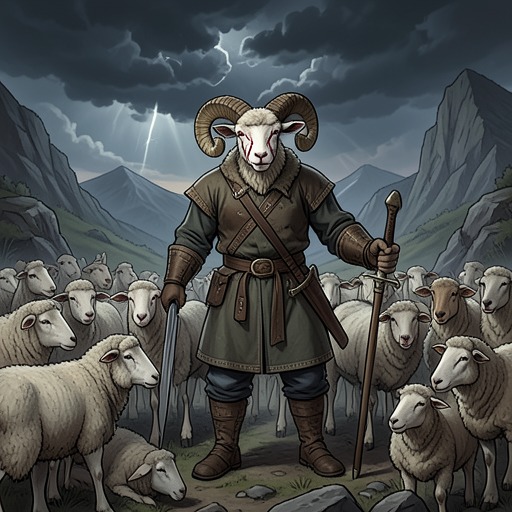
Dogs
Three Bags FullDogs are never a single, simple presence in the flock’s world. Tess is George Glenn’s faithful sheepdog and companion; Gabriel’s dogs are quiet, accomplished herders; and a wolfhound’s approach transforms a familiar pasture into a hunting ground. Through these contrasts, the flock distinguishes not only what dogs do, but how their movements, sounds, and attention change the meaning of an encounter.
Companionship and Loss
Tess is George Glenn’s old sheepdog, remembered by the flock as his most faithful companion and the gentlest dog ever to herd them. Their description of her as the one real love of George’s life places her close to him in a way that exceeds the ordinary work of managing sheep. Her absence becomes conspicuous after George’s death: Miss Maple adds the question of Tess’s whereabouts to the flock’s unanswered questions, and the sheep themselves wonder where she has gone.
When Rebecca brings Tess back in a car, she is changed. Her eyes are described as strange and sad, and she no longer races across the meadow or leaps around George’s caravan looking for him. Instead, she stays close to Rebecca, following her red skirt like a very young lamb following its mother. The change is visible in what Tess no longer does: grief appears not as an explanation, but as a break in her familiar habits and attachment to George.
Later, as Rebecca sits on the caravan step, she gently pats Tess’s head. Tess gives her tail a very slight wag—the first wag for a long time. This small response does not erase the earlier loss, but it marks a new connection taking shape. Tess follows Rebecca into the caravan, remaining close to the human who has brought her back to the flock.
Gabriel’s Quiet Herders
Gabriel’s dogs are introduced through their ability to impress. Their master’s dogs perform remarkable tricks, and Gabriel wins the sheepdog trials in Gorey every year. The sheep are drawn to Gabriel and expect great things from him as a shepherd, so his dogs’ reputation contributes to that anticipation. Their competence, however, is also a source of unease: skill at guiding a flock is inseparable from the power to direct sheep where they would not necessarily go themselves.
The dogs’ silence makes their authority especially unsettling. They do not bark; instead, they stare at the sheep, and that attention is enough to stir an old fear of wolves. When they briefly gather the flock together, Gabriel counts the sheep without making a sound. Gabriel looks at each animal in turn and gives a nearly imperceptible nod, which most of the sheep take for approval. Othello punctures that hopeful reading by recognizing that Gabriel was counting them. In the sheep’s eyes, the same quiet inspection can feel at once flattering and calculating.
Their skill is clearest when Gabriel’s own flock must be moved. After George Glenn’s sheep feign scrapie, Gabriel whistles for his dogs and tears open the wire fence around the enclosure. The dogs drive Gabriel’s sheep out in orderly fashion, without causing any of them to panic. Within minutes, the fenced enclosure is empty and dust on the path is all that remains of Gabriel and his flock. The episode demonstrates the dogs’ precision, while its consequence is decisive: their disciplined herding helps Gabriel withdraw from the pasture.
Herding and the Threat of the Hunt
Elsewhere, sheepdogs become frightening through a change in scale and context. As human groups gather near the dolmen, their dogs range farther across the meadow and form a small pack: three sheepdogs and another dog. The flock recognizes the old discomfort of being herded, chased apart, and brought together again. Their fear is not initially the fear of a novel experience; it is the return of a familiar helplessness, as dogs move like predators while directing the sheep.
The additional dog makes that discomfort into immediate terror. A gray wolfhound moves low to the ground like the sheepdogs, but the resemblance does not reassure the flock. Unlike the herding dogs, he does not bark or hesitate. His approach makes the sheep feel, for the first time, that they are being hunted. The flock breaks into panic and scatters, carrying the startled sheepdogs along with it; Mopple runs through the human crowd and knocks Harry the Sinner over.
From her rocky ledge, Zora can see what follows. Near George’s Place, Othello and the wolfhound rise from the ground, and Othello attacks rather than fleeing. The dog first loses his nerve and swerves away from the charging ram, then crouches with his teeth bared, ready to spring. The danger lies not simply in the wolfhound’s presence but in the difference between a dog that herds and one whose movements signal an attack. Othello’s unexpected counterattack briefly reverses the assumed relation between dog and sheep.
Dogs within Human Systems
Dogs also mark the human arrangements surrounding the pasture. When the butcher arrives, the sheep fear him intensely, and the dogs themselves are said to be afraid of him. The detail enlarges the butcher’s menace beyond the sheep’s response: even animals associated with control and force are affected by his presence. Yet the flock’s knowledge remains rooted in what it can observe and sense; the dogs’ fear is part of the scene’s atmosphere, not an explanation of the butcher’s power.
The novel’s contrasting dogs therefore occupy different positions in the sheep’s experience. Tess belongs to a history of care and shared life with George; Gabriel’s dogs exercise trained, silent control; the wolfhound brings the possibility of predation into a familiar landscape. The flock reads these differences through concrete signs—whether a dog barks, stares, herds without panic, or approaches as if to hunt. Dogs help reveal the limits of the sheep’s security, but they are not merely interchangeable threats: their distinct conduct shapes the flock’s judgments, memories, and responses.