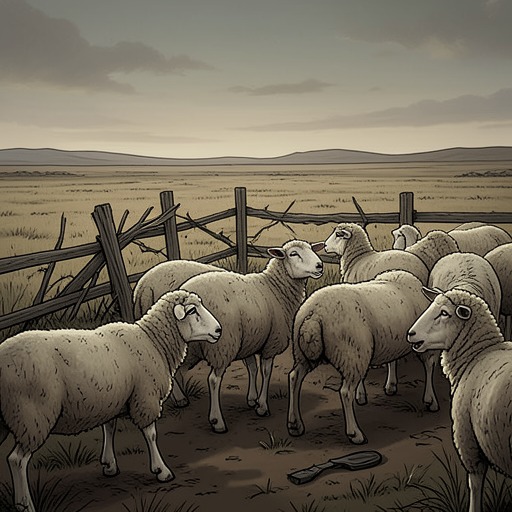
Focus and Paying Attention
Three Bags FullFocus and Paying Attention is Melmoth’s survival discipline: a way for the flock to notice what is actually before them, govern their own reactions, and avoid being herded by fear or force. Its lessons begin with a deceptively simple contrast. A sheep may be grazing without truly attending to the world; a sheep that pays attention turns the same act into an alert, self-directed search. The distinction matters because, in Melmoth’s teaching, survival depends not on having different surroundings but on perceiving them differently.
The Enemy Within
Melmoth introduces the discipline by asking the flock to name its worst enemy. The answers range across the dangers currently pressing on the sheep: the butcher, Gabriel, the master hunter, and the wolf. Zora offers the abyss, which reflects her own habitual way of understanding danger. Melmoth rejects the external list. The sheep are their own worst enemies when they are stout and lazy, cowardly and scared, thoughtless and simpleminded. The charge is severe, but it shifts the problem from an enemy the flock cannot control to habits it might change.
His first instruction is disbelief: the sheep should not accept what they do not understand, but should understand what they believe. Othello is to help them learn. The lesson therefore treats attention as more than alertness to an immediate threat. It requires questioning the first impression and examining how an apparently ordinary action is being performed. Melmoth’s method is practical rather than abstract: the flock watches a sheep grazing and learns to discriminate between absent-minded routine and deliberate awareness.
Othello’s Demonstration
Othello first grazes as if lost in thought, roaming dreamily while searching for grass. At Melmoth’s signal, he begins to graze with intense concentration, his senses extended through the grass and outward in every direction. The visible action remains the same. Mopple the Whale guesses that Othello is eating different fodder, more clover and less oat grass; Miss Maple recognizes that there is no difference in what he is eating. Melmoth’s point is that the change lies in Othello’s attention, not in the grass.
The distinction produces the central paradox of the lesson: the attentive sheep sees but is not seen. Attention does not make Othello physically different or erase danger; it makes him more capable of detecting what is around him. Melmoth links that heightened awareness to survival, and to the flock’s ability to track the hidden thoughts of humans, whose words and scents may mislead. The only ones who can ensure that the sheep continue paying attention, he insists, are the sheep themselves. Forgetfulness makes them vulnerable again.
The Stone and the Work of Practice
Melmoth next directs the flock’s attention to a stone. Heather objects that stones are not dangerous, and Melmoth counters that one flying at a sheep’s head could kill. His lesson is not simply that the flock should fear every stone. It is that a familiar object can become dangerous under circumstances the sheep have failed to consider. A lamb pays attention once it recognizes that its own skin is at risk. The flock stares at the stone so intently that they remain fixed on it through a sudden storm, becoming drenched as rain and lightning transform the scene around them.
Heather soon tires of the exercise. She wants to learn to herd sheep and become dangerous. Melmoth answers that she cannot herd anyone until she can herd herself: she is already a danger to herself, and only after she learns not to be can she pose a danger to others. Attention is thus bound to self-command. It does not mean simply watching harder; it means becoming less governed by impulse and more capable of directing one’s own action.
The afternoon’s lessons take different forms across the flock. Maude discovers she can sleep with her eyes open in broad daylight; Mopple the Whale finds he can go an entire afternoon without grazing; Sara learns to shoo flies by twitching muscles without moving her ears; Heather learns to keep quiet. Not every sheep masters Melmoth’s art, but the exercises make attention bodily and specific rather than a vague ideal. The flock later walks along cliff tops, attending to every step, and is sent to steal Gabriel’s dripping-wet shepherd’s hat from the caravan steps after he runs inside to escape the cloudburst.
The training has comic failures as well as successes. During a mock attack, Mopple the Whale concentrates so hard that he forgets to swerve and is run down. Heather, equally absorbed while grazing, swallows the wrong way and chokes. These mishaps show that attention itself is not an automatic safeguard: it must be directed and practiced, and an undisciplined concentration can create fresh risks. Still, the flock learns faster than it understands. Watching everything with the intensity Melmoth demands leaves them with less time to feel afraid. Awareness does not abolish danger; it changes how much of the sheep’s attention fear is allowed to occupy.
Herding Themselves
As evening approaches, Melmoth extends the lesson from noticing danger to resisting control. Lane regards being herded as something that simply happens, a response built into the legs. Melmoth argues that it happens because the sheep let it happen: dogs and flock may move them because they have not learned to direct themselves. He tells them to forget the flock and the dogs and herd themselves.
For practice, Melmoth takes the role of sheepdog, circling the flock in a rush of mock attacks, feints, and sudden withdrawals. The sheep’s task is simply to stand still. Some run instinctively; others manage to remain in place, and all end exhausted. The exercise turns his earlier insistence on self-command into a physical test. Attention must hold through pressure and movement, not merely while the flock studies a stationary stone or watches Othello graze. The discipline’s culminating rule is therefore active resistance: the sheep must notice what is happening, recognize their own tendency to flee, and choose whether to follow it.
A Sensory Way of Knowing
The teaching grows out of a world in which smell, sight, and bodily proximity provide different kinds of information. Before Melmoth’s formal lesson, Miss Maple investigates George’s body by circling it, inspecting the spade, smelling his clothes and face, and finally putting her nose into the wound. The other sheep watch from a distance; Maple’s close examination makes attention an investigative act, one that accepts unpleasant evidence rather than looking away.
Mopple the Whale’s encounter with the fallen spade in the mist shows both the power and the limits of such perception. He notices that the tool smells unusually clean, then follows a faint human trace through the odors of soapy water, whiskey, and cleaning fluid. Only gradually does he realize that he is sensing a person moving beside him. His discovery depends on distinguishing the scent of the spade from the more complicated human smell, but the mist and his fear also unsettle his judgment. Attention supplies clues; it does not guarantee calm or certainty.
The same sensory difference shapes the flock’s understanding of humans. When Miss Maple watches Beth and Rebecca through a window, she cannot smell them and experiences the missing information as an incomplete, ghostly world. Later, while preparing its contest performance about George’s death, the flock works to make a rag carry a scent resembling Beth’s: Maude finds a faint sour smell, and the sheep strengthen it with dirt, chewed sorrel, and a recently deceased shrew. These episodes place Melmoth’s teaching within a broader method of knowing. The sheep attend not only to what humans say or what their bodies visibly do, but to traces that human observers may overlook. Focus and Paying Attention gives that sensory intelligence a discipline—and turns it, finally, toward the flock’s own freedom of action.