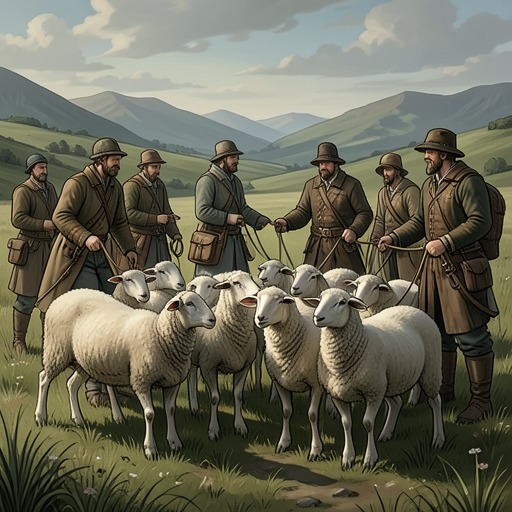
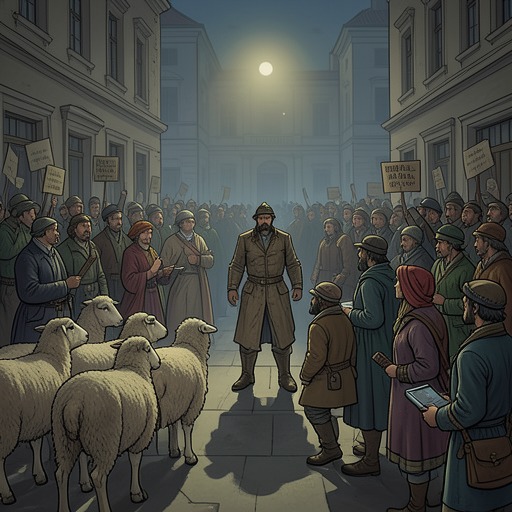
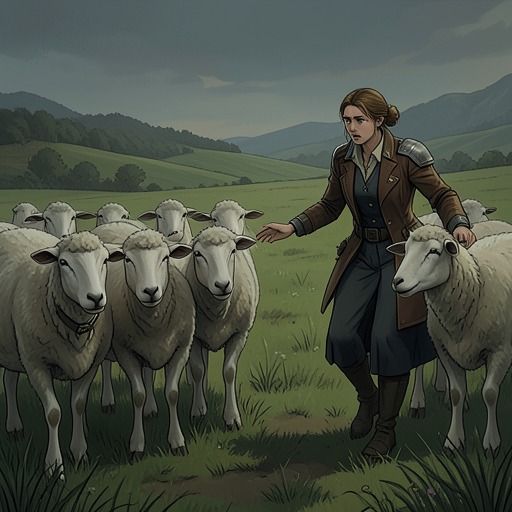
Gabriel and his sheep
Three Bags FullGabriel’s relationship with Gabriel’s meat-breed sheep is care organized around an ending they cannot recognize: he feeds and confines them so they will grow fat, while they experience his management as shepherding. The contradiction becomes legible to Zora through an older ram who names their fate, turning an apparently abundant pasture into a place of fear and impending slaughter.
Husbandry and hidden purpose
When Gabriel repairs the wire fence, Gabriel’s meat-breed sheep look greedily toward George’s Place. Eddie observes that they are hungry, and Gabriel responds with pride that they eat a great deal and are good doers, adding that they have to be fattened. His language makes their appetites sound like a successful husbandry problem; the ram’s later account reveals that weight gain is not an end in itself but preparation for death.
Gabriel’s method becomes visible when he takes George’s scythe from the toolshed behind the shepherd’s caravan and cuts grass on the side of the hill facing away from the sea. The local flock had known the implement, but not its use: George had said that people who keep sheep could spare themselves a scythe. Gabriel uses it to make fodder, yet the spectacle looks less like grazing than destruction. The blade passes through grass that lies flat without resistance, and the cut grass smells good even as its loss horrifies the watching sheep. Gabriel’s meat-breed sheep feed on what he has mown, while Zora’s flock sees the cost of a practice that treats grass, and ultimately the animals, as material to be harvested.
Their hunger and confinement reinforce one another. The wire fence keeps Gabriel’s meat-breed sheep from wandering freely into George’s pasture; later, while Gabriel repairs it, his animals continue to cast hungry looks toward George’s Place. A powerful ram among them stops eating the mown grass and watches the other flock. His attention creates the possibility of communication across the barrier, even though the surrounding conditions are designed to keep the animals contained and occupied.
Zora and the ram
Zora approaches the ram despite having resolved not to speak to Gabriel’s sheep after earlier efforts failed and after they swarmed over her flock’s meadow. She tries passing him more than once before moving closer to the wire. His older age and apparent intelligence draw her interest, but what holds her attention is the abyss she senses in him. Their encounter begins not as a general exchange between flocks but as a tentative connection with an animal who appears to understand something the others do not.
The ram tells Zora that Gabriel’s meat-breed sheep are meat, and explains the sequence plainly: they eat, grow fat, and die. He warns her to run away, but lowers his head and falls silent when she asks why he does not warn the others or escape himself. His knowledge is real, yet knowledge alone cannot open the fence or persuade a flock kept from seeing its destination. Zora recognizes the depth of what he has understood; the ram, in turn, can tell from her wide eyes that she has understood him. For a moment, their recognition crosses the barrier more effectively than words alone could.
The ram explains the forces that keep Gabriel’s meat-breed sheep in place as fences made of fear. The sheep are young and do not understand; the mother ewes forget, and want to forget. Gabriel’s fences are high and his dogs fast. The ram looks toward Gabriel with an empty expression, carrying an understanding that has not made escape possible. Zora sees him as exceptionally brave, not because he has defeated these restraints, but because he looks into the coming danger alone, day after day. Her consoling image of his becoming a cloud sheep places his likely death beside the flock’s legend of sheep who graze in the sky, without changing the immediate reality of his confinement.
Control, flight, and the flock
Gabriel’s authority is also tested when three sheep go off and he pursues them. Miss Maple reads the episode through his position as lead ram: he wants Gabriel’s meat-breed sheep to remain together, in one place and still, like his own flock, but cannot keep them all together. The escaped animals’ movement exposes the limit of control; Gabriel’s pursuit shows that he responds to separation by trying to recover them, not by relinquishing his claim over their whereabouts. Miss Maple also concludes that Gabriel is watching the shepherd’s caravan because something important is inside it and must not get out, linking his attention to the caravan with his efforts to keep his animals contained.
This relationship contrasts with the way the local flock interprets the role of a shepherd. After George is found dead, the sheep initially wonder who will bring them hay; their experience of a shepherd includes practical care and a shared pasture. Gabriel’s treatment complicates that expectation: he supplies cut grass and manages a flock, but the ram understands those acts as steps toward slaughter. The pastoral appearance of feeding therefore conceals a severe asymmetry: Gabriel knows the purpose of fattening, while the animals around him largely continue to eat without understanding what their appetites are serving.
The choice of a different future
The distinction between care and control resurfaces when George Glenn’s will is read. The remaining fortune is left to George’s sheep so that they can go to Europe, with an authorized representative appointed to accompany them as shepherd. The representative must ensure that the sheep receive stories read aloud and observe conditions including a ban on selling or slaughtering them; a third party will check that these obligations are met. The legal arrangement makes the fate of George’s flock explicit, in sharp contrast with the hidden purpose governing Gabriel’s meat-breed sheep.
When the lawyer asks whether anyone else wants the position, Rebecca volunteers. Gabriel stands beside the lawyer, but the sheep are relieved at the prospect of travelling under someone other than him. His soft Gaelic murmuring does not draw them back: Othello steps forward, turns away from Gabriel, and trots to Rebecca, and the flock gathers around her. This choice does not itself free Gabriel’s meat-breed sheep or establish their future; it shows the local flock asserting a preference about who will guide them. Set beside the ram’s warning, that collective movement distinguishes a shepherd chosen by the sheep from a lead ram who tries to keep his flock in place while its members remain unaware of where their feeding leads.