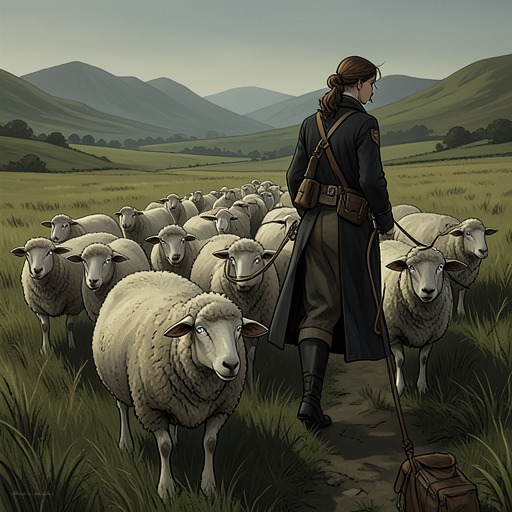
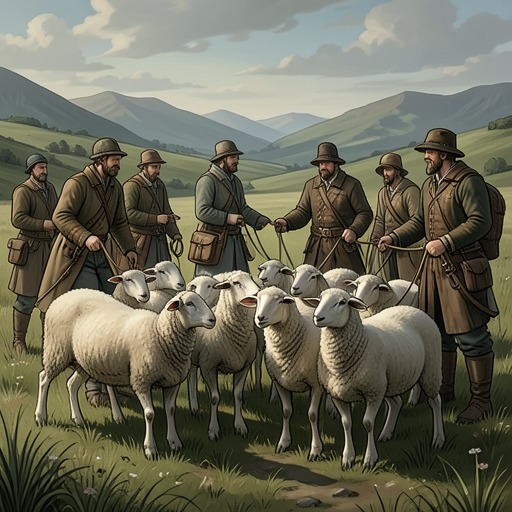
Gabriel arrives at the Glennkill pasture with his flock
Three Bags FullGabriel arrives at the Glennkill pasture with his flock at a moment when George Glenn’s sheep have lost both their shepherd and their sheepdog. His approach first registers as noise and movement in the distance, then as a new human presence accompanied by dogs and another flock. Gabriel appears to offer care and order, but the arrangement he establishes is also useful to him: it keeps his own sheep on nearby grazing land while he waits for George’s will to be read. The arrival therefore turns a sudden vacancy into an uneasy new dependence.
A pasture without its shepherd
The sheep’s first encounter with Gabriel’s approach is not a formal introduction. A dark shape moves quickly along the path toward the meadow, and panic sends the flock galloping uphill without taking their eyes off it. The figure they identify as God has been pacing the meadow, following a trail with his nose; he walks around the dolmen and up toward the cliffs, nearly going over the edge before looking up at the sea. When he hears the approaching noise, he freezes, turns, and flees along the path toward the moorland. The sheep hear the sound too: a rush like the one they made when they invaded George’s vegetable garden, followed by barking dogs and human voices. Only then do they see a flock moving toward them, unlike any they have encountered before.
The pasture has already changed in George’s absence. On the morning after the sheep find him dead beside the hay barn, a crow perches on his sweater while a rabbit sits nearby; the sheep meet at a distance, near the cliff. The following day, once they venture out, Mopple the Whale leads them to the vegetable garden behind George’s caravan. George had fenced it off, but Lane pushes back the bolt and Maude, Cloud, and Heather begin eating the buttercups, peas, and tomatoes. The neatly planted beds are soon stripped. The sheep fall silent, feel ashamed, and return to the meadow. Othello, who did not join the raid, then draws Miss Maple’s attention to the garden spade’s usual place beside the caravan: it is missing. Gabriel’s arrival follows this discovery of a world in which familiar human supervision has vanished, but the missing tool and the body by the hay barn give that freedom a disturbing edge.
The newcomer and his flock
When Gabriel drives the flock toward the meadow at dawn, he is tall against the sky and wears a slouch hat. The sheep initially have high expectations of his abilities as a shepherd. His dogs briefly herd them together, then Gabriel counts them without making a sound. The dogs never bark; they only stare, and that silence revives the sheep’s deep fear of wolves. Gabriel’s attention seems more personal. Standing outside the caravan, as still as the dolmen, he looks at every sheep in turn and gives each one an almost imperceptible nod. Most interpret the gesture as approval and take pride in having been inspected. Othello punctures that optimism: Gabriel was counting them, not praising them. He keeps apart from the others and regards the new shepherd with suspicion.
The arrival also divides the pasture. Cloud suggests asking Gabriel’s sheep about their lives, but Gabriel’s dogs have gathered them at one side of the meadow while he puts up a wire fence. The barrier makes the sheep’s grazing area smaller, particularly around the place where mouse weed grows. Maude objects less to the specific loss of that patch than to the principle of being fenced in. At the same time, the flock is relieved not to have to mingle freely with the newcomers, whom they find strange: short-legged and long-backed, with long, humorless noses, restless eyes, and pale colouring. Their close, curly down offers little wool, although they do not look recently shorn. The sheep cannot understand why Gabriel keeps animals that do not grow a proper fleece, and their uncertainty marks the distance between the two flocks before they know what the newcomers are for.
Care with a practical purpose
Gabriel’s authority is presented as temporary, but he makes himself at home beside George’s caravan. When Josh visits, Gabriel explains that the sheep need looking after until the will is read. He has received support from the management office on the grounds of animal welfare and hygiene regulations, and says that keeping the flock there saves him the cost of grazing his own. He also makes clear that he can stay beside the caravan as long as he likes. Josh leaves reassured; Gabriel, by contrast, reaches for a key he had left on the caravan step and finds it gone, only to see it shining from the roof in a magpie’s beak. The small interruption offers no resolution to the larger uncertainty over who will control the pasture, but it shows that Gabriel’s presence does not give him command of everything around him.
The practical side of his shepherding becomes stark when he takes George’s scythe from the toolshed and cuts grass at the foot of the hill, on the side facing away from the sea. George had said that people who keep sheep could spare themselves a scythe; Gabriel uses one anyway. The sheep have never seen a human grazing in this manner. To them, the blade passes through the grass like a gigantic iron claw, leaving the cut stalks flat and the living meadow altered. Gabriel is gathering grass for his animals, yet the sight appears to the flock as destruction without purpose. Mopple trembles in indignation and horror. What had seemed at first like the arrival of a capable replacement shepherd thus acquires a more troubling aspect: Gabriel’s care is real in its practical function, but it is bound to a different way of using the land and managing animals.
Significance of the arrival
The arrival changes the flock’s immediate circumstances without restoring the world they knew under George. Gabriel counts and confines sheep, claims the right to stay, and supplies grass, but his flock’s presence narrows the meadow and his methods disturb the animals he is meant to look after. His explanation to Josh makes the arrangement’s mixed motives explicit: care for George’s sheep coincides with cheaper grazing for his own. The sheep, meanwhile, read his gestures and equipment through their own experience—first as signs of approval, then as evidence of counting and cutting.
The scene also reverses the pastoral promise of an open, abundant meadow. In place of George’s watchful, fenced vegetable garden, the sheep now face a divided pasture, silent dogs, and a scythe that makes the act of feeding look like violence against the grass. Gabriel’s arrival is not simply the solution to the flock’s abandonment. It begins a new contest over space, care, and the meaning of shepherding, while the will’s pending reading leaves his authority provisional.