Gabriel’s meat-breed sheep
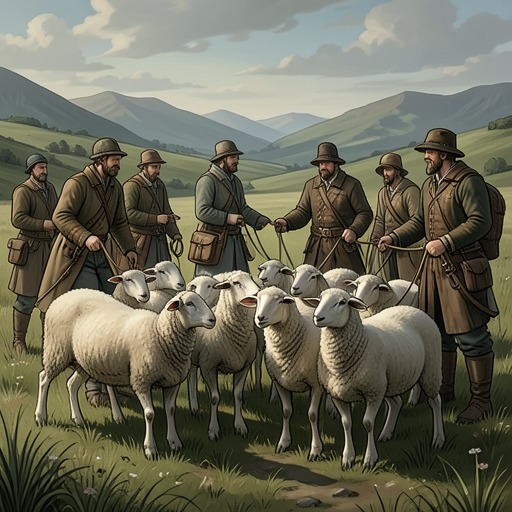
Three Bags FullGabriel’s meat-breed sheep are the tightly grouped flock Gabriel brings to the Glennkill pasture, where their grazing and care reveal that they are being fattened for slaughter. They first appear as a mass pressing into limited space; later, one ram’s warning gives that image its terrible meaning. Their presence turns pastoral plenty inside out: grass is not simply food and abundance, but part of a system preparing animals for death.
Arrival and First Impressions
When Zora approaches, Gabriel’s sheep graze shoulder to shoulder, so close that their arrangement seems uncomfortable. They remain absorbed in feeding, and although their senses ought to register Zora’s arrival, none acknowledges her. Sheep lift their heads and scan their surroundings, but their eyes pass over her as if she were invisible. Zora waits politely for someone to address her, then bleats loudly when patience fails. Their muzzles stop, their necks rise, and countless pale eyes turn toward her, yet the attention produces no conversation or welcome.
The encounter establishes more than a contrast between two flocks. Zora is accustomed to looking into an abyss, and she stands her ground before the unfamiliar sheep, but neither that confidence nor her playful attempt to graze alongside them changes their silence. Their close formation and apparent inattention make them seem almost inaccessible to the neighboring flock. The difficulty is not simply that the groups do not know one another; the animals’ shared world has not yet supplied a common understanding through which Zora can reach them.
Their physical presence soon becomes harder to ignore. At night, Gabriel’s sheep break out of their fenced enclosure and advance toward the hay barn in a compact phalanx of necks and moving heads. In the dark their pale bodies seem to give off a wan light, and their numbers become newly apparent. They move together across the meadow like a machine passing over a field, grazing toward George’s flock. Zora’s alarm recalls her earlier failure to make contact, but now the separation between the groups has become a direct threat to the pasture.
Fences, Grass, and Gabriel’s Care
Gabriel’s sheep are kept in a fenced patch of meadow. When Gabriel repairs the fence, they look greedily toward George’s Place, and one of them remarks on their hunger. Gabriel acknowledges that they eat a great deal and describes them as good doers who must be fattened. His words are practical from the perspective of livestock management; to the sheep listening, they begin to sound like a clue about what their bodies are being made for.
Gabriel then takes a scythe from the toolshed behind the caravan. George had kept the tool polished, but the flock had not understood its purpose. Gabriel uses it to cut grass on the side of the hill facing away from the sea. The sheep watch a human working at pasture, an unsettling reversal of the ordinary division between shepherd and grazer: Gabriel cuts the grass while they eat, yet the instrument’s passage through the meadow appears to them as destruction rather than husbandry. Its hostile singsong note accompanies flattened blades that offer no resistance. The scent rising from the dead grass intensifies the scene’s horror for the flock, and Mopple the Whale trembles in the summer sun.
The sight changes how George’s flock regards Gabriel. Heather proposes ignoring him, noting that he does not look at them either. The sheep turn their hindquarters toward the caravan and graze past him in a deliberate display of contempt. Gabriel appears not to notice. One of his sheep, however, has stopped eating the cut grass and is watching them. The contrast matters: the larger flock seems absorbed in feeding, while this older, powerful ram attends to the other sheep and possesses a knowledge he is trying to communicate.
The Ram’s Warning
Zora recognizes the ram as the one who had caught her attention before. She has resolved not to speak with Gabriel’s sheep again, after her first attempt failed and after their massed incursion into the meadow, but this animal’s watchfulness draws her back. She senses an abyss in his pale eyes and makes several passes near him before he finally speaks. His first words connect fodder with death. When Zora assumes he means the cut grass, he corrects her: the sheep themselves are meat.
The ram’s statements are spare and difficult for Zora to absorb. Gabriel’s sheep eat; they grow fat; they die. The ram lowers his head before completing his thought about himself. He repeats his warning to run away, while Zora tries to understand what he means. The words good doers, Gabriel’s insistence that the sheep be fattened, and the ram’s account of their fate come together in her mind. She recognizes that the flock is a meat breed, and that the grass Gabriel cuts is not merely food but part of the process by which they are prepared for slaughter.
The ram’s knowledge is not shared by the flock around him. They continue feeding on the mown grass, apparently without understanding the fate he sees approaching. His ability to name their danger does not give him power to make the others understand it. In this, his predicament differs from Zora’s: she has a flock to which she can report what she has learned, while he appears isolated within the very group whose future he comprehends. His repeated warning expresses both urgency and the limits of what he can do.
Zora’s Account and the Flock’s Doubt
Zora carries the discovery back to George’s flock. She explains that Gabriel is fattening his sheep for their meat and connects their rapid growth to the designation meat breed. She also recalls that George had said Mopple the Whale belonged to a meat breed and had used the phrase under the knife. That association makes the danger immediate rather than abstract: the fate threatening Gabriel’s sheep belongs to a category that can include a familiar member of Zora’s own flock.
Her explanation does not arrive as a complete report from the ram. Zora admits that he did not state everything directly; she inferred the truth from his fear, his fragments, and Gabriel’s actions. The distinction shows how the flock’s knowledge is assembled. The scythe gives them a visible disturbance, Gabriel’s comments supply a practical clue, and the ram’s warning supplies the missing connection between fattening and death. Zora has to interpret those signs before she can ask the others to believe her.
The ram’s story gives the episode its sharpest reversal. In a pastoral setting where abundant grass ordinarily signifies security, Gabriel’s mowing is not evidence of shared care for the meadow. It is part of an economy that turns nourishment into weight and weight into value, while the animals being fattened do not necessarily understand the consequence. The flock’s close, repetitive grazing thus carries a double meaning: it is ordinary feeding, but also the visible stage of a fate the ram can foresee and the others cannot.
Narrative Significance
Gabriel’s meat-breed sheep widen the novel’s attention beyond George’s flock and their investigation. They have their own vulnerability, expressed not through a human explanation of animal husbandry but through the sensory and social details available to the sheep: cramped grazing, pale eyes, the smell and sight of cut grass, and a ram’s broken warning. Their experience makes the difference between being fed and being cared for impossible to take for granted.
The episode also tests the limits of communication across flocks. Zora’s first attempt to make contact meets apparent indifference, and her later understanding depends on noticing one animal who watches, listens, and speaks. She then has to translate his fear into a form her own flock can recognize, using Gabriel’s words and the remembered example of Mopple the Whale. Gabriel’s sheep therefore function neither as a faceless backdrop nor simply as a threat to pasture. Through their uneven access to knowledge, they reveal the violence concealed within an apparently ordinary routine of feeding and fattening.