George Glenn
Three Bags FullGeorge Glenn is known to the flock first as the shepherd lying dead in the grass, a spade driven into him, and only later as a man whose life contained attachments and despair the sheep could not fully understand. His apparent murder sets the flock investigating; the eventual disclosure that he chose to die, with Beth’s help, changes the meaning of that first scene without erasing the sheep’s sense of responsibility toward him. In memory, he is at once their practical caretaker, reader of stories, teacher to Othello, and the person who promised that his sheep would go to Europe.
Identity and Life at the Pasture
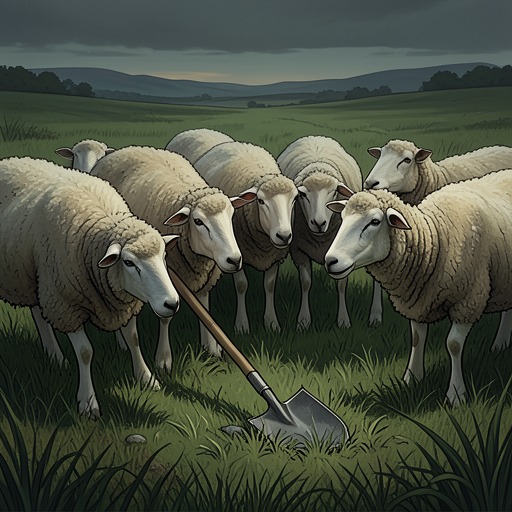
George’s body lies beside a path near the hay barn, impaled and still. The sheep gather at a distance, on the cliffs, where they cannot smell the blood; although they feel responsible, they do not know what to do. Miss Maple insists that someone deliberately put the spade into him and calls the act murder. That conclusion gives the flock an immediate task: they owe their shepherd the same effort to find a culprit that he once made when a fierce dog took one of their lambs.
The flock’s memories complicate the image of an employer who simply kept animals. George spent long days in the meadow, arriving early while the sheep still slept close together. Tess had to drive them apart, and George laughed at their reluctance to begin work. While they grazed, he tended his vegetable garden or made repairs. Later, he would sit by the steps of his caravan and read aloud. The stories ranged from fairy tales and books about sheep diseases to a detective story he abandoned halfway through, leaving its murder unresolved. Most often, he read love stories about red-haired heroines and became angry at their plots, especially when he connected them to his wife.
His daily presence also shaped the flock’s understanding of its surroundings. Behind the caravan, his fenced garden held lettuces, peas, radishes, cress, tomatoes, endives, buttercups, and chives. While George was alive, the fence and his watchfulness kept the sheep out. After his death, they pushed the bolt aside and ate the beds almost at once. Their raid ended in embarrassment; Othello, who had not joined in, led Miss Maple to the spot where George’s garden spade usually leaned. It was missing. The ruined garden and absent tool turn ordinary traces of his care into clues in the flock’s inquiry.
Land, Work, and Conflict
George’s pasture was valuable to people beyond the flock. Villagers speaking after his death accuse him of blocking development: they say he rejected offers for the land, kept tourists away, and made money through nighttime boats bringing drugs to his caravan. These are allegations voiced by others, not facts established by the sheep’s immediate observations. Their complaints nonetheless reveal a sharp contrast between George’s use of the place and the commercial plans they imagine for it: to them, the view is wasted on sheep; to George, the flock and pasture are his life’s work.
The later arrival of Gabriel makes that contrast visible in a different way. Gabriel takes George’s scythe from the toolshed and cuts grass himself. The sheep had seen George polish the blade with a red-and-white rag, but he had said that people who kept sheep could spare themselves its use. Gabriel’s cutting is therefore not simply an unfamiliar agricultural task to them. The iron blade turns the meadow into a scene of destruction: grass is laid flat, while Gabriel gathers it to feed his sheep. The difference between the two shepherds is registered through work on the same land and through the tool George left behind.
The Will and the Promise of Europe
George’s will was drawn up and signed on April 30, 1999, before three witnesses, including the lawyer who later reads it. It directs that the will be publicly read at noon beneath Glennkill’s old village lime tree on the Sunday following his death, or one Sunday later. The formal setting gathers villagers and sheep around a document that is both a legal instrument and the means by which George speaks to the flock after his death.
The decisive provision leaves his fortune to his sheep so that they can go to Europe, as he had promised them. The revelation first meets disbelief and laughter from Kate, while the sheep take in the promise with mounting joy. For Othello, the inheritance also calls back to lessons George gave him behind the caravan: how to lead a flock, keep his nerve while moving, and guide others forcefully but cautiously past or over obstacles. Othello remembers George’s confidence in him and imagines putting that training to use on the journey. The will thus gives the sheep more than a destination. It turns remembered instruction into a possible future, though George will not travel with them.
Rebecca and the Private Story
Rebecca’s account supplies an intimate identity that the flock had not known how to name. In a story she tells the sheep, a girl has two fathers, one secret and one acknowledged. She and the secret father are fond of each other, but after a quarrel they do not speak for a long time. A letter says that he plans to travel to Europe and wants to see her first. The girl hides her happiness and keeps him waiting; he waits until he dies. The framing makes clear that George was Rebecca’s secret father and that the missed meeting became a lasting sorrow between them.
That revelation places the promise of Europe beside a journey George could not make while alive. His provision for the sheep points forward, while Rebecca’s story looks back to a reunion deferred until it was too late. The flock hears the tale as a sad account rather than as a complete explanation, but it gives emotional context to the will and to George’s absence from the journey he arranged.
Death and Aftermath
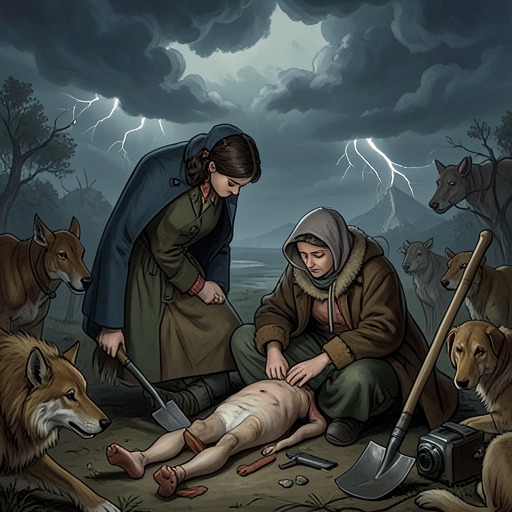
Beth’s later confession overturns the flock’s first interpretation of George’s death. She recalls that, late one evening, he came to her door. She began speaking about the Gospel as she had in their previous encounters, but he gently stopped her and said that what he needed to discuss was important. Beth explains that he intended to die and that she could not give him the courage to continue; she also helped him carry out what he wanted, fearing that otherwise he would not be buried. She went to the meadow in pouring rain after he told her it would be over within an hour, and found him already dead. The evidence does not describe the precise method he used, but it establishes that his death was not the murder the flock had inferred from the spade.
George’s posthumous presence is built from such partial knowledge: the body that prompts an investigation, the routines the sheep remember, the document that secures their future, and the confessions that expose private grief. His death is not made simple by the revelation of suicide. The sheep’s original conviction that he deserved protection arose from their history with him, while Beth’s account shows the loneliness and remorse surrounding his final choice. His legacy remains active in both directions: the flock carries his lessons toward Europe, and his concealed past alters what they understand about the shepherd they thought they knew.