George Glenn's despair and loneliness
Three Bags FullGeorge Glenn’s despair and loneliness are presented not as a sudden crisis but as a long retreat from human company, hope, and eventually life itself. Beth remembers him moving away from everything over many years, while Rebecca’s account of a father and daughter makes their private estrangement part of that decline. His wish to travel to Europe remained real, but by the time the journey seemed possible, fear and lateness had overtaken it.
A Long Withdrawal
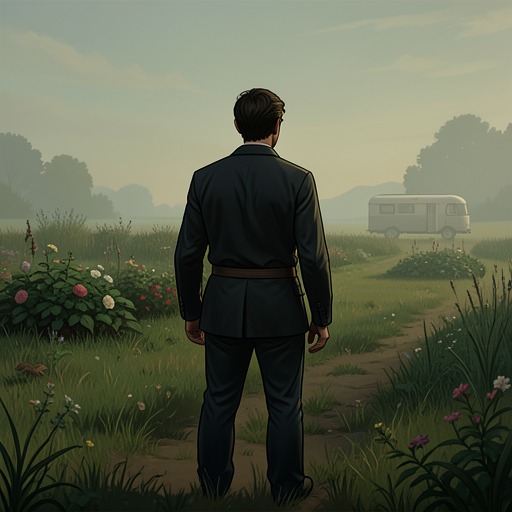
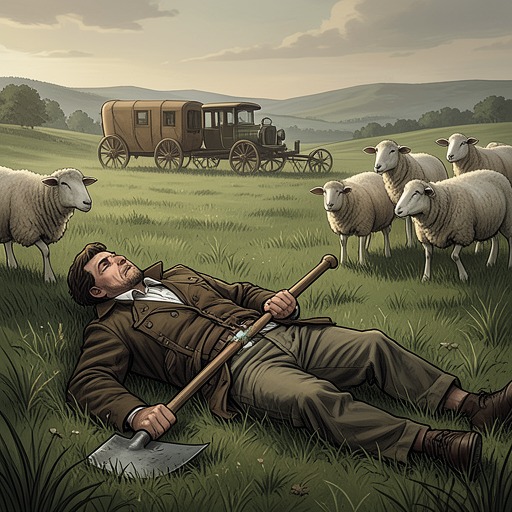
Beth describes George as lonely, habitually alone with his sheep, and progressively detached from the world around him. In her account, he moved away from everything step by step, toward what she calls something black. The image conveys an ongoing change rather than a single identifiable turning point: his isolation had become visible to her, even though she could not say exactly what had started it.
The decline had been especially severe when Beth returned from Africa seven years earlier. She did not know what had happened to George then and did not want to speculate, but she recalls that from that period onward he got on with no one in the area, or with God. At first, she thought his estrangement might have resulted from her own absence. She later recognized that explanation as vanity, and admitted that although she said much to him, she never said the one thing she most wanted him to hear.
George and Rebecca
Rebecca gives the father-daughter separation an oblique, story-like form. In her tale, a little girl has a secret father as well as an acknowledged one; she and the secret father are fond of each other, but after a quarrel they stop speaking. When he sends word that he plans to travel to Europe and wants to see her first, she conceals her happiness and makes him wait. The story ends with him waiting himself to death.
The tale presents estrangement as something maintained by both affection and silence. The girl’s concealed joy does not become a meeting, and the father’s wish to travel does not become a journey. Its fable-like distance lets Rebecca speak about her relationship with George without initially narrating it as direct confession, but the circumstances make the emotional connection clear.
Europe and the Final Crisis
George’s desire to go to Europe had not simply disappeared. Beth recalls that he told her he would still like to go, but was afraid and felt it was too late. She also remembers having given him a handkerchief and says that hope itself could be difficult to bear: the greater the hope, the greater the fear that it might fail. She thought he may no longer have had the courage to discover whether the journey was possible after all.
Beth’s testimony connects that fear to the loneliness she had observed, but it does not supply a single explanation for George’s decision. She says she could not give him the courage to continue and that she eventually helped him do what he wanted, fearing that otherwise he would not be buried. Her trembling hands and difficulty tracing the lines on the cloth give the disclosure a bodily expression of grief; the admission is painful precisely because care and assistance have become inseparable from her remorse.
Naming the Death
For the sheep, suicide is a new and difficult concept. When Zora asks whether George’s action was crazy, Fosco names it as suicide and explains that humans sometimes look at the world and decide they do not want to live. The explanation gives the sheep a word for what happened, but it does not make George’s choice comprehensible to them. They are especially baffled because he had usually explained things in terms they could understand.
Rebecca, too, holds onto uncertainty about George’s final intentions. She imagines that he may have believed, almost to the end, that he would still go to Europe; in her understanding, he then went on a different journey. The thought helps her, though her reddened eyes and tears show that it does not resolve her grief. George’s despair remains legible through its consequences and through the people who remember him, but its precise beginning and final inward logic remain unknown.