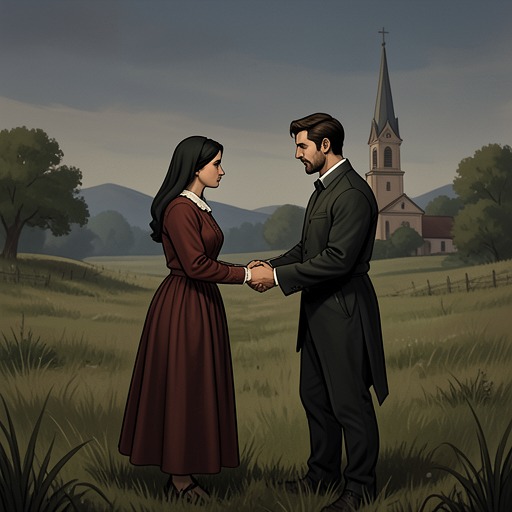
George Glenn’s suicide and Beth’s assistance
Three Bags FullGeorge Glenn’s suicide and Beth’s assistance emerge as the answer to the flock’s murder investigation, but the revelation is also a painful account of a final failed farewell. George came to Beth because he had decided he could not continue toward the life he had imagined in Europe; she begged him not to die, yet could not change his mind. His insistence that a spade be involved, and Beth’s arrival in the meadow after he was already dead, explain why his death appeared to be a murder. The confession resolves the mystery while exposing how little the flock had understood of George’s loneliness and despair.
The Final Visit
Beth places the decisive encounter on the Sunday before last, late in the evening. George knocked at her door while she was still awake. As in their previous meetings, she began talking about the Gospel; this time he gently stopped her and told her the matter was important. Beth had imagined a different kind of intimate moment with him, but George had come to say goodbye. When she assumed he meant that he was leaving for Europe, he corrected her. She understood that he meant something more final, though the account does not specify every word that passed between them afterward.
George explained why he had come, and Beth repeatedly begged him not to do it. He had once looked forward to Europe and, in some sense, still wanted to go. But he was afraid and believed it was too late. The contrast matters: the promised journey had not become meaningless to him; rather, facing it had become unbearable. Beth could not supply the courage he lacked. Her account presents the decision through the limits of what she could do and say, not as a sudden, fully explained turn of events.
Beth’s Part in the Death
Beth acknowledges that she even helped George do things the way he wanted. She connects that assistance to her fear that, otherwise, he would not be buried. The confession is explicit about her involvement but does not set out its practical details, so it does not establish precisely what she did. She says she would have gone with George, but he did not want her to. He told her that in an hour he would have it over with; Beth went to the meadow in pouring rain and found him already dead.
That sequence separates Beth’s helplessness from the final act without making her a detached witness. She had pleaded with George, could not persuade him, and then followed the course he had asked of her. Her recollection gives the waiting and the rain particular weight: by the time she reached him, the decision she had tried to prevent had already become irreversible. She describes the aftermath as wrong and sinful, yet cannot make that judgment cancel her sense that she had acted for him. Her tears and the brief, fragile smile that appears as she remembers him register grief that has not been settled into a simple explanation.
The Spade and the Appearance of Murder
When Ham quietly asks why George’s death involved the spade, Beth says she does not know why George insisted on it. She remembers that he wanted it to give people something to think about and that she could not persuade him otherwise. The detail makes the appearance of murder part of George’s own plan, but it does not explain his full purpose or describe exactly how the spade was used. Beth calls the decision terrible; her answer offers no neat distinction between the truth of his death and the misleading impression he left behind.
Ham’s reply shifts the question from the object to the person: the issue, he says, is not the spade but George. Beth responds by defending the depth of George’s fear and loneliness. She recalls an earlier moment involving a handkerchief: she had placed it in his hand without speaking, and he had looked at her without understanding. Only later did she recognize her silence as the great mistake of her life. In her account, that earlier failure and the final visit are linked by the same painful inability to say or do what might have changed the course of their relationship. She does not claim that one moment explains the other; instead, the handkerchief becomes the measure of a hope she could barely bear and a fear that proved stronger.
Revelation and Consequences
Beth sees George as having moved away from everything, step by step, alone with his sheep. She had noticed that isolation even though, as she says, he laughed at her. Her testimony therefore changes the flock’s understanding not only of how George died but of the life it had watched from the pasture. What they had treated as a murder to be solved was also a death shaped by a despair they had not recognized in time.
The flock reaches the conclusion through questions and competing judgments. Zora asks whether George murdered himself; Fosco confirms the idea and names it suicide. Mopple initially insists that Beth is lying and refusing to admit that she killed George, but the flock reads her scent as evidence that she is telling the truth. This contrast shows how the sheep’s investigation depends on ways of knowing different from human legal or verbal proof, even as the meaning of the event must be learned through Beth’s account. Suicide is a new word for them, one George can no longer explain. Fosco supplies a general human meaning: some people look at the world and decide they do not want to live. The murder mystery thus ends not with a hidden attacker exposed, but with the flock confronting a human choice it had not previously understood.