George and Melmoth
Three Bags FullShepherd and Flock
George’s bond with Melmoth belongs to the larger pastoral life he shares with his flock. George spends much of his time in the meadow, arriving early while the sheep are still huddled together and beginning the day with repairs or work in his vegetable garden. In the afternoon, the flock gathers by the steps of his caravan to hear him read. These routines establish a shepherd who is present in the sheep’s daily world, not merely a distant provider of food. The relationship is still unequal: George decides where the flock may go and what it may eat. But the sheep remember his company, his labor, and his stories as parts of a common life.
That care is tested after George disappears. With no shepherd or sheepdog, the flock eventually ventures out from the barn and raids the fenced garden, eating its vegetables. The garden had been part of George’s everyday work, and the sheep had been kept out of it by his watchfulness. Their raid ends in silence and shame; Othello then notices that the spade usually kept by the caravan is missing. The episode makes George’s absence tangible through the broken routine of his pasture, while the flock’s determination to find the person who killed him rests partly on the care it remembers: George had tried to find the culprit when a fierce dog took one of their lambs. His relationship with the flock therefore carries an obligation that survives his death.
Melmoth as the Lost Sheep
Melmoth’s separation from the flock gives George’s shepherdly care a more personal and precarious form. At night, George follows Ham, a butcher, in pursuit of Melmoth. George is lagging behind and warns Ham against chasing the sheep at night, stopping in the middle of his warning. In the darkness they come upon a human leg bone among the stones. The discovery changes the search: Melmoth is present as a witness to the scene, while George and Ham must confront the human remains.
George’s response is practical as well as personal. When Ham hesitates at the prospect of handling a body, George reminds him that he is a butcher and appeals to the work he does every day. Yet after the two men turn away, George turns back toward Melmoth with a friendly call and identifies him as his own lost sheep. He tries to entice him with a voice associated with food, although Melmoth can tell that George has no piece of mangel-wurzel to offer. Melmoth wants to return to the flock, but cannot bring himself to go. The failed reunion is not a simple refusal of George: the sheep’s longing and his inability to act remain side by side.
The Key and the Parting
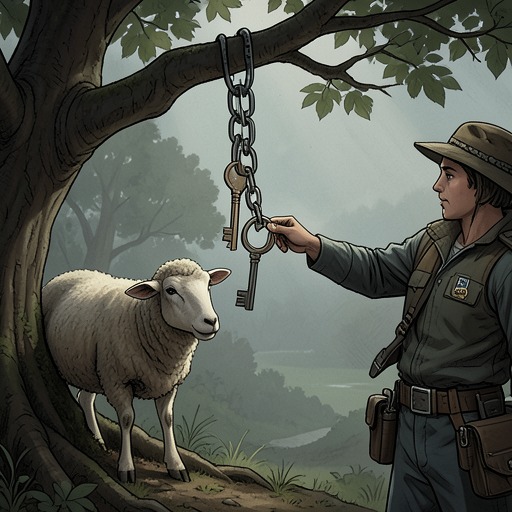
George’s connection to Melmoth is bound to a small concealed object. Carrying a knife, George searches in the wool beside Melmoth’s throat and finds a narrow thread buried deep in the fleece. He cuts it; a smooth, shining key falls to the ground, and George picks it up with a sigh. The key had been tied around Melmoth’s neck earlier. Melmoth remembers George explaining the choice by calling him the wildest of the flock, a moment he had regarded as important. The remembered attachment thus has a physical form, but the object also has a purpose that the scene does not explain. George retrieves it without telling Melmoth what it means.
After taking the key, George walks away without looking back. Ham protests that a sheep without a flock cannot manage and asks why they are leaving him. George answers that Melmoth will manage. The assurance is not followed by a reunion: the lights carried by George and Ham disappear into the darkness, while Melmoth remains behind. The episode gives no explanation for why Melmoth cannot follow, so the separation should not be mistaken for a freely chosen break with George. What it does show is George making a final judgment about Melmoth’s capacity to survive alone, even as he chooses to leave him.
Care, Secrecy, and Separation
The relationship’s meaning lies in its unresolved contrast. George’s description of Melmoth as his lost sheep and his attempt to call him home express a recognizable bond of belonging. The key, however, connects that bond to something George keeps concealed: Melmoth’s fleece has served as the hiding place for an object that George deliberately retrieves. The scene gives no grounds to say why George chose Melmoth, what the key opens, or whether the sheep understood its importance. Instead, it lets a remembered token of closeness become the instrument of a parting.
George’s decision to leave Melmoth also complicates the flock’s memory of him as a protective shepherd. The sheep later regard George’s death as a wrong that must be investigated, recalling his efforts to protect them from danger. Their memories do not cancel the painfulness of the encounter with Melmoth; they place it within a broader picture of care that has limits and costs. George may believe Melmoth can survive alone, but the scene ends before that belief is tested. Their bond therefore remains neither a complete rescue nor a simple rejection: George recognizes Melmoth, recovers the hidden key, and leaves him to face the dark apart from the flock.