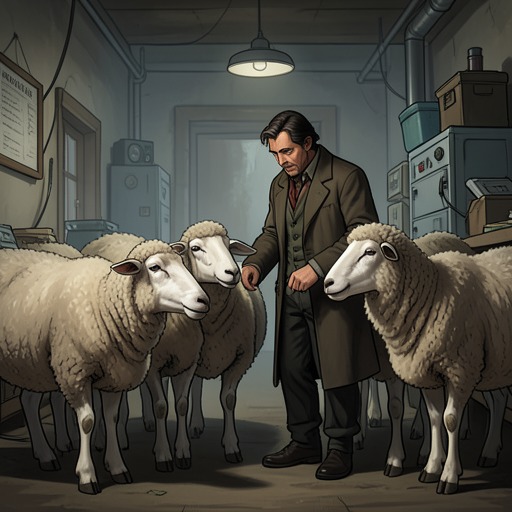
George and his flock
Three Bags FullGeorge and his flock have a relationship built from ordinary acts of care that become newly legible after his death. He brings the sheep into his daily life, tending a garden beside their meadow and reading aloud to them; they respond not as passive livestock but as a community that remembers him, judges what is done to him, and sets out to identify his killer. The bond is affectionate, but the novel also places it against human claims on land and animals, and against the flock’s discovery that not every shepherd’s care means the same thing.
Care and Shared Routine
George spent much of his time in the meadow. He arrived early, when the sheep were still huddled together and sleepy, and urged them to get to work while he tended the vegetable garden or made repairs. Tess had to drive the sheep apart; they felt affronted by the interruption, though that grievance faded by afternoon. Then they gathered by the steps of George’s caravan to hear him read.
The reading ranged across fairy tales, a book about sheep diseases, and a detective story that neither George nor the sheep followed to its conclusion. Most often he read romantic stories about red-haired heroines. Those books also gave the sheep a glimpse of his bitterness toward red-haired women, especially his wife. The scene makes their closeness specific: George did not simply keep the flock fed, but shared a repeated part of his day with them, even when his choice of books and the feelings behind it remained partly beyond their understanding.
His care also shaped the physical landscape they inhabited. Behind the hay barn stood his rickety caravan and a fenced garden planted with lettuces, peas, radishes, cress, tomatoes, endives, buttercups, and chives. While George was alive, the sheep were not allowed to enter. After his death, Lane pushed back the bolt and several sheep raided the beds; within minutes the neatly planted garden was gone. Their shame afterward, and Othello’s discovery that the spade normally kept beside the caravan was missing, mark the garden as more than a source of food: it was part of a daily order maintained by George, now broken with him absent.
Loyalty After His Death
When the flock found George lying dead beside the hay barn with a spade in him, its first alarm gave way to a meeting. Miss Maple argued that they owed him an investigation: George had tried to find the culprit when a fierce dog took one of their lambs, and he had been their shepherd. For the sheep, his death was therefore not an impersonal human affair. It violated a reciprocal obligation formed through his care, and they understood the killing as a wrong that demanded an answer.
That loyalty persists even when George’s past becomes disturbing. Melmoth remembers George calling him his lost sheep and inviting him back to the flock. When George later approaches him with a knife, finds a thread buried in his fleece, and cuts it, a key drops to the ground. Melmoth remembers that George had tied it around his neck because he was the wildest of the group. George retrieves it and walks away without looking back. The episode holds affection and separation together: George recognizes Melmoth as his, but the flock’s bond with its shepherd cannot prevent a departure that Melmoth himself cannot reverse.
The flock eventually interprets George’s own departure from it through the secret surrounding Weasel McCarthy. Miss Maple reasons that George had discovered that his flock had killed McCarthy and that what he had taken for sheep were, in that respect, like wolves. His relationship with the flock is thus tested by the very idea of loyalty: the sheep believe they owe him justice, while their account of his past suggests that he too confronted a painful conflict between belonging and what he believed had been done.
Care, Land, and Other Shepherds
Human accounts of George offer a harsher picture than the sheep’s memories of their daily life together. In a conversation about the future of Glennkill, Harry and Tom accuse him of obstructing development, driving away tourists, and secretly making money through boats arriving at night and goods taken to his caravan. Their remarks present George as a barrier to commercial plans for the land. The contrast does not settle every claim about him, but it shows how the same pasture could mean a home and livelihood to George and his flock, and a potential tourist enterprise to the people discussing its future.
The arrival of Gabriel makes the difference between shepherds visible to the sheep. Gabriel fences his own flock into one side of the meadow, reducing the space available to George’s sheep. He says that his animals eat a great deal and need to be fattened. Later, using George’s scythe, he cuts grass for them. The sheep remember George’s view that someone who kept sheep could spare himself a scythe; to them, the implement becomes a hostile instrument that cuts down grass without consuming it. Their horror gives physical form to a contrast between George’s familiar care and Gabriel’s management of animals for fattening.
The Bond Beyond George’s Life
George’s will extends his responsibility toward the flock beyond his death. It leaves the remainder of his fortune to his sheep so they can go to Europe, as he had promised them. The lawyer explains that the money will be administered and that the animals will need an authorized representative to accompany them as shepherd. Gabriel volunteers for the position. The legal arrangement therefore preserves the flock as the beneficiaries of George’s promise, while placing their future under the authority of another human shepherd.
That promise gives the relationship an afterlife without making it simple. George’s care is remembered in the flock’s habits, in the land and garden he maintained, and in the stories he read aloud; his killing turns memory into a demand for justice. Yet the will also shows the limits of human protection: the sheep’s journey depends on money, legal administration, and a representative whose fitness they must confront for themselves. The flock inherits both George’s promised future and the task of deciding what it means to be shepherded after him.