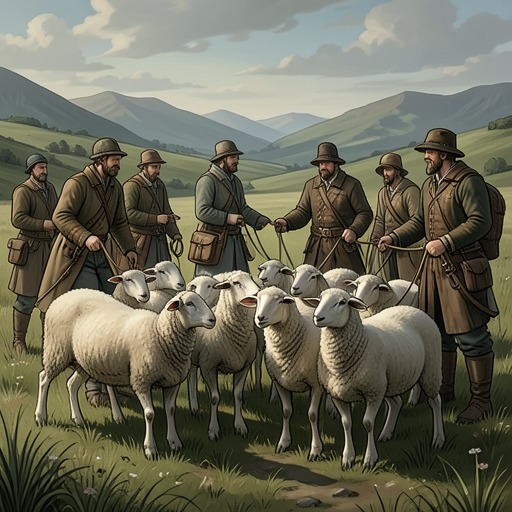
George’s flock defends the pasture from Gabriel’s flock
Three Bags FullGeorge’s flock defends the pasture from Gabriel’s flock in a night-time confrontation over George’s Place, a grazing ground the flock has set aside as a memorial to its dead shepherd. The defense begins as a simple attempt to hold a boundary against a larger group, but the sheep’s improvised line cannot withstand the pressure for long. Othello’s tactics and Lane’s appeal for help turn the retreat into a strange, carefully directed dispersal, restoring both flocks to their own enclosures without a lasting fight.
The pasture and the threat
The immediate alarm comes from Miss Maple, who wakes to the close scent of Gabriel’s sheep and bleats to rouse the flock. They gather at the hay barn door and watch the newcomers advance across the meadow. Gabriel’s sheep have broken out of their fenced patch and are grazing toward the barn in a compact, close-set phalanx. In the dark their pale bodies seem to give off a wan light; seen together, they are numerous enough to resemble a machine moving across a field. The danger is not an attack on an individual sheep but the advancing mass of animals, whose grazing threatens to overwhelm the smaller flock’s space.
The threatened ground matters especially because it includes George’s Place. George’s flock has voluntarily given up grazing there so that the pasture can remain a memorial to George. The prospect of Gabriel’s sheep eating it bare therefore combines a practical loss of ground with an affront to the flock’s act of remembrance. Mopple reacts with fury, and the flock decides to defend the place rather than accept the incursion. Their response gives collective form to a rule they have chosen for themselves: this piece of land is not simply available forage.
Othello’s defensive line
Led by Mopple, the sheep trot to George’s Place. Their first uncertainty is tactical: they know what they want to protect, but not how sheep can defend a meadow from other sheep. Othello supplies the answer. He arranges them in a circle, shoulder to shoulder, with their heads turned toward the approaching flock, and takes a position in the middle so that he can lend a hoof wherever the line is threatened. The formation translates an abstract resolve into a visible barrier, each sheep’s place in the ring depending on the others holding theirs.
For a moment, the plan seems straightforward. Then a short-legged young sheep pushes Cordelia aside and breaks through. Othello gallops over and drives the intruder back out of the defended ground with a single charge. The breach shows both the usefulness and the limits of the ring: Othello can repel one sheep, but the attackers keep pressing, and the defenders are not facing a lone challenger. The pressure forces George’s flock backward step by step. Mopple remains in his original place, like a rock among breaking surf, while Gabriel’s sheep push the others away from the boundary. Zora’s hind legs have already reached the forbidden herbs, a concrete sign of how far the line has given ground.
A call for help, and a different kind of resistance
Seeing that the circle cannot hold, Othello tells Lane to find Melmoth. He cannot tell her where to look; she leaves anyway, glad to be running rather than standing in the line, and uses her speed to force a path through Gabriel’s sheep. Othello immediately fills the gap between Heather and Miss Maple. Heather questions how Melmoth could turn the intruders back if they would not follow him. Othello’s answer is that they will run away from him. The distinction shifts the plan from controlling Gabriel’s flock by command to making it move through fear.
Meanwhile, the defenders struggle with the means of holding their ground. Zora nips one intruding sheep on the nose. The sheep cries out, and although the pushing and resistance continue, the sound leaves George’s flock reluctant to try violence again. Their purpose is to protect George’s Place, not to injure the animals pressing into it; the painful yelp makes that limit felt in the middle of the confrontation. The line has little room to act forcefully without becoming a source of harm itself.
Then Gabriel’s flock suddenly stops shoving and listens to the darkness. A dark body is hunting around them, circling closer. The sheep cannot later recall exactly what follows: flight, panting, crowding together, scattering, and tense expectation run into one another. What they remember is not a rout driven by panic, or a sense that there is no escape. Instead, there is always another step to take, as if someone outside their confusion is herding them with skill. The sequence leaves the pursuer’s identity indistinct in the flock’s recollection, even as its effect is unmistakable.
The restored boundary
After what seems to be only a short time, the two flocks are back where they belong: George’s flock in the hay barn and Gabriel’s flock behind its wire fence. The immediate contest ends not with Gabriel’s sheep captured or defeated, but with the invasion reversed and the separation restored. Lane stands atop the cliffs, gazing dreamily into the night with shining eyes. Her return to the scene after being sent for Melmoth links her errand to the uncanny intervention, though the flock’s confused memory does not spell out exactly how the dark figure achieved its work.
The defense makes George’s Place more than a disputed patch of grass. George’s flock treats it as a memorial boundary, and the animals defend that meaning through organization rather than through a simple contest of strength. Othello’s circle gives the flock a shared tactic; the pressure exposes its weakness; Lane carries the appeal beyond the line; and the unseen hunter turns the imbalance around. By the end, the pasture is not secured by permanent victory but by the re-establishment of a boundary, with each flock returned to the place from which it came.