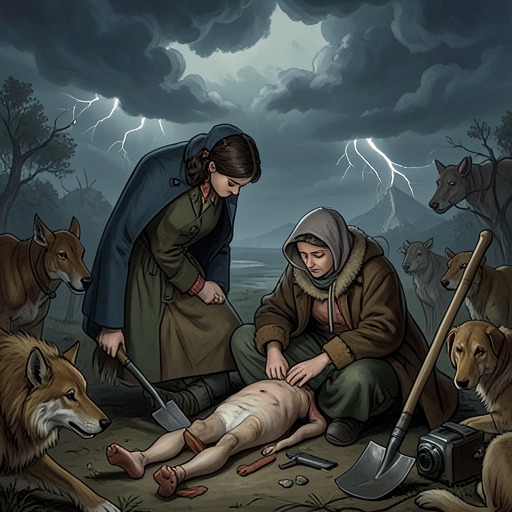
George’s spade
Three Bags FullGeorge’s spade is at once an ordinary garden tool, the conspicuous instrument found in George’s body, and a clue that Miss Maple uses to question the apparent shape of his death. Its movement through the story—from the garden, to the crime scene, into police custody, and back into the flock’s reasoning—makes it more than a weapon: it is the object around which competing readings of violence gather.
The Garden Tool and Its Disappearance
Before George’s death, the spade belonged to the working life of his small vegetable garden behind his caravan. The garden grew lettuces, peas, radishes, cress, tomatoes, endives, buttercups, and chives, but a fence and George’s watchfulness kept the sheep from eating its produce. After his death, Lane pushed back the gate’s bolt and the flock raided the beds. When the sheep returned to the caravan, Othello drew Miss Maple’s attention to the place where the spade usually leaned. It was gone. The empty space beside the whitewashed caravan and the flies basking there made an everyday absence suddenly consequential: the tool associated with tending the garden had become part of an unresolved death.
The missing spade is also noticed by Tom O’Malley. At the scene, he sees it and judges it a good tool he could use. He decides to regard it as his own in future and plans to hide it under the dolmen, intending to return for it after dark despite his unease about the place. His response sharply contrasts with the flock’s: the sheep are trying to understand how their shepherd died, while Tom treats the same object as useful property. The account records his intention, not a successful recovery; the police later remove the spade from George’s body.
At the Crime Scene
George is found lying in the green grass beside the hay barn, near the path through the fields, with the spade protruding from his insides. The flock initially fears that the shepherd is dead and wonders who will bring them hay, but Miss Maple steadies them. She argues that it is midsummer on a rich Irish pasture, when hay is unnecessary, and that even a sophisticated wolf would not drive a spade through a victim. Sir Ritchfield makes the distinction more bluntly: George did not die of an illness, because a spade is not an illness. The tool makes death materially undeniable while also disrupting the flock’s first explanations for it.
Miss Maple approaches the body despite its smell in the summer sun. She circles at a respectful distance, inspects the spade, sniffs George’s clothes and face, and finally puts her nose into the wound. She returns to the flock with blood on her muzzle. The act establishes the spade as something she examines rather than merely sees, although it does not immediately yield a complete explanation. Later, the policemen pull the spade out of George, wrap it and the body in large plastic bags, search the ground, and leave in a white car. Rain follows, making the meadow look as if nothing has happened; the removal of the tool therefore takes the most visible evidence away from the flock without settling what it means.
A Clue with Two Histories
The spade’s significance expands when Miss Maple connects George’s death with McCarthy’s. She reasons that George had really been poisoned, even though his death was made to look like a spade attack. Spades, she observes, are not ordinarily dangerous tools, and their sudden association with two deaths is too pointed to dismiss. In her interpretation, the staged appearance of George’s death invokes McCarthy: whoever killed George may have intended to remind someone of that earlier killing. The spade thus carries a history beyond the wound it caused or appeared to cause; it may be a deliberate message as well as physical evidence.
Miss Maple does not present the connection as a settled solution. She considers whether the apparent warning was aimed at the butcher, who knew about McCarthy and had, in her view, safeguarded himself; she also entertains the opposite possibility, that someone wanted the story to emerge and had killed George to bring it out. The same spade can therefore support conflicting accounts of purpose. Its conspicuousness suggests design, but does not identify the designer or establish what the message was meant to accomplish.
Object, Evidence, and Interpretation
The spade’s changing context gives it a double character. In the garden it is a practical implement, usually kept behind George’s caravan; at the scene it becomes the stark sign of apparent murder; in Tom’s eyes it is desirable equipment; and in Miss Maple’s investigation it is a link between deaths that might otherwise remain separate. These meanings do not cancel one another. The ordinary usefulness that makes Tom covet the tool sits uneasily beside the violence attached to it, while its familiarity to the sheep makes its sudden role in the crime especially disturbing.
The contrast between the spade and other tools reinforces that tension. When Gabriel later uses George’s scythe to cut grass for his sheep, the flock watches a familiar agricultural setting turn frightening: the blade passes through the grass in a destructive sweep. The scythe is not the murder weapon, and the episode does not solve the spade’s mystery, but it shows how a tool’s purpose can look different from the sheep’s perspective. George’s spade likewise cannot be reduced to its practical function or to the visible wound. Its evidentiary force depends on interpretation, and the flock’s investigation repeatedly tests what the object seems to prove against what it may have been made to suggest.