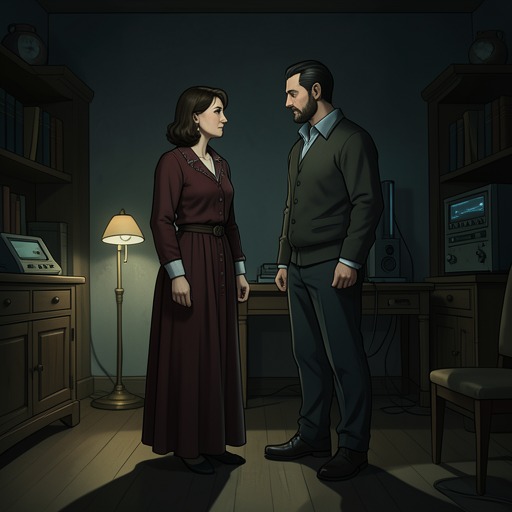
George’s will concerning his estate and flock
Three Bags FullGeorge’s will concerning his estate and flock turns the question of who owns George Glenn’s property into a more consequential question: who will be responsible for the flock, and will the flock have any say in that responsibility? Initially a rumoured document that humans hope will settle competing claims, it ultimately makes the flock the beneficiary of George’s fortune and directs that it travel to Europe. Its practical conditions protect the flock from sale and slaughter, while the appointment of Rebecca as its representative depends on a choice the flock makes for itself.
An Unknown Will and Its Rumoured Contents
After George Glenn’s death, the will is known to exist but remains unread. Kate says that George left it with a lawyer in town and searched for a long time before finding the right lawyer. She believes it will determine who receives his possessions, yet she does not want them and worries that George may have left something to another woman. Her uncertainty leaves the meadow, and the flock’s future, open to other people’s claims.
The prospect of the document immediately becomes entangled with the threat of Ham acquiring the flock. A long-nosed man argues that the valuable grazing land needs someone to care for it and suggests that Ham could buy the animals if Kate does not want the responsibility. Kate objects that Ham is not a shepherd and would not care for them. The flock, hearing this exchange, fears being sold to a butcher; Miss Maple, however, recognizes that the will may determine what happens and reassures them that it says who George’s things and sheep belong to. Heather imagines that its contents will prove George would never have sold the flock to the butcher. At this stage, the will is less a known legal settlement than a promise of possible protection.
Other humans also treat the document as a source of leverage or revelation. The butcher tells Lilly to wait for the last will and testament, suggesting that it will show how close she and George were. Separately, people speculate that George’s fortune came not from his sheep but from smuggling, and Josh reports the rumour that the contraband may be hidden in the will rather than in the caravan. Gabriel says they will find out when the document is read on Sunday. These suspicions establish the will’s place in the investigation and local disputes, but they do not establish that the will itself contains the contraband or proves the claims about George’s affairs.
The Inheritance and Its Conditions
At the reading, the lawyer first announces that the rest of George’s fortune amounts to a sum beyond anything the sheep have heard before. He then reads the decisive provision: George leaves the money to the flock so that it can go to Europe, as he had promised. Kate laughs hysterically at the news, while Ham reacts in silence. Harry the Sinner questions whether the provision can be genuine; the lawyer confirms that it is legal and says that he will administer the money.
The bequest does not simply transfer money to an unstructured group of animals. The will requires an authorized representative to accompany the flock to Europe as its shepherd. It sets out that representative’s rights and duties, and provides for the lawyer to check that its terms are observed as a third party. The arrangement thus makes the flock a beneficiary while assigning a human the formal work of carrying out its journey and care.
The printed conditions spell out what that care must include. The sheep must have stories read aloud to them for at least half an hour each day. None may be sold or slaughtered, and breeding must give primary concern to a dense fleece rather than economic efficiency. The representative receives a salary, which decreases by a specified amount every time a sheep dies; the lawyer nevertheless considers it substantial. Together, these provisions make the flock’s welfare an enforceable responsibility rather than a vague appeal to kindness, while the salary clause gives the representative a direct financial consequence tied to the animals’ survival.
Choosing a Representative
The will leaves the appointment to the lawyer’s judgment, preferably immediately, and the people of Glennkill respond to the opportunity with visible interest. They study the printed terms and look between the lawyer and Gabriel, whose presence appears to hold them back from openly competing. The flock understands the moment through its own social image: like sheep reluctant to challenge a lead ram, the humans hesitate while Gabriel stands beside the lawyer.
Rebecca breaks the pause by offering to take the job. The lawyer accepts, and her willingness to read aloud suits one of the will’s unusually specific duties. Her appointment is not merely a human decision made on the flock’s behalf, however. Gabriel murmurs in Gaelic, but Othello steps forward, looks at him, turns away, and trots to Rebecca. The other sheep gather around her, and Maude calls her name. Their movement makes clear that the legal representative has also been chosen by those the will places in her care.
Legal Protection and Animal Agency
The will’s structure holds together two kinds of authority. The lawyer administers the money, defines and supervises the representative’s obligations, and formally appoints the person who will accompany the flock. Yet the terms give the flock concrete protections, and its gathering around Rebecca supplies a collective preference that the human procedure alone had not established. Rebecca’s appointment therefore answers both a legal need for a representative and the flock’s evident refusal to follow Gabriel to Europe.
The will also changes the meaning of George’s earlier promise. The journey is not an abstract hope voiced by a shepherd: the fortune is committed to it, and the representative’s duties are written down in detail. Daily stories, protection from slaughter, and breeding for a dense fleece place the flock’s continuing life at the centre of the inheritance. By making those obligations part of a legal document, George’s will concerning his estate and flock converts an uncertain future into a plan—one whose success still depends on a human representative, but whose beneficiaries visibly take part in choosing her.