George’s will provisions for the sheep
Three Bags FullGeorge’s will provisions for the sheep transform his promise of a journey to Europe into a concrete arrangement for the flock’s future: money is left to them, a human representative must accompany them as shepherd, and explicit conditions govern their treatment. The provisions matter not only because they promise a destination, but because they place care, oversight, and the flock’s own choice at the center of an inheritance administered by people.
The bequest and its administration
The will is read after George Glenn’s death, when the sheep have already found him lying beside the hay barn with a spade in his body. Miss Maple argues that the flock owes their former shepherd an effort to discover who killed him: George had sought the culprit when a fierce dog took one of their lambs, and no one had the right to attack him. His will therefore arrives in a setting where his care for the flock and the question of justice remain closely joined.
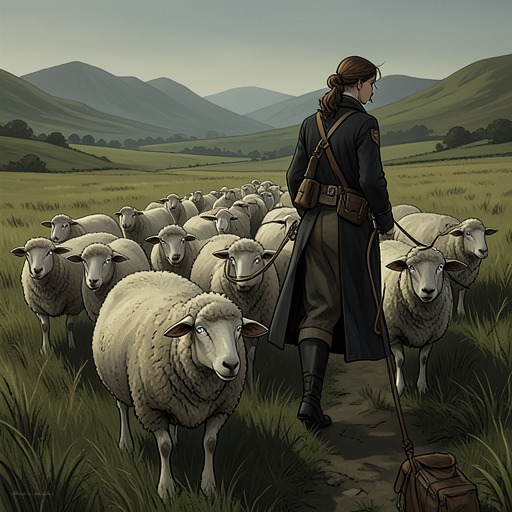
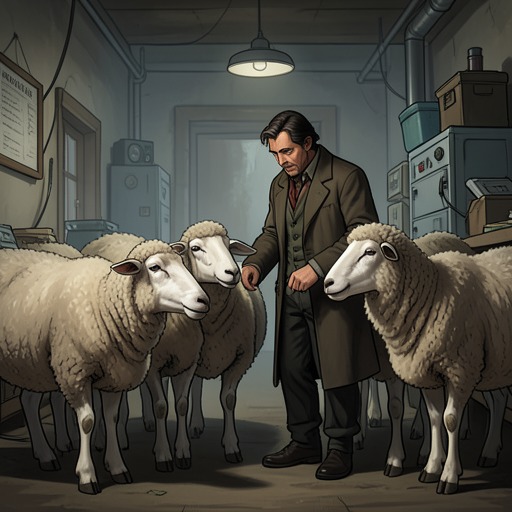
The lawyer announces that the rest of George Glenn’s fortune, whose stated amount is unfamiliar to the sheep, is left to them so they can go to Europe as promised. He will administer the money. The animals cannot simply make the journey alone under the terms described: they need an authorized representative to accompany them as shepherd, and the will specifies that representative’s rights and duties. The lawyer is to appoint someone using his own judgment, preferably at once, and he distributes printed details so the villagers can see what the job entails.
The arrangement makes the representative answerable for more than transport or basic possession of the flock. The lawyer says that a third party—himself—will check whether the conditions are met. This oversight gives the bequest a practical structure: the sheep are its beneficiaries, a shepherd is responsible for carrying out its requirements, and the lawyer retains a role in verifying performance.
Care conditions and financial incentives
Among the provisions, the sheep must have stories read aloud to them for at least half an hour each day. The requirement formalizes an established part of their life with George Glenn. He used to arrive early while they were still huddled in sleep, set them grazing while he worked in the vegetable garden or made repairs, and read to them later by the steps of his caravan. His reading ranged from fairy tales and a book about sheep diseases to a detective story and, most often, romance novels. The daily-reading clause thus preserves a familiar form of companionship as a specified duty of the new shepherd.
The will also forbids selling or slaughtering any of the sheep and directs that dense fleece be the primary concern in breeding them. Eddie recognizes that these terms are not economically attractive, and the lawyer confirms that economic efficiency is not the governing aim. The prohibition safeguards the flock from being treated as stock for sale or meat, while the breeding instruction prioritizes the quality of its fleece rather than a stated commercial return. In the context of Gabriel’s separated flock and the sheep’s unease about their different bodies and purpose, the clauses define a protected future for George’s own animals rather than a general rule for all sheep.
The representative’s salary is linked to the flock’s survival: it decreases by a specified amount whenever one of the sheep dies. Gabriel asks what would happen if an epidemic killed them all. The lawyer replies that the representative would receive a small final premium in recognition of services, after which further payments would cease. The provision anticipates both individual deaths and the possibility of losing the whole flock, but it does not make the representative’s compensation independent of their condition. Its economic mechanism sits uneasily beside the expectation of care: the job pays handsomely, yet each death reduces the salary.
Appointment and the flock’s response
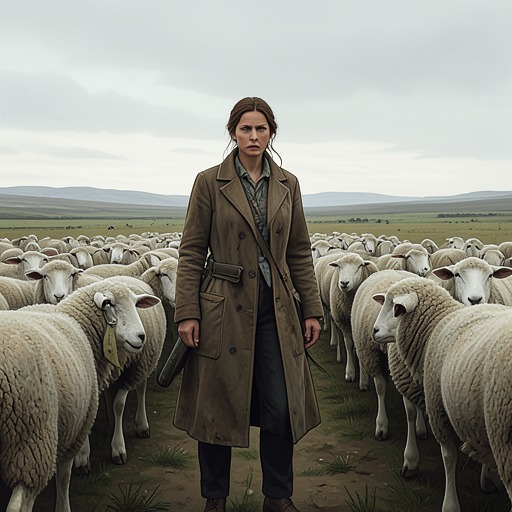
The printed conditions make the appointment consequential. When the lawyer asks whether anyone wants the position, the villagers fall silent. They look between the papers and Gabriel, and the sheep sense their hungry expectation; none of the people immediately claims the job. The lawyer asks again, with apparent disappointment, before Rebecca says she would like to do it. She stands beside Beth, pale but beaming, and the sheep are relieved: they would not want to go to Europe with Gabriel.
The distinction between appointment and consent becomes visible when Gabriel murmurs in Gaelic. His voice has a charm that once might have enchanted the flock, but Othello steps forward, looks at Gabriel, turns, and trots to Rebecca. The others follow and cluster around her. The will gives the lawyer formal authority to appoint a representative; the flock’s movement supplies a public, bodily answer about whom it will accept. The appointment is therefore not presented as a purely administrative choice made over the animals, even though the lawyer controls the legal procedure.
Promise, memory, and significance
The journey to Europe is more than a financial benefit: it is the promise around which the bequest is organized. In a later reading, Rebecca tells the sheep a story about a little girl with a secret father and an unsecret one. After a quarrel, the girl keeps the secret father waiting; he has written that he plans to travel to Europe and wants to see her first, but dies waiting. The story places a promised European journey beside a missed meeting and a death. It does not alter the will’s terms, but it gives the promise an intimate weight in the flock’s life with Rebecca.
The will also marks a shift from George Glenn’s personal authority to written rules, delegated care, and third-party checks. During his life, he kept the sheep out of his fenced vegetable garden through watchfulness; after he is gone, they push the bolt and eat the beds. That episode shows how dependent their boundaries had been on his presence. The testament instead spells out obligations that can continue without him, from daily reading to protection against sale and slaughter.
Taken together, the provisions bind inheritance to ongoing treatment rather than merely transferring money. They promise the flock a future in Europe, set limits on what a shepherd may do to them, and preserve a part of their shared routine with George Glenn. Their force depends on human administration, but the scene of Rebecca’s selection makes clear that the animals are also participants: the legal arrangement names their representative, while the flock gathers around the one it accepts.