Ghosts
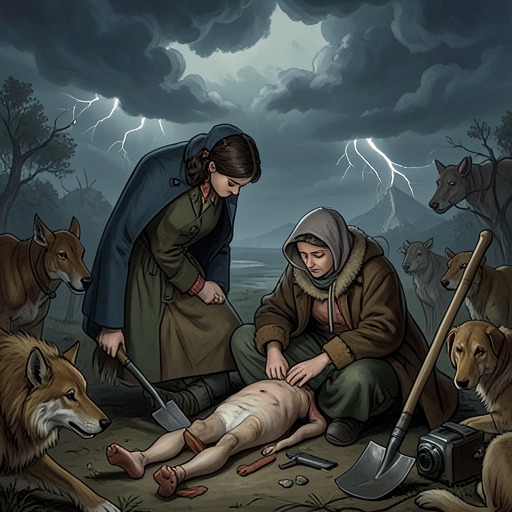
Three Bags FullGhosts are not simply supernatural intruders in the flock’s life: they are a language for fear, death, and the limits of what can be known. The sheep’s encounter with the supposed Wolf’s ghost leads them toward Melmoth, but his return does not dispel the uncanny. Instead, he insists that a witnessed ghost may be real even when its identity remains uncertain, making ghost stories part of the flock’s effort to interpret a world that human explanations cannot fully clarify.
Fear and the Wolf’s Ghost
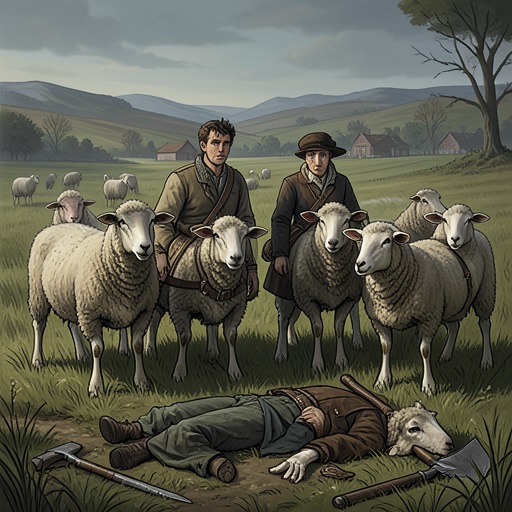
The flock’s fear takes hold amid the aftermath of George Glenn’s death. When Lane considers whether the Wolf’s ghost might really have been one of the Devil’s hounds, the suggestion spreads unease even though the sheep are in a sunny meadow. They move closer together, and Cloud bleats anxiously. Maude answers with a sardonic counter-theory: the hounds need not be large if human souls are small. The exchange shows how the sheep test frightening ideas against what they believe about humans, while also revealing that a clever explanation does not necessarily remove fear.
The supposed apparition acquires a more concrete explanation when Melmoth returns. Miss Maple pictures his shaggy form in darkness, with glowing eyes and crows on his back, and recognizes that it accounts for the hoofprint that had troubled the investigation. The recognition changes the apparent ghost from an unknown presence into a familiar ram in an unfamiliar guise. Yet the flock does not simply stop being afraid: the sheep privately wonder whether Melmoth is as frightening as the ghost, or whether the ghost was no more frightening than Melmoth. Familiarity rearranges the mystery without making it disappear.
Melmoth’s Account of the Unseen
Cloud’s lamb approaches Melmoth directly, cautiously asking about the report that he is the Wolf’s ghost. Melmoth identifies himself as Melmoth, not as a ghost. When the lamb then asks whether there is no Wolf’s ghost, Melmoth refuses the simple conclusion. He says that if a sheep saw a Wolf’s ghost, then that is what it saw; he had been with George Glenn on the night in question, but cannot say that he was the only one there. His account allows the apparition to have been Melmoth and still leaves room for something else. It makes uncertainty, rather than proof or debunking, the point of the encounter.
Melmoth grounds that uncertainty in the flock’s own folklore. He names harmless presences such as water-hole crawlers, hedge creepers, sea fingers, and hay specters, then describes the more dangerous Weeping Lamb, whose cry draws mother ewes into the mist, and the Red Goat, whose appearance foretells a ram’s death in a duel. He also warns of the Lone Mist, a scent so alluring that one sheep follows it away from the flock toward a black lake in the bogs. Its danger is conveyed through the sheep’s sense of smell and the threat of being drawn away, rather than through a clearly shown monster. Melmoth says that only one sheep has escaped it, but when the lamb suspects that he may be that survivor, he turns attention away from himself: the story matters more than its teller.
Stories, Sensation, and Uncertainty
Melmoth’s lesson is to gather stories and attend to them with the ears, eyes, nose, head, and heart. He lists the Howling Hounds, Thule the Scentless, the Vampire Sheep, the Headless Shepherd, and finally the Wolf’s ghost. This catalogue places the apparition within an ongoing tradition of tales rather than treating it as a puzzle that can be closed once Melmoth has been recognized. The crows on his back spread their wings as he agrees that the Wolf’s ghost belongs in that tradition; then he disappears into the gorse hedge, leaving the sheep with the impression that they might have dreamed his visit. His exit reinforces the unstable border between an encountered presence and a story told about one.
That instability belongs to a larger contrast between sheep and human perception. Miss Maple finds that she cannot smell Beth and Rebecca through a windowpane; without scent, she feels cut off from the information that would tell her whether they are truthful or afraid. To her, the human world is therefore incomplete and uncertain. The flock’s later attempt to represent Beth through a prepared scent makes the same sensory difference practical: the sheep reason that humans have noses, but acknowledge that human scent-perception is poor. Against this background, ghosts are not merely an opposite to ordinary reality. They expose how much any account of reality depends on what a creature can sense.
Death and the Limits of Explanation
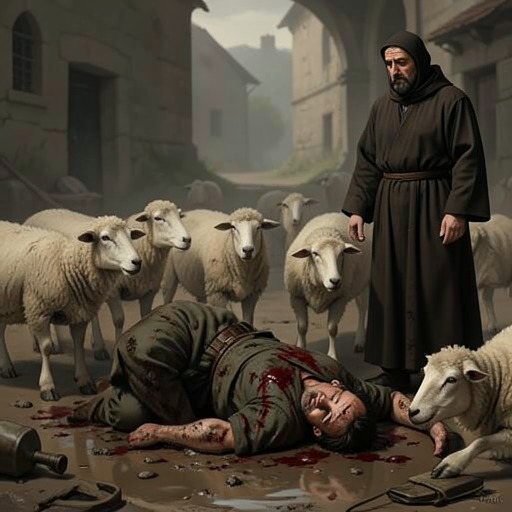
The novel repeatedly sets ghostly possibility beside material evidence. George Glenn’s body lies in the grass with a spade in it, and Miss Maple examines the wound closely before reporting that he is dead. Later, Mopple finds the fallen spade in the mist and detects traces of human smells on it, including soap, whiskey, and cleaning fluid, before realizing that a person is moving nearby. Such clues support the flock’s investigation, but they do not settle what the Wolf’s ghost was. The physical facts of death and the sensory traces left by people coexist with stories about spirits; the novel does not make one erase the other.
Ghosts consequently mark both danger and a limit to certainty. Melmoth’s tales warn of being lured away from the flock, of deaths that cannot be prevented, and of presences that cannot be safely approached. At the same time, his response to the lamb refuses to ridicule belief or to claim knowledge he does not possess. The Wolf’s ghost may have been Melmoth in the dark, but the possibility of another presence is left open. By letting the flock’s investigation proceed through observation while its folklore continues alongside it, the novel makes attentive uncertainty—not a final verdict—the lasting significance of its ghosts.