Glennkill cliffs
Three Bags FullThe Glennkill cliffs are the steep coastal edge of the pasture, a place where the flock gathers, turns back from danger, and confronts the limits of what it knows. Their significance grows through sharply different encounters: they stand near the scene where the sheep find George Glenn dead, become the proposed setting for revenge, and later test Mopple the Whale’s courage. When Melmoth disappears from the cliffs, the familiar boundary becomes the site of an unresolved separation.
Setting and Surroundings
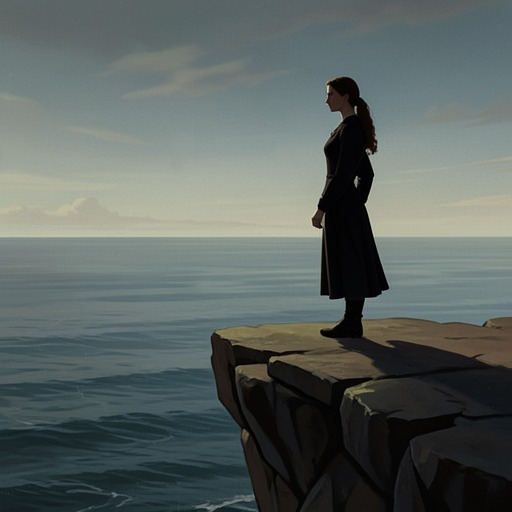
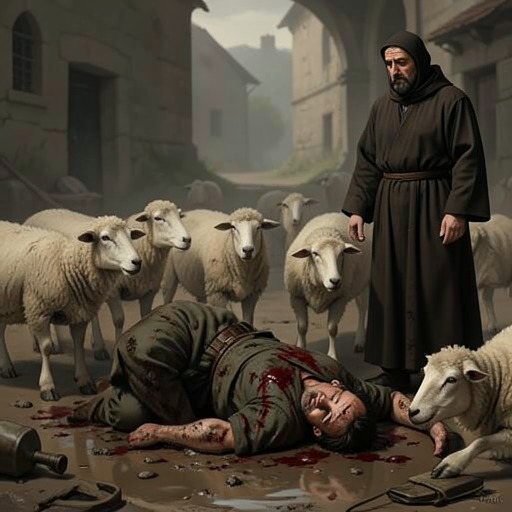
The cliffs rise beside the grassy fields and look out toward the sea. The flock’s first meeting after finding its shepherd dead takes place close to the edge, while George Glenn’s body lies farther inland, beside the hay barn and not far from a path through the fields. The contrast places the sheep’s deliberation within sight of the pasture’s abrupt drop, even as the immediate evidence of violence remains among the everyday features of their grazing ground.
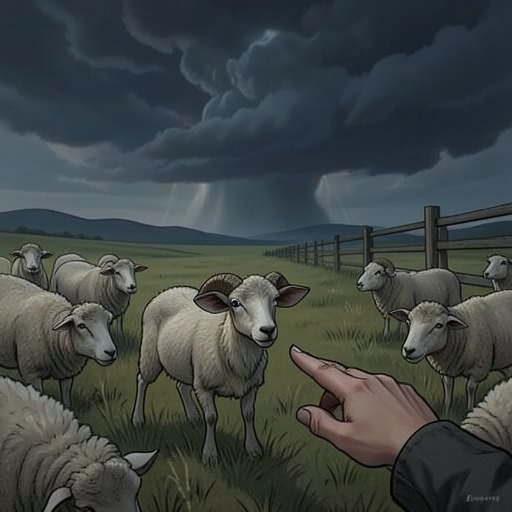
The cliffs also mark the outer limit of the sheep’s movement. On the morning after George Glenn’s death, the flock runs across the meadow toward the steep edge, stops short of the drop, and races back toward the hay barn. Their play gives the landscape a measure of both exhilaration and danger: the edge draws them, but the sheep still know where to turn back.
Pasture, Work, and Human Claims
The cliffs overlook land that carries competing meanings for the humans around it. In a conversation about George Glenn’s death, Harry and Josh discuss the possibility of drugs being hidden on the property and worry that the scandal would undermine plans for a dolmen attraction, pony rides, a cultural center, and a seaside hotel. Tom then describes boats landing on the beach at night and material being taken to George Glenn’s caravan. From this perspective, the coastal pasture is not merely a view but valuable property, contested between tourism, suspected smuggling, and George Glenn’s use of the land for his sheep.
The sea-facing geography also shapes Gabriel’s arrival as a different kind of human presence in the pasture. He takes George Glenn’s scythe from the toolshed behind George’s shepherd's caravan and begins cutting grass at the foot of the hill on the side facing away from the sea. The sheep have never seen a human graze in this manner. To them, the blade passes through the grass like a hostile iron claw, flattening plants Gabriel does not intend to eat. The scene makes the pasture’s abundance feel vulnerable: the same grass that sustains the flock can be cut down as an act of destruction.
The Edge as a Test
The cliffs enter the flock’s argument about justice when Cloud blames Kate for George Glenn’s death and suggests that her death would be fair in return. Othello proposes pushing her off the cliffs, explicitly invoking the location as a means of carrying out the flock’s imagined retaliation. Zora rejects the cliffs as the place to do it, while Heather insists that the flock wants Kate to feel afraid. The exchange turns the physical drop into a measure of how far the sheep might go in answering violence with violence; the proposal is discussed, not carried out in this scene.
Later, the edge becomes the setting for a quieter test. One morning, while the others still sleep, Mopple the Whale leaves the flock and stands for a long time before Zora’s rocky ledge. He advances step by step, recalling that Zora and Melmoth have been able to do it and that he has faced a butcher. At last he reaches the ledge and carefully lowers his head to taste its herbs. The small, deliberate movements make the cliff a threshold crossed through attention rather than a place conquered by force.
Melmoth’s Disappearance
The cliffs are also where Melmoth leads the flock for a story about saying goodbye. His invitation draws the sheep along willingly; as they follow him, his storytelling is associated with a strange wind and mysterious scents. Then crows in a tree begin calling like carrion crows. The sheep look for a dead animal but see none. When they turn back, Melmoth has vanished.
The flock searches under the dolmen, in the hay barn, and behind George’s shepherd's caravan, then checks the hedge and the shade tree. They cannot explain how Melmoth could have reached the hedge so quickly from the cliffs, and their search finds no trace of him. The disappearance gives the coastal edge a new uncertainty: unlike the sheep who run to it and return, Melmoth is last seen there and does not reappear in the immediate search. The cliffs thus gather the location’s recurring tensions—danger and curiosity, violence and restraint, belonging and departure—without resolving the mystery they contain.