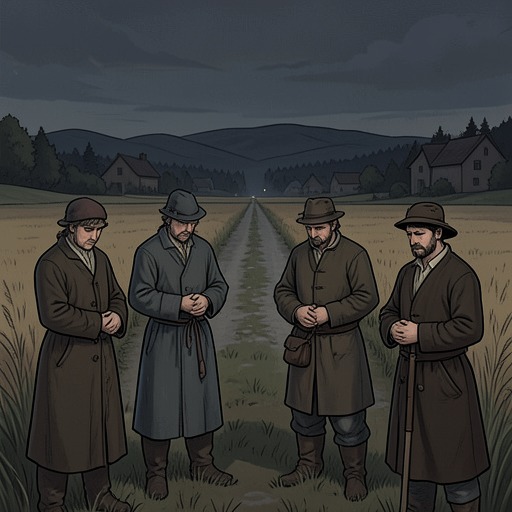
Glennkill’s silence about George’s murder
Three Bags FullGlennkill’s silence about George’s murder is not an empty gap in the investigation but a condition actively maintained by a frightened and divided community. Beth alone says she approached the police; the priest reports that no one has confessed, even privately; and Miss Maple reads the villagers’ scattered movements as evidence that they suspect one another. Their accounts do not establish who killed George, but together they show how the absence of testimony becomes part of the case itself: it protects secrets, deepens distrust, and leaves the sheep to reconstruct what the people will not say.
The Public Silence and the Police Findings
Beth tells the red-haired woman that she was the only villager to ask the police about the murder. She fears that the whole community will be stifled by its silence, and her account gives that silence a concrete investigative context. The police concluded that George had first been poisoned and had fallen asleep peacefully; the spade was driven into him only after he was already dead. The sequence makes the spade a further act against a corpse, rather than the cause of death, and leaves Beth fixed on the question of why it was used.
Beth interprets the villagers’ response through a local superstition: for the first hour after death, the Devil’s hounds supposedly wait beside the body to swallow the dead person’s soul. She imagines George’s soul left in horror beside the spade and believes Glennkill cannot live again until its black sheep has left the flock. This is Beth’s religious and moral interpretation, not a police finding. Her account nevertheless shows how silence becomes more than reticence: in her view, the murder has contaminated the village’s shared life, and the failure to speak prevents any restoration.
An Older Rupture and a Precedent for Concealment
Beth locates a change in Glennkill years before George’s death. She had spent six months in Africa and, on returning seven years later, found more superstition and less fear of the Lord. George, she says, was affected more than anyone and grew increasingly reclusive. When asked what had happened, she answers bitterly that the villagers insisted nothing had happened, although they had been waiting ever since for something to save them. The account offers no explanation of what that earlier event was; its significance lies in the community’s insistence on nothingness and the expectation that some rescue would arrive from outside it.
George’s earlier theory about McCarthy’s concealed body supplies a sharper precedent. George tells Ham that many people connected with The Mad Boar had acted together: they hid McCarthy and then circulated the story that he had been there the previous day. In George’s reasoning, delaying discovery would make the time of death harder to establish and give the participants ready-made alibis, while the person who organized the scheme may have stayed away from the pub. This is George’s assessment of the conspiracy, not a complete identification of its members. It nevertheless presents collective silence as a practical tactic, capable of turning a shared secret into protection for individual participants.
Confession, Memory, and Suspicion
The priest’s conversation with Ham reveals how unusual the silence about George is to him. He says that no one has spoken about George, not even in the confessional, although people had considered the murder. By contrast, McCarthy’s killing had been discussed with him. The priest is disturbed precisely because confession had once been a familiar outlet for guilty consciences; now, even the confessional has not broken the silence. Ham’s subdued reaction does not resolve the mystery, but it makes clear that the lack of disclosure is recognized by people inside the village, not merely suspected by Beth.
The sheep test whether that absence can be explained by forgetting. At the dolmen, Cordelia proposes filling a hole in Ritchfield’s memory with more memories, while Cloud questions the logic of plugging a rat hole with rats. The exchange distinguishes a damaged memory from a concealed truth: a memory gap might be repaired, but it cannot explain why people who remember remain silent. Miss Maple makes that distinction more directly after hearing what the priest said. Mopple the Whale observes that humans can retain memories for years, recalling both George’s memory of sheep gnawing bark in autumn and the long-remembered killing of McCarthy. Miss Maple concludes that forgetfulness is not the explanation for the villagers’ behavior.
The Sheep’s Reading of a Divided Community
Miss Maple compares the villagers’ conduct over George with the coordinated behavior George had described over McCarthy. If the people had acted together as a group, she reasons, they would hold together as a flock does after grazing a place bare. Instead, they run about in confusion and try to discover what others know. Josh visits Gabriel to find something out; Eddie comes too; and Gabriel watches Josh, Tom O’Malley, and Harry when they enter the meadow at night. Miss Maple’s point is not that she knows each person’s role, but that mutual suspicion has replaced collective solidarity. The silence therefore appears to her as evidence of division, rather than proof that every villager shares the same secret.
She also suspects that Gabriel’s attention is directed toward keeping information from getting out. In Miss Maple’s reconstruction, Gabriel had been the lead ram when McCarthy was killed and knows that George and Ham had helped keep the people involved safe. Now that George is dead, she thinks the villagers fear that what was hidden will emerge from George’s shepherd’s caravan. The sheep look toward the caravan, which had seemed harmless to them and had previously yielded little beyond George himself. Miss Maple calls Gabriel the master hunter, turning his watchfulness into a possible explanation for why the flock is being observed. These are her deductions from the pattern she sees, not confirmed findings about the murder.
The Possibility of Disclosure
Silence in Glennkill is neither uniform nor absolute. Beth has spoken to the police; the priest has heard people speak about McCarthy; and George had openly advanced a theory about the earlier concealment to Ham. At the Smartest Sheep in Glennkill contest, Inspector Holmes receives another possible route into that past: a discreet man leaves a videocassette beside his Guinness and tells him it will explain McCarthy. The man disappears before Holmes can question him. The tape’s arrival does not establish what it contains or solve George’s murder, but it turns the concealed history of McCarthy into something that may be carried beyond the village and examined.
The contrast between the two cases sharpens the meaning of Glennkill’s silence. McCarthy’s death generated confessions and, in George’s account, a coordinated effort to control the timing and story of discovery. George’s death produces no confession, even though the priest expects people to unburden themselves and the police have identified a sequence that raises further questions. For the sheep, this difference is legible in the villagers’ failure to act as a flock: they are not united by a shared account but separated by suspicion. The community’s silence thus preserves uncertainty while also revealing the fractures and earlier secrets that make certainty so difficult to reach.