Ham’s fall from the cliffs in the fog
Three Bags FullHam’s fall from the cliffs is a turning point whose cause remains uncertain but whose apparent accident is openly challenged. The book first places the reader in a fog-bound landscape of danger, then lets two men’s conversation disclose that Ham may have been lured to the cliffs by a scented note. He survives the fall, but the doctors do not expect him to walk again. The event therefore changes his physical future while opening a question the available account does not resolve: who summoned him, and what did Ham remember?
Circumstances and Suspicion
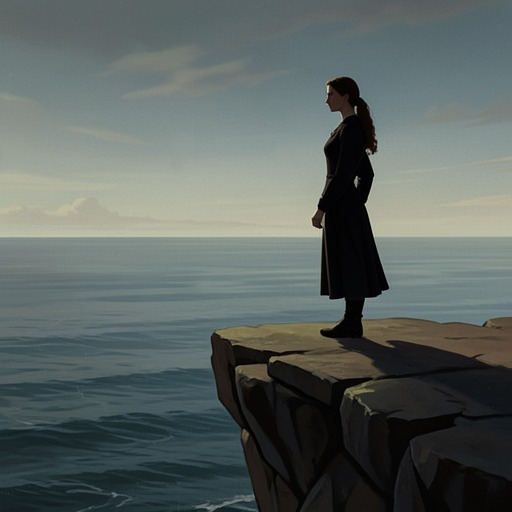
The fall is discussed after the fact rather than shown directly. One of the men asks whether Ham’s injury was really an accident; the other answers with certainty that it was not. His reasoning begins with Ham’s reputation for sure-footedness and the apparent improbability of his being on the cliffs at all. He proposes that someone lured him there, using a note carrying the scent of violet perfume. The detail turns a seemingly simple fall into a possible act of deception, while identifying neither the sender nor the reason for the trap.
The conversation gives no account of the precise moment Ham went over the edge: there is no description of his route, the weather at the instant of the fall, or what happened immediately afterward. Its emphasis is instead on how the accident story fails to satisfy the men discussing it. Their suspicion is specific enough to suggest a deliberate summons, but it remains an accusation rather than a solved explanation. The note and its perfume become clues to an unseen approach, not proof of who arranged the meeting.
The Fog-Bound Cliff Sequence
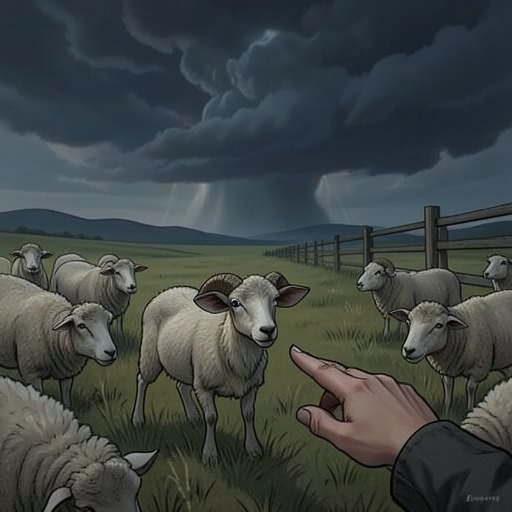
The book also places Mopple in a dense mist near the cliffs, where the landscape itself becomes difficult to read. After emerging from the hay barn, he finds the fallen spade that Tom O’Malley had left on the meadow. It carries only a faint trace of human scent, which Mopple slowly distinguishes as soapy water, whiskey, cleaning fluid, a short rancid beard, and unwashed feet. Before he can make sense of the figure moving sideways through the mist, he loses his nerve and runs.
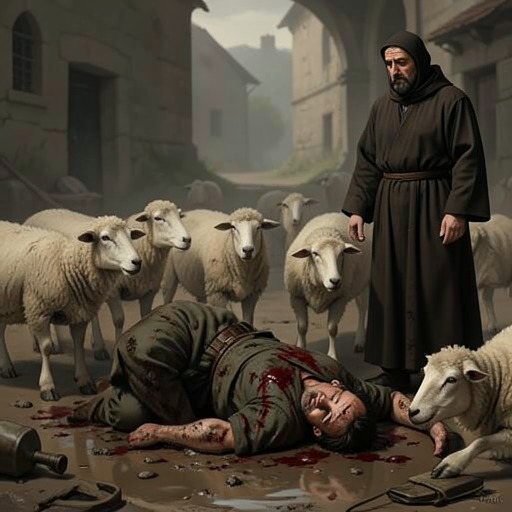
Mopple collides with the butcher, who repeatedly falls in the mud while trying to seize him. When the butcher clenches his hands together, Mopple is too exhausted and frightened to move; then the man abruptly disappears. As the mist briefly parts, Mopple realizes that he is standing at the edge of the abyss and retreats. This episode supplies a vivid, bodily image of danger in the fog and at the cliff edge, but it does not establish that the butcher caused Ham’s fall or that Mopple witnessed Ham going over. The separate account of Ham’s injury comes through the later conversation, which names the possible lure but leaves the fall itself offstage.
Injury and Prognosis
The men confirm that Ham is alive. The doctors consider his chances not so bad, yet they expect that he will never walk again. That distinction gives the fall its stark consequence: Ham has survived, but the prognosis describes a lasting loss of mobility. The conversation does not give a fuller medical account or establish whether his condition later changes, so the expected inability to walk is the clearest reported consequence available here.
The severity of the injury also sharpens the earlier doubt about accident. The men contrast the fall with Ham’s customary sure-footedness and question why he would have been at the cliffs. Those observations make the possibility of deliberate luring feel consequential rather than incidental: someone may have drawn him into a situation that has left him alive but gravely incapacitated. Yet the evidence stops short of naming a culprit or confirming the suspected scheme as fact.
Memory and the Unanswered Case
The conversation turns from Ham’s body to his memory. One man hopes the accident may have erased what happened; the other rejects that hope, arguing that Ham retains what enters his head. To support the claim, he recalls an earlier occasion at George’s wedding, when Josh got Ham drunk glass after glass. Ham usually drank very little, but on that evening he kept accepting the drinks until he could not remember his own name and did not react to a fly settling on his eye.
That anecdote demonstrates how thoroughly intoxicated Ham once became, but the speakers use it for a different purpose: they distinguish temporary drunken oblivion from Ham’s ordinary capacity to remember. Their disagreement gives the fall a continuing narrative stake. If Ham remembers the note, the summons, or whoever brought him to the cliffs, his account might matter; the conversation does not say what he can recall, whether he is able to communicate it, or whether anyone ultimately identifies the person responsible. The event thus remains both a physical catastrophe and an unresolved suspected crime.