Ham’s severe injuries and incapacity after falling from the cliff
Three Bags FullHam’s severe injuries and incapacity after falling from the cliff alter the meaning of his apparent disappearance: he is not dead, but his survival leaves him physically disabled and may preserve knowledge that others fear will return to trouble them. The flock first sees him from above, while a later overheard conversation supplies the prognosis and raises the possibility that his fall was no accident.
The fall and the flock’s first sight of Ham
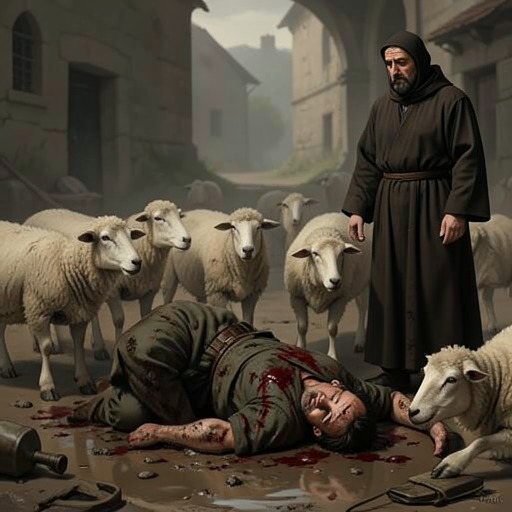
In the aftermath of the fog, the flock gathers near the cliff edge and sees Ham lying on a small patch of sand among the rocks below. From that height he looks flat and broad, and at first he appears not to be moving. Sir Ritchfield claims to see blood at the corner of Ham’s mouth, but the others do not trust his observation that day. Their reaction changes when Ham’s left eye opens. It seems to search the sheep on the cliff top, then closes again; the flock retreats cautiously. Maude optimistically suggests that the sea will wash him away, a response that exposes how little they know about his condition and how readily they mistake apparent stillness for a final end.
The open eye is the first unmistakable sign that Ham is alive, but it does not tell the flock whether he can move, understand what is happening, or recover. The scene keeps those questions at a distance: the sheep can see his body but cannot reach him or determine what has happened inside it. Only later does the conversation among human voices establish that the fall has left him gravely injured. The narrative therefore separates discovery from explanation, allowing the flock’s uncertain view of the figure below to precede the human assessment of his survival.
Injury, survival, and the prognosis
In the later conversation, one man reports that Ham will not die and that the doctors consider his chances reasonably good. The crucial qualification is that they expect he will never walk again. The account provides no medical diagnosis or description of the injuries themselves; its emphasis is on the contrast between survival and lasting physical incapacity. Ham is alive, but the prospect of returning to his former mobility is bleak.
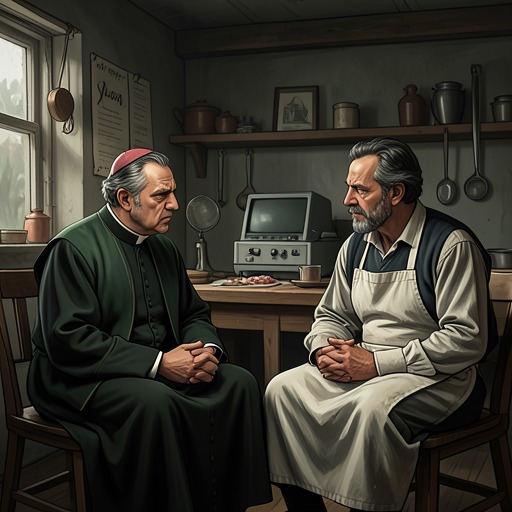
The conversation treats the news as consequential rather than reassuring. One speaker initially wonders whether the fall was an accident, while another argues against that explanation by invoking Ham’s sure-footedness and asking why he would have been at the cliffs. This speaker proposes that someone lured him there with a note carrying the scent of violet perfume. That claim makes a deliberate trap plausible within the conversation, but it does not identify who sent the note or establish the circumstances as fact. The episode leaves the suspected lure unresolved while making clear that Ham’s fall is bound up with questions the people around him would rather not face.
Memory and the threat of what follows
The men’s concern shifts from Ham’s body to his memory. One hopes that the accident may leave him unable to remember what happened; another insists that Ham will remember once he wakes. Their confidence is based on their experience of him as someone who holds on to what enters his mind, even though they dismiss him as not especially quick to understand. The distinction matters: they do not expect him to grasp everything immediately, but they fear that a remembered fact will remain with him.
To explain that fear, one man recalls the evening of George Glenn’s wedding, when Josh got Ham drunk. Ham normally drank very little, but on that occasion he downed glass after glass and became so incapacitated that he could not remember his own name or react when a fly settled on his eye. The men remember the episode with amusement, including the payment Josh received for each glass and the trouble that followed. Yet the story’s purpose in their present conversation is not simply comic. The temporary blankness of that drunken night becomes a comparison for the uncertainty after Ham’s fall: the hope that he might forget is set against the insistence that he will remember.
Consequences and narrative significance
The conversation ends with the prediction that, once Ham wakes, the situation will begin again. The speakers do not specify exactly what will recur, and the evidence does not reveal what Ham remembers or what he might later do. Their fear nonetheless makes his survival an unresolved pressure on those who discuss him. His inability to walk is a lasting consequence of the fall; his possible memory is a separate consequence, one that may give him knowledge even as his body has been severely limited.
For the flock, the episode also demonstrates the limits of reading a human body from a distance. The eye opening provides evidence of life, but neither the flock’s observation nor its guesses about the sea explain the extent of the injury. Human speech supplies the prognosis, while its uncertainty about the cause exposes a different gap: even those speaking about Ham do not offer a settled account of how he fell. The resulting state is defined by this double uncertainty. Ham has survived, the doctors expect permanent loss of walking, and the people around him fear that he will retain a memory capable of renewing the conflict.